I love a good bargain, and for decades, I’ve made TJMaxx and Marshalls two of my must-stop shops whenever I’m looking to buy new clothes.
Often, they don’t have the right size and fit for my pants, but I invariably find at least one or two name-brand shirts or sweaters, and for my money, there’s no better place to get socks and t-shirts.
I’m clearly not alone, given that those stores, which are owned by the same company, The TJX Companies, Inc. (TJX), generate billions of dollars in sales per year, including sales of $60 billion last fiscal year.
“With our proprietary planning and allocation systems and expertise, we can create a differentiated treasure hunt shopping experience that appeals to a broad range of shoppers across each of our markets,” said CEO Ernie Herrman on a recent earnings conference call.
Undeniably, appealing to those seeking great deals on unexpected finds has been a good business model. However, a subtle shift has emerged suggesting TJMaxx and Marshalls, collectively known as MarMaxx, may need to work harder to keep customers spending.
Also read: Albertsons, Dollar General can’t match Walmart’s grocery prices
According to a Morgan Stanley research report shared with me, MarMaxx is under pressure as shoppers increasingly feel penny-pinched by the economy, including rising inflation.
TJ Maxx, Marshalls stores face sales headwind
In TJX Companies’ second quarter, comparable sales at MarMaxx stores open at least one year grew only 1%, and that increase wasn’t due to foot traffic but to higher prices.
“Comp sales increased 1% and were entirely driven by a higher average basket, partially offset by a small decrease in customer transactions,” said CFO John Klinger about the results.
A drop in customer transactions isn’t a recipe for success, and TJX’s struggles are evident in the company’s stock price, which has fallen 17% since mid-June, raising questions about what’s behind TJMaxx and Marshalls’ lackluster customer trends.
Morgan Stanley analyst Alex Straton took up the subject directly in his report, “What’s Going Wrong at Marmaxx? Our Survey Says More Macro Than Micro.”
“Cutting overall spend is the #1 reason for reduced Marmaxx spending, with TJ Maxx & Marshalls still leading Off-Price brand perception – we think indicative of a macro, not micro, problem. Notably, however, high prices rank #2, & Marmaxx is alone in seeing “good value” perception erode– pointing to a value perception gap that may be under-appreciated,” wrote Straton.
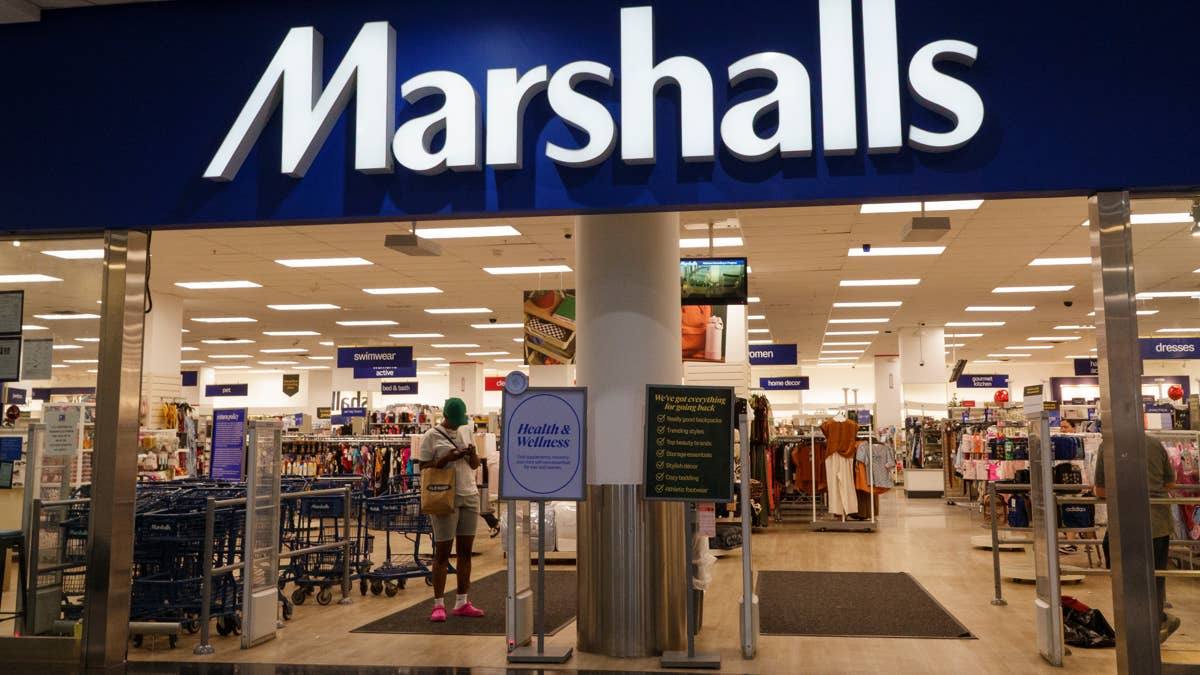
TJMaxx stumbles amid a hit-and-miss economy
The biggest ‘macro’ likely impacting customer behavior is inflation, which has rebounded in the wake of the Iranian conflict’s impact on global oil markets.
Crude oil prices, as measured by West Texas Crude, have risen to about $90 from below $60 per barrel this year. Because oil is used throughout the economy to produce and ship goods and directly drives gasoline and diesel prices, customers’ wallets have been crimped.
In September, the Consumer Price Index, a common inflation measure, rose 3.4% year-over-year, up from 2.4% in January. AAA reports that the price of a gallon of gasoline has climbed to $4.37 from $3.12 a year ago.
Unfortunately, higher prices haven’t been offset by rising pay. Real wages, which subtract inflation from wage growth, were down 0.1% from July to August, suggesting dollars aren’t stretching as far.
More Retail:
- Home Depot is making a big bet on cautious consumers
- Another state just banned a controversial retail pricing practice
- JPMorgan just flagged a slow-build food crisis
Given that backdrop, it’s easy to understand why Straton thinks the MarMaxx customer problem is economic, a point underscored by the Conference Board’s latest Consumer Confidence Survey data, which showed the weakest confidence among American consumers since 2014.
“Consumers’ net views of their Family’s Current Financial Situation turned negative in September, as the share of consumers who said their finances were “bad” rose to overtake those saying “good” for the second time since the question was introduced four years ago,” wrote the Conference Board’s economists.
Morgan Stanley thinks the problem could fix itself this holiday season
Morgan Stanley doesn’t think the situation improved in the third quarter, but a turnaround could occur over the holidays.
“N3M [next three months] spending intentions are negative across the Off-Price group, but worst at the TJX banners, with Marmaxx high-frequency demand data also still soft – making 4Q the earliest likely comp inflection,” wrote Straton.
In the fiscal fourth quarter last year, MarMaxx comp sales grew a much healthier 5%, and Straton thinks this year’s fiscal fourth quarter will be the soonest TJX may see a positive shift.
Much will likely depend, however, on how the economy evolves from here. If shoppers continue to feel pressured by inflation, including gasoline prices, they may still reduce how much they’re willing to spend on presents, or on discretionary purchases for themselves.
“Accessories/handbags (-17%), footwear (-10%), & home (-9%) are the biggest spending drags at Marmaxx,” wrote Straton.
It’s hard to imagine sales of those items surging from here if MarMaxx customers continue to feel bootstrapped.
Nevertheless, Straton struck an optimistic tone for investors:
“We see the pressure as temporary rather than structural, & would use ongoing stock weakness ahead of a potential 4Q improvement as a buying opportunity.”