Every AI headline obsesses over GPUs. The chips get the attention, the stock gains, and the breathless coverage.
But a GPU sitting idle while it waits for data to arrive is just an expensive space heater, and that overlooked wait is exactly what two chipmakers addressed this week.
Microchip Technology (MCHP) and Micron Technology (MU) demonstrated a storage system built to close that gap.
Microchip makes the microcontrollers and connectivity chips found in data centers, cars, and factory equipment.
Micron is one of the world’s three major memory chip makers, alongside Samsung and SK Hynix, producing the DRAM and NAND flash that AI servers depend on for memory and storage.
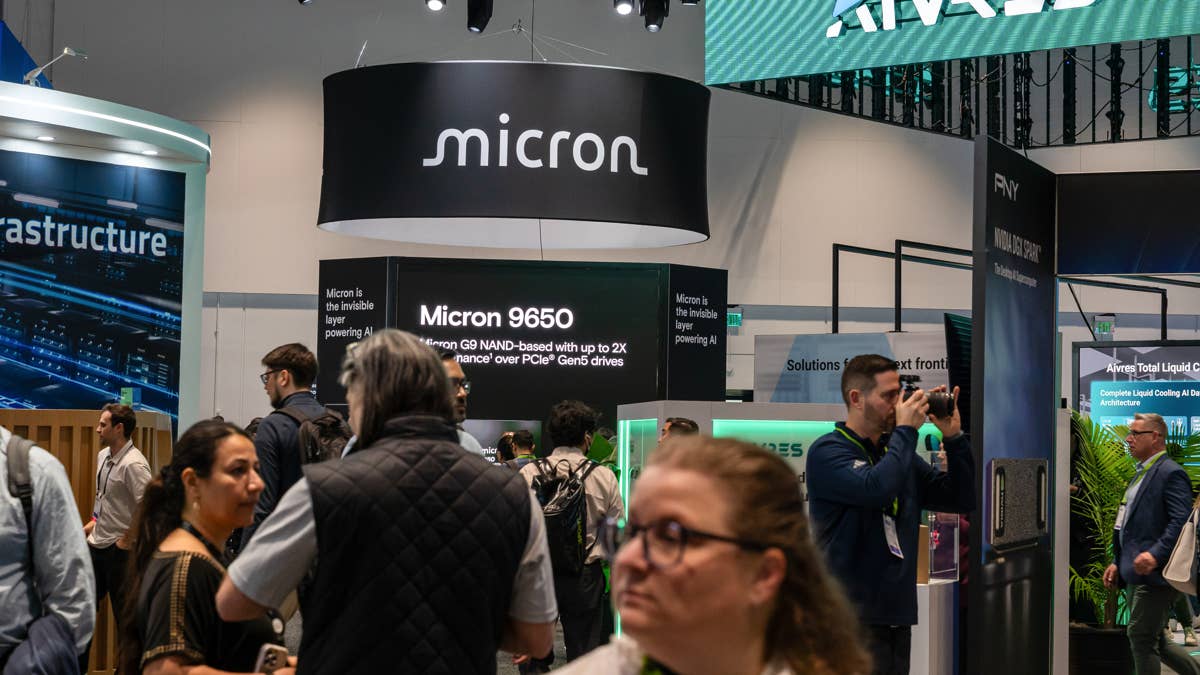
At the 2026 Future of Memory and Storage Conference, the two companies linked Microchip’s Switchtec PCIe Gen 6 switch to multiple Micron 9650 solid-state drives, allowing the drives to run at full Gen 6 speed.
PCIe Gen 6 doubles bandwidth to 64 gigatransfers per second per lane compared with Gen 5, according to Investing.com. For data center operators, that means GPUs spend less time waiting on data, which directly increases the value they extract from hardware that already costs tens of thousands of dollars per unit.
The architecture also supports disaggregated storage designs, letting operators add drives independently of processors rather than replacing entire server chassis, Microchip’s announcement confirmed.
Markets reacted immediately. Micron (MU) shares gained more than 5% and Microchip (MCHP) shares rose more than 4% in premarket trading on Aug. 4, according to a Seeking Alpha report. That reaction reflects more than one product demo. It reflects two different comeback stories meeting on the same rack of hardware.
Microchip avoids another Gen 5 mistake
Microchip’s push into Gen 6 follows a costly stumble. CEO Steve Sanghi said the company’s Gen 5 PCIe switch arrived nearly two years late, leaving Microchip largely in second-source positions, according to Yahoo Finance.
Broadcom leads the PCIe switching market with more than a billion ports shipped, according to Broadcom’s own product page.
Being a second-source supplier means customers only turn to you when the leader cannot meet demand. That caps pricing power, no matter how good the underlying chip.
Microchip says its Gen 6 switch is built on 3 nanometer process technology against rivals’ 5 nanometer designs, with more lanes and lower power draw.
That technical edge matters because Microchip is also emerging from the deepest inventory correction in the analog chip sector, one that included a fab closure and pay cuts across an 18,000 person workforce, according to 24/7 Wall St.
Winning design slots in AI storage would give the recovery a growth story beyond simply clearing excess inventory.
Micron is stretching its AI story past memory chips
Micron’s stock has soared this year almost entirely on high bandwidth memory, the chips that sit inside AI processors from companies such as Nvidia. That demand pushed Micron past a $1 trillion market valuation in May, CNBC reported.
The 9650 SSD is a bet that the same AI buildout that revalued Micron’s memory business will do the same for its storage business.
More Micron:
- Michael Burry doubles down on AI chip bubble with Micron short
- Micron just dethroned Nvidia in one key way
- How many employees does Micron have in 2026? Its workforce, locations & layoffs explained
- Micron’s CEO sold big last week. Was it a warning sign?
Micron calls the 9650 the industry’s first mass-produced PCIe Gen 6 SSD, positioning it for AI training, real-time analytics, and large-scale databases. Unlike HBM, which is baked directly into the GPU package, SSDs sit further from the processor and compete on a more crowded field that includes Samsung, SK Hynix, and Kioxia.
A performance lead here is harder to defend, but it broadens Micron’s exposure beyond a memory market that some analysts already worry is due for a supply correction of its own.
Micron said it ran 18 months of interoperability testing across the Gen 6 ecosystem before this week’s demonstration. That timeline is a reminder that faster interconnect standards demand deeper coordination between component makers, not just faster individual parts, which is exactly why the two companies chose to demo together rather than separately.
Storage is becoming AI’s next infrastructure fight
Compute gets financed, refinanced, and profiled endlessly. The switches and drives that keep processors fed get a single afternoon at a storage conference. That asymmetry is starting to close as hyperscalers realize that idle compute caused by a data bottleneck is just as costly as a shortage of chips themselves.
Microchip already says it is committed to PCIe Gen 7, meaning this week’s demo is a checkpoint, not a finish line.
The companies that quietly wire AI data centers together, rather than the ones that headline the keynotes, may be where the next round of AI infrastructure spending shows up first.
Investors chasing the next big AI winner might do better watching the plumbing instead.
Related: Bank of America doubles down on Micron stock after AI bombshell