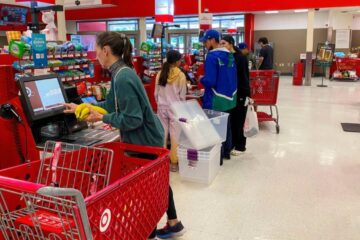
Tariffs are raising the cost of everyday goods, from clothing to toys, but their impact on household finances may extend beyond higher checkout prices.
A Federal Reserve Finance and Economics Discussion Series paper, revised in August 2026, suggests that consumers are cutting spending by more than the price increases alone would explain.
Economists Leo Feler and Sinem Hacioglu Hoke tracked transactions across 126,448 households and linked the data to a tariff-sentiment survey in the Federal Reserve research.
Their findings point to a spending pullback that goes beyond the immediate cost of goods, raising questions about how consumer sentiment could affect household budgets during the holiday shopping season.
Also Read: America’s spending average floats above most families
4% spending decline on 1%-2% price increase shows hidden toll of tariff anxiety
The Federal Reserve study analyzed transaction-level data alongside a tariff sentiment survey of 21,000 respondents. At the mean tariff-exposure level, spending on affected goods fell roughly 4%, while prices on those items rose only 1% to 2%.
The researchers found that lost purchasing power from those price increases explained at most one-third of the contraction, while the remaining two-thirds stemmed from precautionary behavior driven by economic pessimism.
Families cut spending to brace for an economy they expected to weaken, a response that went beyond adjusting to the price increases.
September’s Consumer Price Index (CPI) data underscores that anxiety, with overall prices climbing 3.7% over the prior year, according to the Bureau of Labor Statistics (BLS).
Heather Long, vice president and chief economist at Navy Federal Credit Union, told PBS NewsHour that the latest inflation data was punishing for household budgets under strain.
<strong>People in the bottom 30 percent don’t have any extra money and are reliant on credit cards and starting to miss payments. The real question is, how long can the middle class hold on?</strong>
When persistent inflation compounds trade-policy uncertainty, the fear itself subtracts more from the economy than the tariff-driven price increases do, the study confirmed.
Middle-income families led the sharpest pullback from nonessential spending
Quantity declines drove the pullback and occurred in nonessential categories, goods families could delay or skip, according to the Federal Reserve study.
Middle-income households proved the most likely to slash discretionary purchases when they reported concern about tariffs, while anxious consumers across all income groups switched to cheaper versions of essential items.
More Personal Finance:
- Pay raises trail inflation so Ramit Sethi says, “Ask for $5,000”
- Your home insurance deductible could be $20,000. Would you be ready?
- Why your next car purchase will be an affordability nightmare
The spending data shows middle-income earners are disproportionately affected because they earn too much to receive means-tested assistance but lack the savings buffer to absorb persistent cost increases without changing their purchasing habits.
The Yale Budget Lab has estimated that tariffs alone add roughly $1,100 per year in costs for the median household, on top of a cumulative rise in consumer prices of roughly 25% since 2019.
That growing burden is pushing families already stretched toward another round of budget cuts as the holiday shopping season opens.

Record toy price jump adds holiday pressure for families already cutting back
BLS CPI data confirmed that toy prices rose 4.2% from August 2026 to September 2026 on a seasonally adjusted basis.
Year over year, the unadjusted change for toys, games, hobbies, and playground equipment reached 6.2%, as families began building their holiday gift lists.
Gas prices jumped 9.1% in September alone, absorbing household dollars that would otherwise flow toward gifts and seasonal purchases. The combined pressure of rising fuel costs and spiking toy prices leaves less room in holiday budgets already tighter than a year ago.
Social Security benefits have lost 13.7% of their buying power since 2016, equal to about $290 a month on today’s average check, The Senior Citizens League found, shrinking retirees’ real purchasing power.
When millions of households pull back at the same time, businesses lose sales volume even as prices climb, creating a feedback loop that could deepen the precautionary spending cycle the study documented.
How families, retirees can navigate tariff-exposed categories before year-end
The Fed study’s two-thirds fear and one-third price split points to one clear rule for households: Adjust spending cuts based on actual exposure.
Feler and Hacioglu Hoke found that tariffs hit nonessential goods harder. This means cutting spending in categories less affected by tariffs brings no savings and only reduces consumption.
Retirees on fixed incomes have less room to manage rising costs, with the Fed data showing tariff pass-through hits the lowest-income households roughly double per point of exposure.
Long noted that Navy Federal members are already spending less on groceries to cover other bills. This suggests that households on fixed incomes should focus on protecting essential spending first.
The Yale Budget Lab projects that cost pressure will persist through 2027 under current trade policy. Accordingly, the Fed’s category breakdown recommends that households and retirees take a few specific steps.
4 steps to take:
- Rank year-end spending cuts by tariff exposure.
- Protect essential purchases.
- Plan durable-goods replacements around long-term supply-chain adjustments.
- Secure holiday purchases before the next CPI report shows whether seasonal price pressures are increasing.
Related: Vanguard economist says sticky inflation will test your patience