Most corporate promises are really promises about capacity. Someone announces a number, and the rest of us quietly assume the machinery behind it already exists.
Europe has spent the better part of a decade refusing to make that assumption. National traffic laws across the bloc still contemplate a human sitting at the wheel with hands in lap, and the European Commission’s framework initially capped manufacturers at 1,500 autonomous vehicles across the entire single market.
That caution carried a cost. While Brussels debated frameworks, private robotaxi fleets in China and the United States more than doubled in 2025, reaching roughly 8,000 vehicles across more than two dozen major cities, according to a May report from the International Energy Agency cited by France 24.
Ride-hailing platforms noticed the gap. So did Chinese autonomous driving firms, most of which are effectively shut out of the American market and need somewhere else to prove they can scale.
Which brings us to the morning of Aug. 14, and to a number that deserves a much harder look than it got.
Uber Technologies (UBER) and Chinese self-driving developer Pony.ai (PONY) said they will deploy more than 2,000 robotaxis across Europe, expanding from Zagreb into four additional cities, with the Middle East to follow, according to CNBC.
What Uber and Pony.ai actually agreed to
The structure of this deal matters more than the number attached to it.
Pony.ai supplies its Level 4 (L4) autonomous driving technology plus the rider-experience and operational expertise it built running fleets in China. Uber supplies customer access through its app, meaning booking, payment, and customer service. Day-to-day fleet operations sit with local partners chosen market by market, according to Business Wire.
More Automotive:
- Edmunds finds record cash in used cars
- 124-year-old truck maker cuts 1,341 jobs due to plant sale
- Carvana CEO warns of lower margins amid rising gas prices
That third leg is the one most coverage skipped. Uber is not buying cars here, and neither is Pony.ai, necessarily.
Vehicle funding and ownership can sit with different partners depending on the market, according to Pony.ai’s Form 6-K filed with the Securities and Exchange Commission. Partners can also take on more than one role at once.
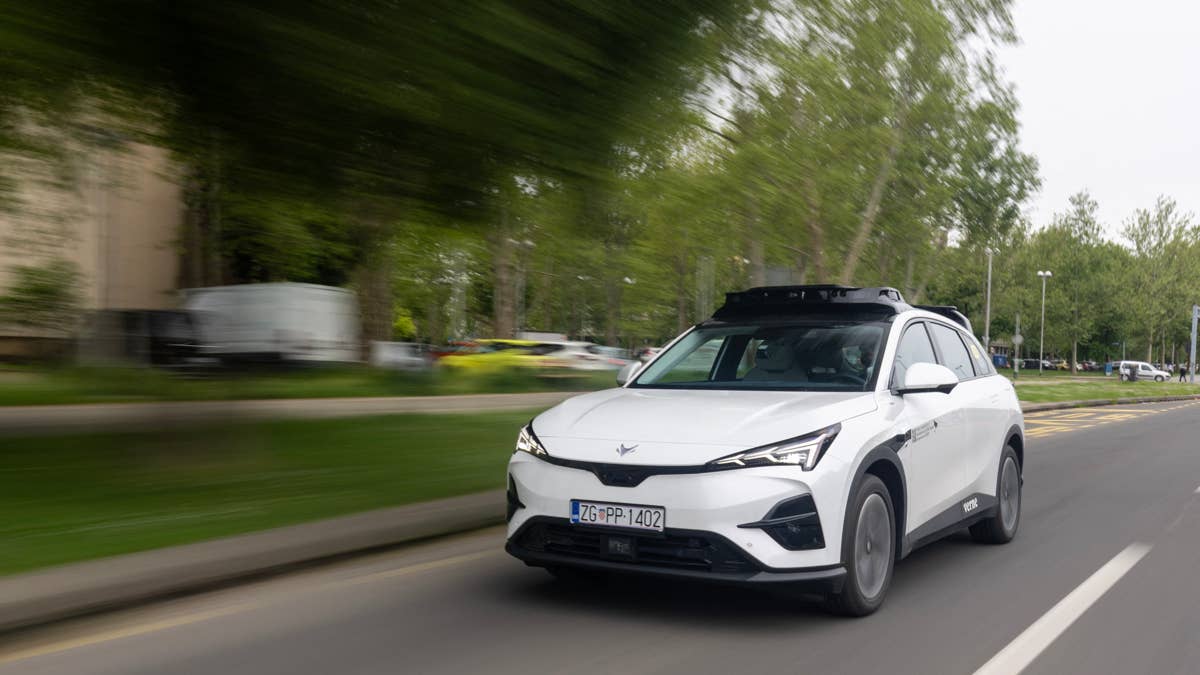
In Zagreb, the local partner is Verne, a Rimac Group company that launched what the companies call Europe’s first commercial robotaxi service in the Croatian capital this spring.
Related: Uber reveals an unexpected problem behind the AI boom
Neither company named the four new cities. Neither offered a timeline for when the additional vehicles reach the road, according to Reuters.
Sarfraz Maredia, Uber’s global head of autonomous mobility and delivery, described the shift as moving “from individual launches to repeatable commercial scale,” according to the joint announcement.
Why the robotaxi fleet math looks stretched
Here is where my analysis parts ways with the press release.
Pony.ai is promising Europe more robotaxis than it currently operates anywhere on the planet. That is not a criticism of the ambition. It is a statement about where the risk actually sits.
The trajectory, in the company’s own numbers:
- The global robotaxi fleet surpassed 1,400 vehicles as of March 25, 2026, according to Pony.ai’s annual results filed with the SEC.
- Roughly 1,700 vehicles were in service by early June, against a year-end target of 3,500, according to France 24.
- First-quarter revenue reached $34.3 million, up 145% year over year and ahead of the $21.7 million analyst consensus, according to Bloomberg.
When I ran those figures against the 2,000-vehicle European pledge, the picture sharpened considerably. Even if Pony.ai hits its 3,500-vehicle global target on schedule, Europe would absorb well over half of everything it has ever built.
That is a manufacturing and logistics problem before it is a software problem. It is also why the asset-light structure exists. Local fleet owners carry the capital, which lets Pony.ai book deployments without financing them.
The market noticed. Pony.ai shares slipped roughly 2% on the announcement, while Uber finished close to flat, according to Yahoo Finance. Both figures move, so verify at publish.
The China question Europe has not resolved
There is a second risk here that neither press release touches.
Chinese autonomous firms are pushing into Europe precisely because Washington closed the door. They are setting up headquarters, striking data deals, and road-testing across the continent, which has prompted alarm from local rivals over competition, according to Reuters.
Europe’s answer has been fragmented. The EU Data Act gives users more control over connected-vehicle data, but weak oversight and inconsistent national rules risk undermining it, according to Merics.
Safety oversight has its own gap. The rapid commercial rollout of robotaxis across Europe is outpacing the independent investigation machinery the United States built through the National Highway Traffic Safety Administration, according to the European Transport Safety Council.
Then there is the branding question. In Zagreb, a Croatian company operates cars built and driven by a Chinese one, and publicly available information does not make clear how much control the operator actually retains.
Multiply that ambiguity by five cities and 2,000 vehicles, and you have a policy fight waiting to happen.
I have watched this pattern play out in the Chinese electric-vehicle tariff dispute, and the sequence rarely varies. Commercial deployment moves first, domestic incumbents complain second, and Brussels writes rules third. The companies that scale fastest before step three tend to keep what they built.
What robotaxi investors should watch next
Uber’s position in all this is genuinely different from Pony.ai’s, and that distinction is worth holding onto.
Uber has assembled more than 30 autonomous vehicle partnerships and committed over $10 billion to the category, spanning Alphabet’s (GOOGL) Waymo, Rivian (RIVN), Nuro, Wayve, and Nvidia (NVDA), according to TechCrunch.
That portfolio approach means Uber does not need Pony.ai to succeed. It needs somebody to succeed, in every market where it wants driverless supply. Pony.ai, by contrast, just tied a substantial share of its credibility to five cities it has not named.
The near-term test arrives fast. Pony.ai reports second-quarter results on Tuesday, Aug. 18, according to Benzinga.
Watch two lines in that report. The first is the fleet count against the 3,500 target. The second is the gap between vehicles built and vehicles actually earning fares, because that spread is what a 2,000-car European pledge either closes or widens.
For anyone holding Uber, the read is simpler than the headline suggests. Every robotaxi that reaches a European curb through the Uber app strengthens the app, regardless of whose logo is on the hood. That is the whole thesis behind Uber’s platform strategy, and this deal does not change it.
For anyone holding Pony.ai, the read is that a promise has been made in public, on a stage set by a partner with 29 other options.
Related: Waymo and Uber make critical robotaxi move in major U.S. market