Let’s examine the performance of Warren Buffett‘s investment conglomerate Berkshire Hathaway.
The shares have traded sideways for most of the past year: Berkshire Hathaway’s Class A shares (BRK.A) rose 10.85%, while the cheaper and more accessible Class B (BRK.B) shares gained 10.89%, trailing the S&P 500’s 16.39% return for the year.
Berkshire Hathaway shares sold off on March 2 after the investment conglomerate reported a decline in financial results for its December quarter, Buffett’s last as chief executive.
Class B shares fell 4.9% on that day, making their worst session since May 5, 2025, when they dropped 5.1% following news that Buffett would step down as CEO.
Operating earnings for the fourth quarter dropped 30% to $10.2 billion. Berkshire earned $7.2 billion from insurance underwriting last year, a 19.5% drop from 2024.
For full-year 2025, Berkshire delivered operating earnings of $44.5 billion, below 2024’s $47.4 billion but above the $37.5 billion average over the past five years.
But after the March 3 selloff, Berkshire shares have rallied for several days.
As of March 6, the Class A shares are down 0.93% and B shares are down 0.73% year to date, slightly surpassing the S&P 500’s 1.54% loss.
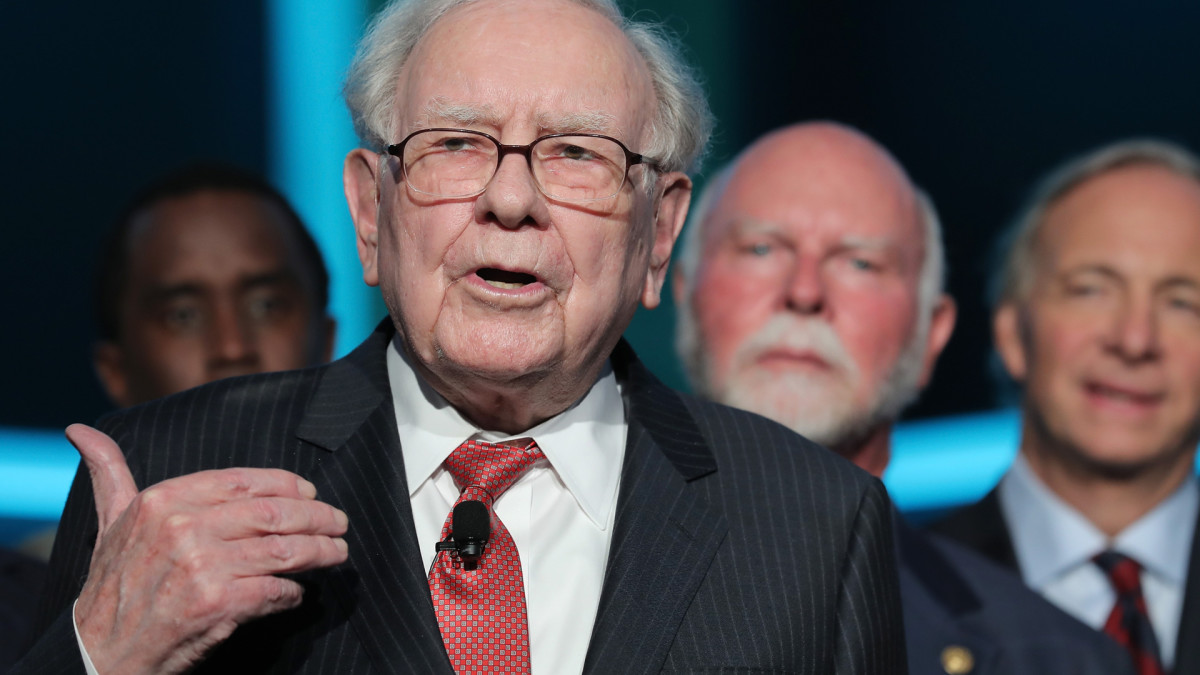
Getty Images
What’s happening after Warren Buffett resigned?
In 1965, legendary investor Buffett took control of Berkshire Hathaway, then a struggling textile maker. He turned it into an investment conglomerate and one of the most closely watched companies in the world.
Buffett stepped down as CEO at the beginning of 2026. Longtime lieutenant Greg Abel took over the chief executive role, with Buffett still serving as Berkshire’s chairman.
Related: Warren Buffett successor Abel sends first Berkshire Hathaway letter to shareholders
On March 5, Berkshire Hathaway said it has resumed repurchasing its own shares for the first time since 2024. Separately, Abel bought $15 million worth of stock himself, an amount equal to his after-tax annual salary, CNBC reported.
Abel also told CNBC that he will continue using his full salary to buy Berkshire shares each year.
“I’m committed to doing this every year,” Abel said. “My entire salary, as long as I’m CEO. We’ll file our 10-K, I’ll write the letter, and after the 48-hour cooling-off period, I’ll purchase.”
Many investors are questioning whether Berkshire’s longtime value investing strategy still works in today’s fast-moving market. But Abel signaled that the company has no plans to change course.
On Feb. 28, Abel posted his first shareholder letter as CEO, vowing that Berkshire Hathaway will not pull back on investing or change its long-standing strategy.
“We maintain a fortress-like balance sheet, ensuring Berkshire’s foundation is never compromised,” Abel wrote. “We preserve this financial strength by using debt sparingly and prudently. Our substantial liquidity enables us to meet our obligations even under the most adverse conditions and to respond swiftly when opportunities arise.”
Berkshire remains financially strong, with its cash and U.S. Treasury holdings standing at $373.3 billion, down slightly from the third quarter’s $382 billion.
“While some of this capital is required to support our insurance operations and protect Berkshire against extreme scenarios, it also constitutes our dry powder,” Abel wrote.
Veteran trader makes fresh call on Berkshire shares
“Time to get back into Berkshire Hathaway,” Stephen Guilfoyle said. He is a 30-year Wall Street veteran who runs Sarge986 LLC, a family-run trading operation.
Guilfoyle had exited his long position in BRK.B the week before the annual meeting of Friday, May 2, because he “felt that the inevitable was coming.”
Related: Costco takes big step to fix one of members’ biggest complaints
“The stock peaked at $542.07 that day. Buffett made his famous announcement that Saturday. The stock has never fully recovered,” Guilfoyle recalled in a note on TheStreet Pro.
But now, he is warming to the stock, based on improving technical signals.
“It’s not difficult to see the basing pattern that’s been in place since early November,” Guilfoyle wrote, pointing to a “rectangle” formation that followed a double top bearish reversal.
He noted Berkshire shares are now “trying to take back its 50-day SMA after having retaken its 200-day SMA,” adding that holding both levels could encourage fund managers who recently exited the stock to reconsider building long positions.
Berkshire Hathaway’s top 10 holdings as of Dec. 31, 2025:
- Apple (AAPL) — 22.60%
- American Express (AXP) — 20.46%
- Bank of America (BAC) — 10.38%
- Coca-Cola (KO) — 10.20%
- Chevron (CVX) — 7.24%
- Moody’s (MCO) — 4.60%
- Occidental Petroleum (OXY) — 3.97%
- Chubb (CB) — 3.90%
- Kraft Heinz (KHC) — 2.88%
- Alphabet (GOOGL) — 2.04%
Guilfoyle estimates that if the shares hold the $494 pivot level, the stock could move toward $568, which would surpass its November high.
Still, the veteran trader said he remains cautious about taking a full position and instead prefers using options to manage risk.
“Interested in laying out some capital for a stock you don’t really trust anymore? Me neither,” he wrote, suggesting a short-term bull call spread as a way to participate in a potential rebound.