For most of a century, Volkswagen (VLKAF) sold German engineering. The badge was a promise that the hardware underneath had been drawn up in Wolfsburg, signed off in Wolfsburg, and shipped out to whoever wanted it.
That promise held in China for roughly 40 years. Volkswagen was the family sedan, the taxi, the first car a middle-class household bought once it could afford one.
Then the market moved out from under the badge. Chinese buyers stopped comparing torque figures and panel gaps and started comparing screens, voice assistants and driver-assistance software that can handle a Shanghai on-ramp at rush hour.
BYD and Geely built those cars faster and priced them lower. Volkswagen, the company that once owned the country’s roads, finished 2025 in third place.
Its answer was to stop exporting engineering to China and start importing it.
On Sunday, Sept. 20, that answer finally got a price tag. FAW-Volkswagen, the automaker’s joint venture with state-owned FAW Group, launched the ID. AURA T6, a five-seat electric SUV that starts at 129,900 yuan, or about $19,240, according to CnEVPost.
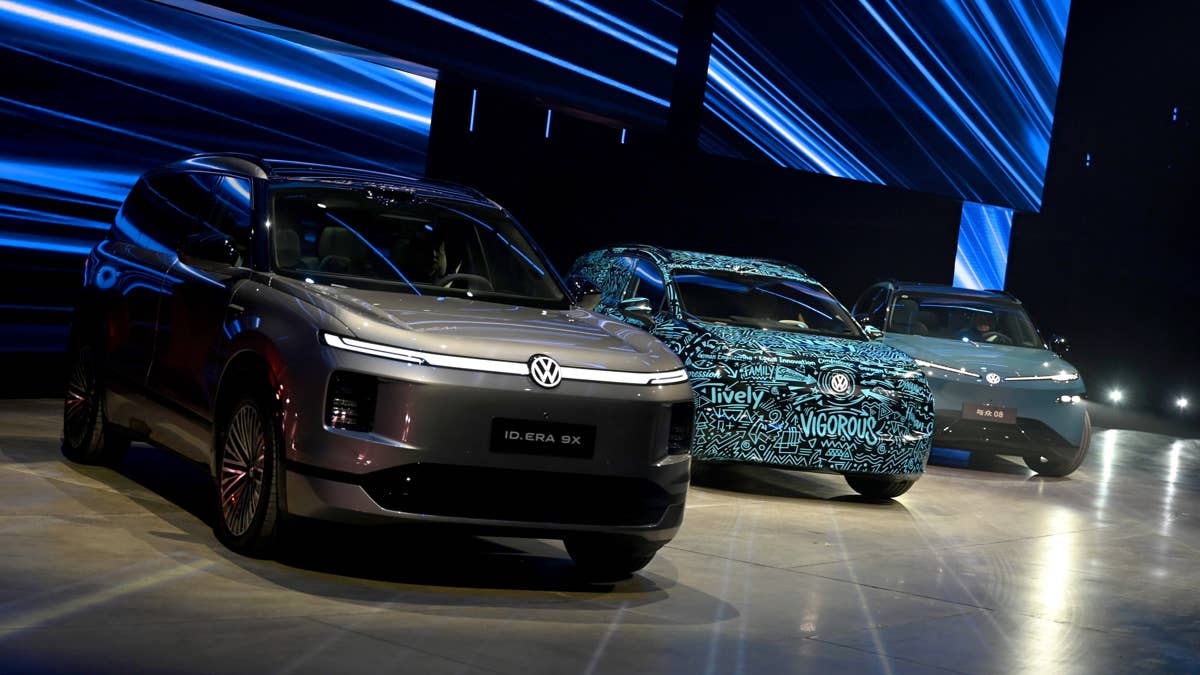
What Volkswagen’s $19,000 electric SUV actually offers
The ID. AURA T6 arrives in four versions, topping out at 166,900 yuan, or roughly $24,720. The launch price landed 6,000 yuan under the pre-sale figure Volkswagen floated on Aug. 28, a 4.4% cut before a single customer took delivery.
Every trim runs a single motor rated at 170 kilowatts, or 228 horsepower, with battery packs of 59.9 and 77.5 kilowatt-hours supplied by CATL (HKEX: 3750). Range tops out at 540 and 660 kilometers on China’s CLTC test cycle, which works out to roughly 335 and 410 miles before you discount for the optimism baked into that standard.
Related: VW’s CEO just survived the fight that sank his predecessors
The cabin carries a 15.6-inch central touchscreen, a 25.8-inch augmented-reality head-up display, a 90-liter frunk and 576 liters of cargo space behind the second row.
When I lined that starting price up against what Americans actually pay, the gap stopped feeling abstract. The average new vehicle sold in the US went for $50,089 in August, according to Kelley Blue Book. Volkswagen is selling a mid-size electric SUV with LiDAR hardware and urban navigation assistance for less than 40% of that.
Why Chinese chips now run a German electric SUV
The two higher-end trims use a driver-assistance system built by Carizon, Volkswagen’s joint venture with Horizon Robotics (HKEX: 9660). The setup pairs a 192-channel LiDAR unit with a Journey 6H chip rated at 420 trillion operations per second, according to CnEVPost.
Underneath sits the China Electronic Architecture, or CEA, developed with Xpeng (XPEV), the Chinese EV maker Volkswagen bought a stake in back in 2023. The cockpit runs on a 4-nanometer chip and supports AI models processed on the vehicle itself.
More Automotive:
- Tesla Cybercab features unexpected restriction at launch
- BYD sends Toyota, Detroit clear message on solid-state batteries
- Xiaomi begins delivering an SUV U.S. buyers cannot legally get
The technology partnerships show Volkswagen’s “growing reliance on Chinese development teams,” according to CnEVPost.
Volkswagen has not been shy about the shift. “China has become one of Volkswagen Group’s key innovation and technology hubs,” Volkswagen Group CEO Oliver Blume said in July, according to Volkswagen Group China.
Here is the arithmetic that frames the decision:
- The ID. AURA T6 starts at 129,900 yuan, about $19,240, and reaches 660 kilometers of range, according to CnEVPost.
- Americans paid an average of $50,089 for a new vehicle in August, according to Kelley Blue Book.
- German automakers saw China sales fall between 30% and 41% in the second quarter, according to Fortune.
- Volkswagen plans 13 new models in China this year, seven of them all-new new energy vehicles, according to CnEVPost.
That is a company losing volume fast enough to hand its software, its silicon and its electrical architecture to local partners, and doing it in public.
The share numbers make the pressure easier to see. Volkswagen’s Chinese joint ventures reclaimed the top spot in passenger vehicle share early this year as EV purchase tax breaks expired, then watched second-quarter deliveries collapse anyway once the subsidy pull-forward ran out.
What the ID. AURA T6 means for American drivers
A Commerce Department rule bars connected vehicles running Chinese-linked software beginning with model year 2027, with hardware restrictions taking effect in model year 2030, or Jan. 1, 2029 for components not tied to a model year, according to the Bureau of Industry and Security.
Set that rule next to this vehicle’s parts list and my analysis is blunt. The ID. AURA T6, as built, is never appearing in a US showroom. Not at $19,240, and not at $40,000 after tariffs and compliance work.
The number worth holding onto is the cost curve sitting behind that sticker. Volkswagen has now proved it can build a software-rich electric SUV for under $20,000 when it stops insisting the engineering has to be German.
American buyers are shielded from the car. They are also shielded from the price, which is the part nobody puts in a press release.
I checked whether the AURA is a one-off discount play or the new baseline, and the product plan answers it. Volkswagen is running 13 launches through China this year on shared architecture, which is how a cost structure becomes permanent rather than promotional.
European buyers get no such shield. Neither do the legacy automakers whose share prices assume a slow, orderly EV transition priced in the $40,000s.
Where Volkswagen’s China playbook goes next
Volkswagen expects to deliver Level 3 automated driving in China as early as the second half of 2027, with Carizon drawing on Horizon Robotics’ AI foundation models, according to Volkswagen Group China. FAW-Volkswagen wants new energy vehicles at roughly 60% of its sales by 2030.
The real test arrives when this cost structure crosses a border. Volkswagen has spent three decades teaching Chinese factories how to build cars. The tuition payment is due, and it is arriving as a parts list.
Whatever badge ends up on the hood of the affordable electric car you eventually buy, a meaningful share of what sits inside it will have been engineered in Shanghai, Guangzhou or Beijing. Volkswagen just stopped pretending otherwise, and it put a $19,240 price on saying so out loud.
Related: Automotive giant’s stock surges amid plan to cut 50,000 jobs