For two weeks every four years, Americans embrace soccer and may even remember that the rest of the world calls it football. This year, however, football-mania will be running even more wild than during a typical World Cup because the United States is hosting the global event.
That’s a massive financial opportunity.
“World Cup shoppers could drive an estimated $7.5 billion in consumer spending — slightly above a similar estimate for the Winter Olympics ($7.2 billion) but below Super Bowl estimates ($11.5 billion),” according to a Numerator report.
A number of brands will be attempting to cash in on the event, but Walmart, Target, and McDonald’s stand out as large retailers making big bets on both interest in the World Cup and the success of the American team.
Walmart has played the long game
Walmart actually partnered with Major League Soccer (MLS), the top league in the U.S., back in July to launch a promotion that would build toward the World Cup.
“Through this partnership, Walmart will activate across stadiums, screens and stores to bring fans closer to the action. As an official partner of MLS and Leagues Cup, Walmart will serve fans at every step of the matchday journey, from in-real-life (IRL) experiences to merchandise, whether they’re shopping for gear, hosting a watch party or connecting with their local soccer community,” the company shared in a press release.
Ad Age thinks the deal could be a winner for Walmart, because MLS counts as a value play for the brand compared to the more established major sports leagues.
“Walmart has never been much for sports sponsorships. The big retailer doesn’t really need the exposure, and its cost discipline makes splashy deals hard to justify. But a new deal with Major League Soccer could change the game,” the ad industry site reported.
Much of the promotion occurs on a grassroots level inside MLS stadiums, and Walmart launched a dedicated web store, Walmart.com/Soccer, for the promotion.
“Major League Soccer is already home to the youngest and most diverse fan base in North American pro sports, and with the 2026 World Cup on the horizon, soccer’s rise shows no signs of slowing down. Walmart’s investment reflects a long-term commitment to supporting the sport’s future in the U.S., starting at the grassroots level and building all the way to the global stage,” the company shared.
Shutterstock
McDonald’s adds World Cup meals and collectibles
McDonald’s has followed a pretty traditional script for its World Cup promotion, offering a meal, Happy Meal, and collectibles tied to global soccer/football stars.
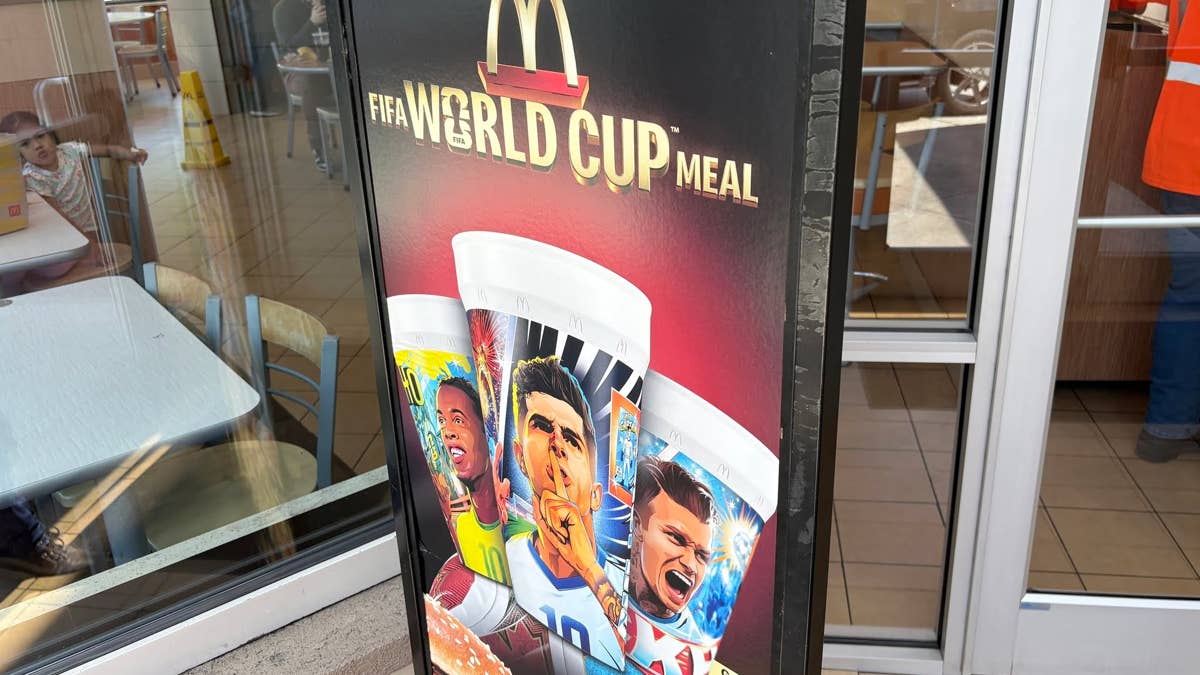
The FIFA World Cup 26 Meal comes with your choice of a Big Mac or 10-piece Chicken McNuggets, paired with our limited edition, gold packaged Big Mac Sauce. There is also a morning version with a Sausage McMuffin with Egg or Sausage Egg Biscuit and Hash Browns.
With each meal, fans receive one of nine collectible cups featuring soccer icons Christian Pulisic, David Beckham, Ronaldinho Gaucho, Thierry Henry, Son Heung-Min, Lamine Yamal, Alphonso Davies, Santiago Gimene, and of course, Grimace, who does not play soccer.
The FIFA World Cup 26 Happy Meal comes with one of 23 Squishmallows plushies, including the official mascots for FIFA World Cup 26, representing the three host countries: Canada, Mexico, and the United States.
“Kitted in unique soccer-inspired jerseys and McDonald’s graphics, the collection invites families around the world into the game,” McDonald’s shared in a press release.
A portion from every FIFA World Cup 26 Happy Meal purchased at McDonald’s helps support Ronald McDonald House families.
World Cup 2026 is a huge marketing event
Nicole Greene, vice president analyst in the Gartner Marketing Practice, wrote a guest piece for Marketing Dive about the impact of the World Cup. She noted that it was an opportunity for brands, but also a challenge.
“The 2026 FIFA World Cup will be one of the biggest brand marketing opportunities in years. It will also test something more fundamental: whether marketers can still earn attention at scale and prove the value of sponsorships,” she wrote.
With the World Cup, however, she shared that brands have a chance to break through the increasing drive to digital promotions based on personalization.
“Unlike fragmented digital environments, the World Cup concentrates attention. It brings together emotion, ritual and shared context over an extended period of time. These are conditions that are increasingly difficult to replicate in the media landscape, and they create a natural opening for brands to seamlessly participate rather than interrupt,” Greene shared.
Chief Client Advisor Brad Hecht agress with Greene, and sees the opportunity as global.
“Soccer (football) is the most popular sport in the world. The association with the FIFA World Cup provides brands with the opportunity to increase familiarity, relevance and empathy—and ultimately be a powerful means to elevate reputation,” he told Forbes.