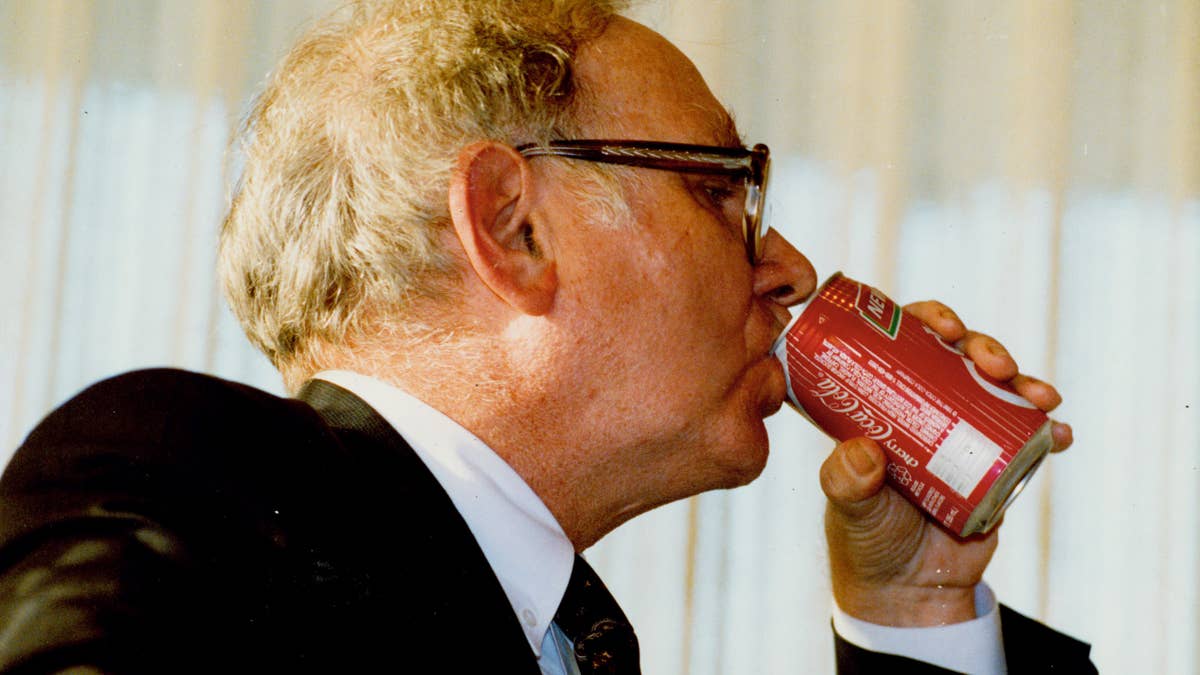
Warren Buffett spent nearly 50 years drinking Pepsi. His son even nicknamed him “Pepsi Warren.” Then a neighbor handed him samples of a new cherry-flavored Coca-Cola, and the legendary investor switched sides.
The soda switch made for a good story. The stock purchase that followed made history.
Buffett began buying Coca-Cola shares in 1988, and Berkshire Hathaway eventually built a 400 million-share position for about $1.3 billion. Today, that stake is worth roughly $37 billion at a share price of $93, while the annual dividend income has climbed to about $848 million.
Read more: Warren Buffett explained how he’d turn $10,000 into $30 billion if he were starting over
For an investor famous for buying businesses he understands, Coca-Cola was a particularly fitting bet. Buffett knew the product long before he owned a piece of the company. What followed was one of Berkshire Hathaway’s most enduring investments.
Berkshire Hathaway chairman emeritus Buffett, 96, took control of the company in 1965 and served as chairman for 56 years. He handed the post to his son, Howard Buffett, in September. Greg Abel became CEO in January, and Buffett remains on Berkshire’s board of directors.
New Coke leaves a mark
Coca-Cola’s troubles started in 1985, when the company replaced its original formula with New Coke. Consumer outrage followed, with thousands of angry calls a day and public protests, until the original recipe returned that year as Coca-Cola Classic.
Then came the October 1987 stock market crash, along with a pricing fight with PepsiCo that weighed on the shares. By 1988, Coca-Cola stock had been hit hard.
Buffett buys while Wall Street rolls its eyes
Buffett started buying anyway. Wall Street largely wrote the move off as too expensive and badly timed. Analysts pointed to a price-to-earnings multiple in the mid-teens, which was not the deep-value territory Buffett was known for, and noted that earnings had softened in 1987.
More Warren Buffett:
- Warren Buffett reveals he broke his own investing pattern
- Warren Buffett has a blunt take on today’s market
- Warren Buffett pulls no punches on stock market for 2026
Buffett saw a different company. He viewed the business, led by CEO Roberto Goizueta and president Don Keough, as a global brand with high returns on capital and enormous room to grow overseas.
Berkshire even got permission from the Securities and Exchange Commission to delay disclosing the purchases for a year so the market would not bid the shares up right away.
Buffett made his intentions clear to shareholders. “When we own portions of outstanding businesses with outstanding managements, our favorite holding period is forever,” Buffett wrote in Berkshire’s shareholder letter in 1988.
The secret came out in March 1989. The New York Times reported on March 16, 1989, that Coca-Cola said Buffett held a 6.3% stake.
Buffett explained the appeal in Berkshire’s shareholder letter later that year. He wrote that he started buying Cokes at six for 25 cents from the family grocery store in 1936 and selling them around the neighborhood for 5 cents each, and that he watched the product blanket the world for the next 52 years. “What was already the world’s most ubiquitous product gained new momentum, with sales overseas virtually exploding,” Buffett wrote in 1989.
Berkshire finished building its stake in August 1994. The $1.3 billion price tag comes to roughly $2.9 billion in today’s dollars, or about $3.25 per share on a split-adjusted basis.
Cashing Coke’s checks
Berkshire never sold a share, and the dividend checks have only gotten bigger. Berkshire collected $75 million from Coca-Cola in 1994. That grew to $704 million in 2022 and $816 million in 2025.
Coca-Cola raised its dividend about 4% in February, lifting the quarterly payout to $0.53 per share and marking its 64th straight annual increase. On Berkshire’s 400 million shares, that comes to about $848 million a year. It is more than 11 times the 1994 check, and each year’s payment equals roughly 65% of what Berkshire paid for the entire stake.
Buffett looked back on the investment in Berkshire’s shareholder letter in 2022, writing that the dividends grew every year “just as certain as birthdays.”
“All Charlie [Munger] and I were required to do was cash Coke’s quarterly dividend checks,” Buffett wrote in the same letter. Berkshire Hathaway vice chair Charlie Munger died in 2023.
For everyday investors, the takeaway is not that every familiar brand will compound this dramatically. It is that durable competitive advantages, steady dividend growth and extreme patience can turn an unloved stock into a cash machine decades later. The crowd in 1988 saw an overpriced soda company with a branding disaster in its past, and the longtime Pepsi drinker has been collecting on that doubt ever since.