Are autonomous vehicles like Waymo really safer than human drivers?
That’s the question some of the biggest tech companies in the world are investing billions of dollars to answer. Alphabet owns Waymo, Amazon owns Zoox, and Tesla has its own Robotaxi division.
The advantages robots have over human drivers are apparent. Robotaxis don’t drink and drive, don’t drive while tired, don’t drive distracted, and don’t get vengeful when someone cuts them off.
Half of U.S. states reported discernible blood alcohol concentration for at least 70% of fatally injured passenger-vehicle drivers in 2023, according to the Insurance Institute for Highway Safety (IIHS).
So it’s clear that eliminating drunken driving would significantly improve road safety. And clearing the roads of people whose driving ability is impaired for other reasons puts us well on our way to a transportation utopia.
On the other hand, driverless vehicles have displayed some disturbing patterns as they accumulate more miles on the road, leading to some awkward interactions with human drivers and even some dangerous situations with children and pedestrians.
So the IIHS conducted a study to find out once and for all: Is Waymo safer than human drivers?
Waymo cars were involved in nearly 70% fewer crashes than humans
Waymo driverless vehicles deployed in San Francisco, Phoenix, Los Angeles, and Austin were involved in 68% fewer crashes than human drivers per vehicle mile traveled (VMT), according to a new study by the Insurance Institute for Highway Safety.
“The results show that, on a limited scale, these driverless cars are safer than human drivers — who can be impaired or drowsy or suffer lapses in attention,” IIHS President David Harkey said.
Researchers estimated that only 22% of the 736 public-road crashes in which automation was engaged between 2021 and 2024 were likely police-reportable, including 89 crashes involving Waymo vehicles.
Waymo’s crash involvement was 76% lower in Phoenix, 35% lower in San Francisco, and 71% lower in Los Angeles, but was 4% higher in Austin, though the sample size there was relatively small.
Waymo vehicles were involved in 85% fewer single-vehicle crashes and 81% fewer injury crashes per VMT.
But before futurists declare the discussion about safety over, the study came with a major caveat: “However, the present data collection system isn’t good enough to allow continuous monitoring of a large-scale expansion.”
The data used in the study go back to 2021, when the National Highway Traffic Safety Administration began requiring self-driving cars on public roads to report crash involvements that result in fatalities, injuries, or property damage of any severity.
But while companies are required to report crash data, they are not obligated to report the miles they log or whether such miles involved a human driver. Waymo provides that information voluntarily, but its competitors do not, making a holistic assessment impossible.
“Even with the mileage data that Waymo provides, a direct comparison with the crash rates of humans is impossible without time-consuming operations to account for the differences between the reports required by the SGO and what humans report,” the IIHS said.
Meanwhile, human drivers are not required to report crashes that result in no injuries or less than $1,000 in property damage to the police. According to IIHS, about half of all crashes and a third of injury crashes by humans go unreported.
Waymo says that the IIHS report validates the company’s own analysis of the first 56.7 million miles of fully autonomous driving under its belt. Waymo’s own number showed its vehicles were involved in 79% fewer injury crashes compared to human drivers.
“We welcome this new research from IIHS, which confirms our previous peer-reviewed analyses and reinforces the significant safety benefits of the Waymo Driver,” a Waymo spokesperson told TheStreet.
“We also support the authors’ recommendation for more robust reporting requirements for AV operators — requirements that Waymo already voluntarily meets.”
U.S. senators question Tesla FSD safety data
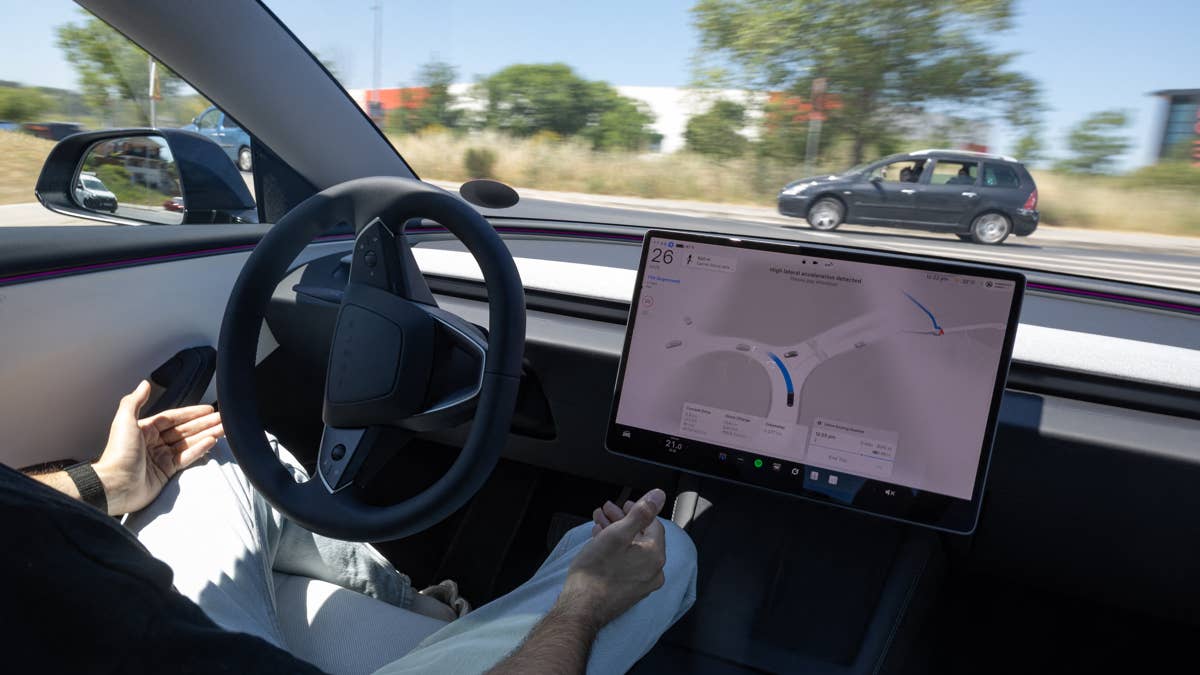
In May, Reuters reported that Tesla was exaggerating its safety claims for FSD and that it is using a team of “data labelers” to help improve the AI that powers FSD.
Based on this revelation, Elon Musk’s declaration that FSD is already up to 10 times safer than human drivers and ready for more widespread adoption may ring hollow.
So Senators Edward Markey (D-Mass.) and Richard Blumenthal (D-Conn.) sent a letter to the National Highway Traffic Administration saying the Reuters report exposes “dangerous gaps” in its autonomous vehicle data collection.
“Tesla has repeatedly told investors, consumers, and the public that FSD is far safer than human driving, but the data analysis justifying those claims is weak and misleading. These representations are not merely marketing claims; they may shape how drivers use Tesla’s FSD, how the public understands the risks of the technology, and how regulators evaluate potential safety defects,” the letter stated.
According to the letter, Tesla’s data justifying the “10 times safer” claim is flawed for several reasons, including:
- Comparing unlike crash outcomes that made Tesla look better
- Comparing newer Tesla vehicles to the entire U.S. vehicle fleet
- Counting FSD-involved crashes only if it is active at the time of crash or within five seconds. The NHTSA uses a 30-second time threshold for all ADAS systems
- Relying on incomplete automated telemetry
Tesla is cooking the books, according to the senators, and the NHTSA has not been able to get the real data it needs, which makes the whole situation more dangerous for drivers.
“The push to allow more autonomous vehicles on public roads depends heavily on the claim that these driving systems are safer than human drivers,” the letter stated.
“To the extent that Tesla or other vehicle manufacturers are misleading the public about their safety data, however, consumers may choose to purchase or ride in an AV based on the unproven expectation that they are safer than non-autonomous vehicles. This type of information asymmetry is a classic market failure, which will likely result in more AVs on the road — and potentially more traffic injuries and fatalities if those systems are not in fact as safe as they claimed.”
Currently, the NHTSA does not require vehicle manufacturers to submit data on the number of vehicles they operate, the distances they travel, and other data that could help contextualize crash rates.
They say that is the type of data that “would help prove or disprove Tesla’s safety claims.”
For this reason, the senators are asking the agency to “significantly expand autonomous vehicle data reporting requirements.”
Related: Waymo shows it learned critical lesson from previous blackouts