On a day when the Dow Jones Industrial Average looked like it might make a run at a new all-time high, Boeing was a surprise laggard.
Wall Street was expecting a huge order for new planes from the People’s Republic of China. Maybe as many as 500 planes, mostly 737 Max airliners.
President Trump, however, dashed those hopes by announcing the order was for 200 planes. He didn’t say much more except that he obtained the number from Xi Jinping, President of China.
Wall Street, however, had a lot to say about the order.
Boeing shares fell more than 4.7% to $229.21 on a day when the Dow had been up as many as 507 points before finishing up 370 points at 50,063. The aerospace giant was, by far, the biggest loser among the 30 stocks in the index. By my calculation, Boeing’s 11.4-point decline alone depressed the Dow by about 70 points.
The problem was that expectations were very high, fueled in part by Boeing CEO Kelly Ortner’s being invited to travel to Beijing with President Trump to celebrate the order. Also, Wall Street had been expecting a big order from China for months, according to Barrons’ Al Root.
“The Administration doesn’t effectively pre-announce a deal unless it’s a fait-accompli,” Seabrook Global Securities analyst Richard Safran told Fortune before the announcement.
So, it may just be a case of Boeing being careful not to say too much — and Wall Street getting overly excited beforehand. Boeing did not return calls for comment.
A 200-plane deal is still impressive
But an order even for 200 planes, equivalent to 3% of Boeing’s current backlog, does not mean it’s chump change.
A 737-Max has a list price of around $100 million, although the actual price will ultimately prove lower, maybe just 60% of the list.
But at list price, the value of the order might be worth as much as $20 billion. And maybe the deal is bigger than reported earlier Thursday.
We’ll see.
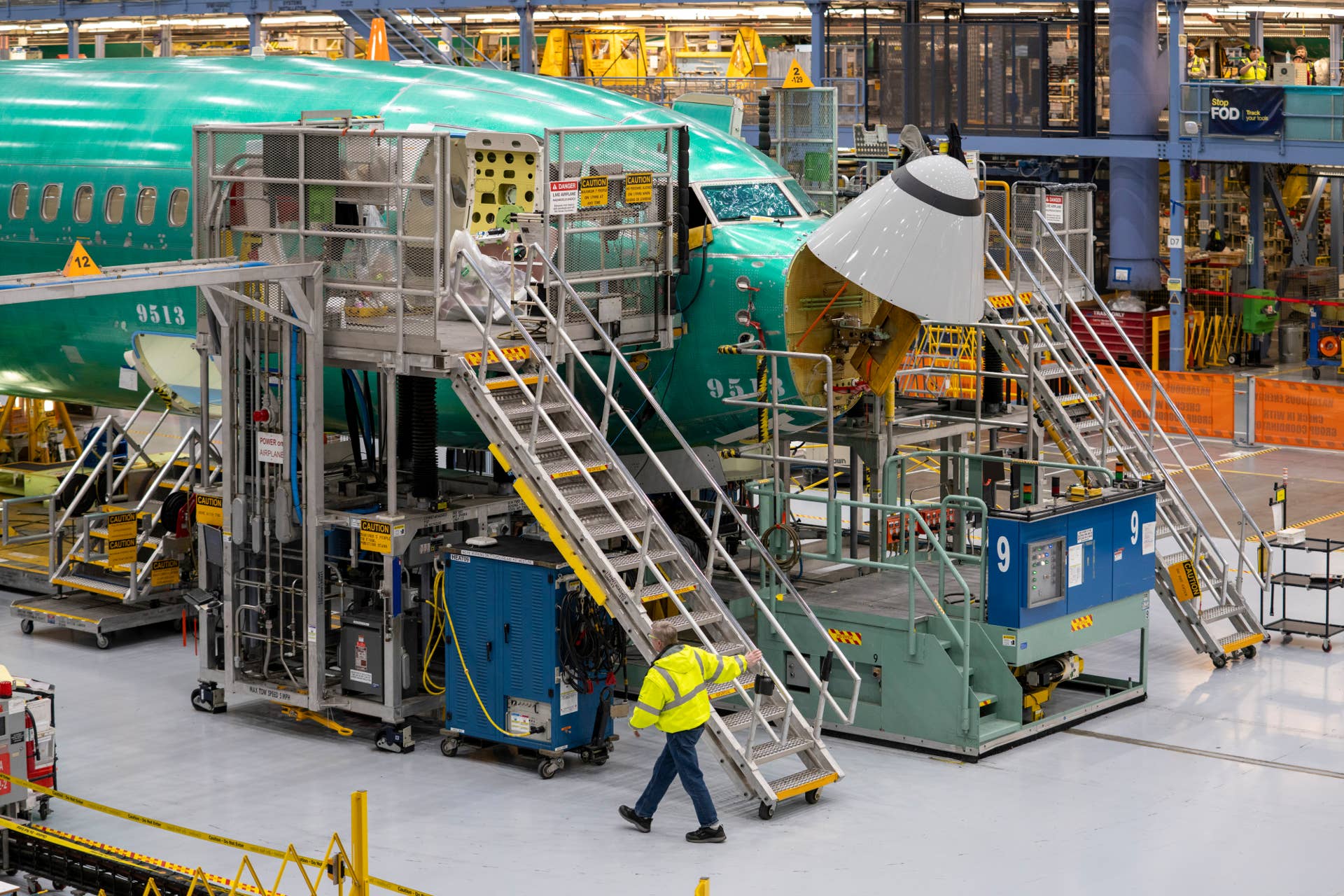
M. Scott Brauer / Bloomberg / Getty Images
Boeing has made a big comeback
Boeing has made a huge comeback from the disastrous period in its corporate history when two 737 Max planes fell out of the sky in 2018 and 2019 due to a software design error in its flight-control systems.
Boeing was forced to halt construction until it could prove the planes were airworthy. The crisis saw the shares fall as much as 68% and led to major management changes. Ortner’s hiring in August 2024 has helped reestablish Boeing’s bona fides with investors. The shares are up about 35% since his hiring and 68% since the tariff panic of April 2025.
More Airlines:
- Spirit Airlines desperately seeks help from an unexpected source
- UBS revisits Boeing stock price after earnings
- JetBlue makes a boarding change some may like
- Another airline shuts down for summer, cancels all flights
One major accomplishment is that Ortner has moved to Seattle after the company moved its headquarters first to Chicago and then to suburban Washington, D.C. Ortner has built up largely positive relationships with Boeing’s unions.
In fact, Boeing is having a better year in terms of orders than its European rival, Airbus. Boeing has delivered more planes so far in 2026, according to data from Forecast International.
Its backlog of commercial airplane orders totaled 6,807 on April 30, up 88 from March. Barrons said that’s about 10 years of work ahead. The 737 is the company’s bread-and-butter, with 4,870 outstanding orders, Forecast International said.
Crashes and missteps have a lingering effect
Boeing has reconstituted itself from the two crashes in the last decade as well as the January 2024 incident when an incorrectly installed door blew out on an Alaska Air flight near Portland, Ore.
The plane’s pilot was able to return the plane safely to Portland’s airport.
But on May 13, a Chicago, Ill., jury awarded $49.5 million to the family of one of the victims of the 2019 crash in Ethiopia.