The company expected to define the next gadget rarely gets there first. It has the most to lose, the most committees, and the most reasons to wait until the product is safe enough to ship without embarrassment.
Smart glasses have sat in that holding pattern for years. Meta (META) has sold millions of camera-equipped Ray-Bans built for photos, music, and notifications, the rare smart-glasses product to find a real audience. Apple (AAPL) has also spent heavily circling the category, reportedly pausing work on its Vision Pro headset to chase a lighter pair of everyday glasses.
Both giants are aimed at the same person, the one who wants a small screen on their face for messages and the occasional photo. Neither has shipped the version a working software engineer would actually want open at their desk.
That gap is where a company most people had never heard of just planted a flag. A Chinese startup called Monako unveiled Monako Glass, a 48-gram wearable it calls the world’s first Linux computer in glasses form, built to run artificial intelligence (AI) coding agents like Claude Code and OpenAI’s Codex right in front of your eyes, according to creator Candy Yue’s post on X (the former Twitter).
Smart glasses have been chasing the wrong customer
For most of the past decade, smart glasses were sold as a lifestyle accessory rather than a tool.
Meta’s Ray-Ban line leaned on cameras, open-ear speakers, and a built-in assistant for hands-free snapshots and calls. The pitch was social, not productive, and it sold well enough to put the category on the map.
More Tech Stocks:
- Morgan Stanley sets jaw-dropping Micron price target after event
- Nvidia’s China chip problem isn’t what most investors think
- Quantum Computing makes $110 million move nobody saw coming
Apple’s plans look similar in spirit. The company is expected to reveal its own glasses no earlier than late 2026, with a commercial launch slipping toward 2027, according to Bloomberg’s Mark Gurman, whose reporting was detailed by MacRumors.
Apple reportedly shelved a planned overhaul of the Vision Pro to move engineers onto the cheaper glasses, a measure of how badly it wants the category. Even so, early versions are described as display-free, camera-forward, and tethered to the iPhone, closer to AirPods for your eyes than a computer you would code on.
That consumer focus left a strange opening. The people most eager to wear a computer all day, the developers and researchers who already live inside AI tools, were never the customer either giant was designing for.
So the biggest names in the race spent their money chasing the mainstream shopper, leaving the power user standing alone in the room.
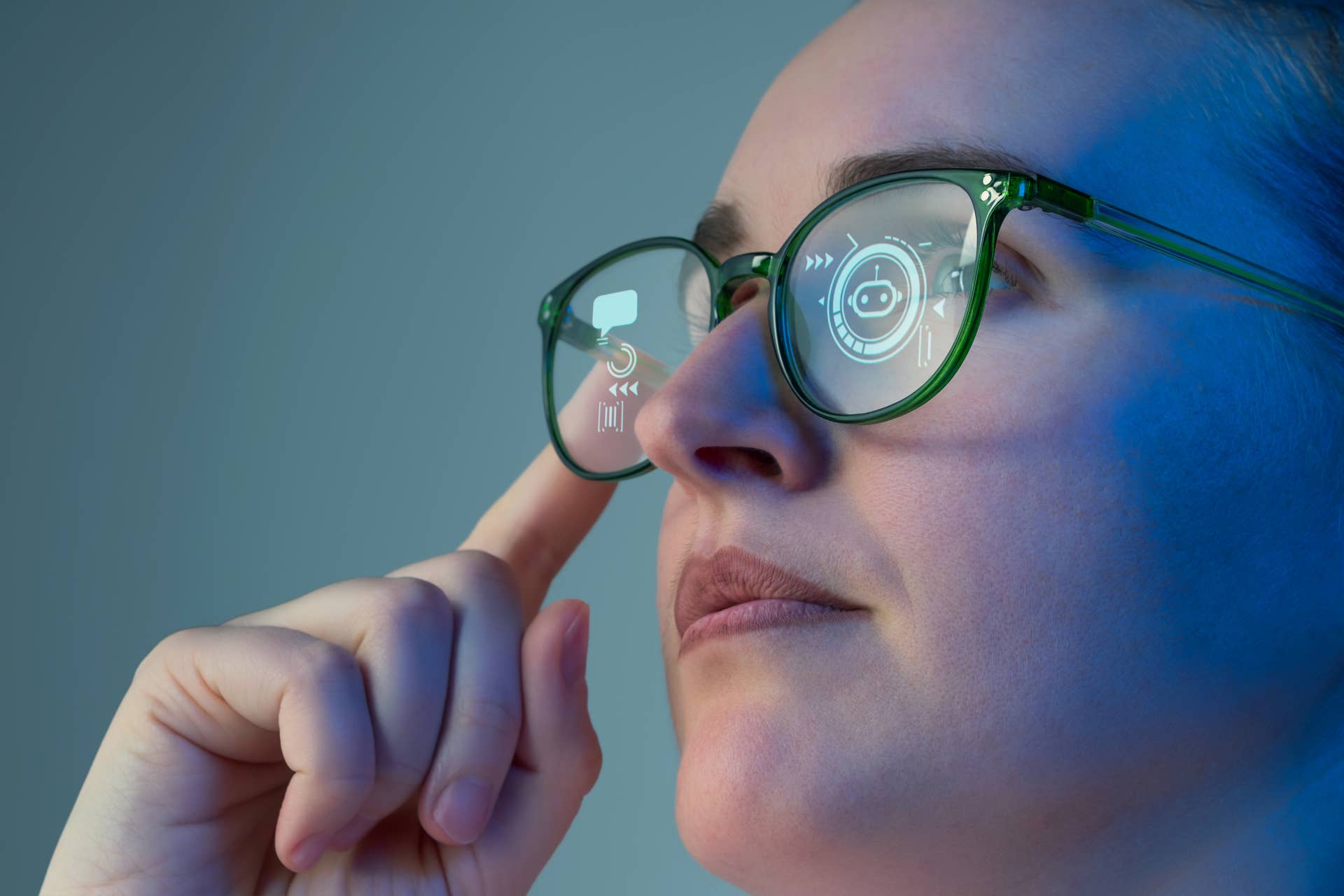
How a 48-gram wearable runs Claude Code and Codex
Monako built for that power user instead.
Monako Glass runs a custom operating system called MonoOS, a Linux-based platform that uses a lightweight application layer to keep individual apps as small as 200 to 500 kilobytes, according to coverage from CIOL. A user can speak a request, watch a coding agent build the thing, then pin the finished app to the glasses for later use.
In the launch demo, the glasses were shown handling AI research, building small applications, and assembling presentations from spoken prompts, with a raised hand to open a menu and a tap to select an app, according to Candy Yue via X.
Related: Apple is coming for the entire $200 billion glasses market
The hardware leans practical rather than flashy. The frames weigh about as much as an ordinary pair of glasses and carry a display, a camera, speakers, and gesture controls, the company said at launch.
One detail stands out to me as the real product insight. The glasses use a bone-conduction microphone that rests on the bridge of the nose and picks up vibrations through the nasal bone, so spoken commands separate cleanly from the noise of a busy room, Monako said.
That is the kind of problem a team only solves if it expects people to dictate code on a train, not just ask for the weather while on a walk.
Here is how the three roadmaps actually stack up:
- Monako Glass shipped a developer-focused concept now, built around Claude Code and Codex, according to creator Candy Yue.
- Meta’s Ray-Ban glasses remain aimed at consumers, centered on cameras and notifications, based on the company’s product positioning.
- Apple’s glasses are not expected to be revealed until late 2026 at the earliest, Bloomberg’s Mark Gurman wrote, as MacRumors reported.
When I lined those three up, the contrast was hard to miss. The most ambitious idea, a wearable built as a coding machine, came from the smallest and least-funded name on the list.
Next smart glasses form factor may skip AI hardware giants
I have watched enough product launches to stay skeptical of a slick reveal video, and this is still a demo.
A launch clip is not a shipping product at scale. Battery life, price, developer support, latency, and the messy reality of signing in to AI agents through a camera and a microphone remain unanswered, as Startup Fortune noted in its assessment of the launch.
There is also the small matter of trust. A wearable camera and microphone that watch your screen and listen to your voice all day raise obvious privacy questions, the same ones that dogged Meta’s glasses.
Monako leaned on Western software to make its case, naming Claude Code and Codex rather than a homegrown Chinese model. That is a tell about where developer trust currently sits, and a shrewd shortcut.
A new piece of hardware does not have to win the model race if it can become the most natural place to talk to the agents engineers already use every day.
Hardware startups can also move faster than incumbents precisely because they have less to protect, no huge installed base to defend, and no marquee brand to bruise if the first version stumbles.
Here is why this matters beyond one gadget: The last two computing shifts, the personal computer and the smartphone, minted fortunes and reordered entire industries. Both arrived from the edges, not from the incumbent everyone assumed would win.
If the next interface turns out to be a pair of glasses you talk to while an agent does the typing, the early lead just went to a 48-gram device from a company almost no one had heard of last week.
Meanwhile, the two firms with the deepest pockets in tech are still deciding which frame colors to test.
That should push any developer, and any investor tracking the AI hardware race, to look past the obvious names. The most valuable seat in a platform shift is rarely saved for the company that looks safest today.
Related: AI-enabled smart glasses allow you to be productive literally anywhere