For years, since its inception 40 years ago, Qualcomm (QCOM) has been the dominant name in smartphone chips, and little else, at least in the minds of investors who had grown comfortable with that narrative.
I have seen the stock trade at a discount to its semiconductor peers precisely because the handset market peaked back in 2017, according to an IMF report. The bear case was simple because we had a great chip company in a shrinking market.
At its 2026 Investor Day in New York on June 24, it was as if Qualcomm (QCOM) had already torn up that story.
The company unveiled a comprehensive data center Artificial Intelligence (AI) infrastructure strategy with a $15 billion revenue target for fiscal 2029, according to the Investor Day press release. And remember that it is a number that arrived alongside Microsoft CEO Satya Nadella and Meta CEO Mark Zuckerberg, appearing on stage as early customers.
According to Yahoo Finance, QCOM surged more than 8% in pre-market trading on June 25, trading near $214, and was up as much as 15% in extended trading on June 24 following the full presentation.
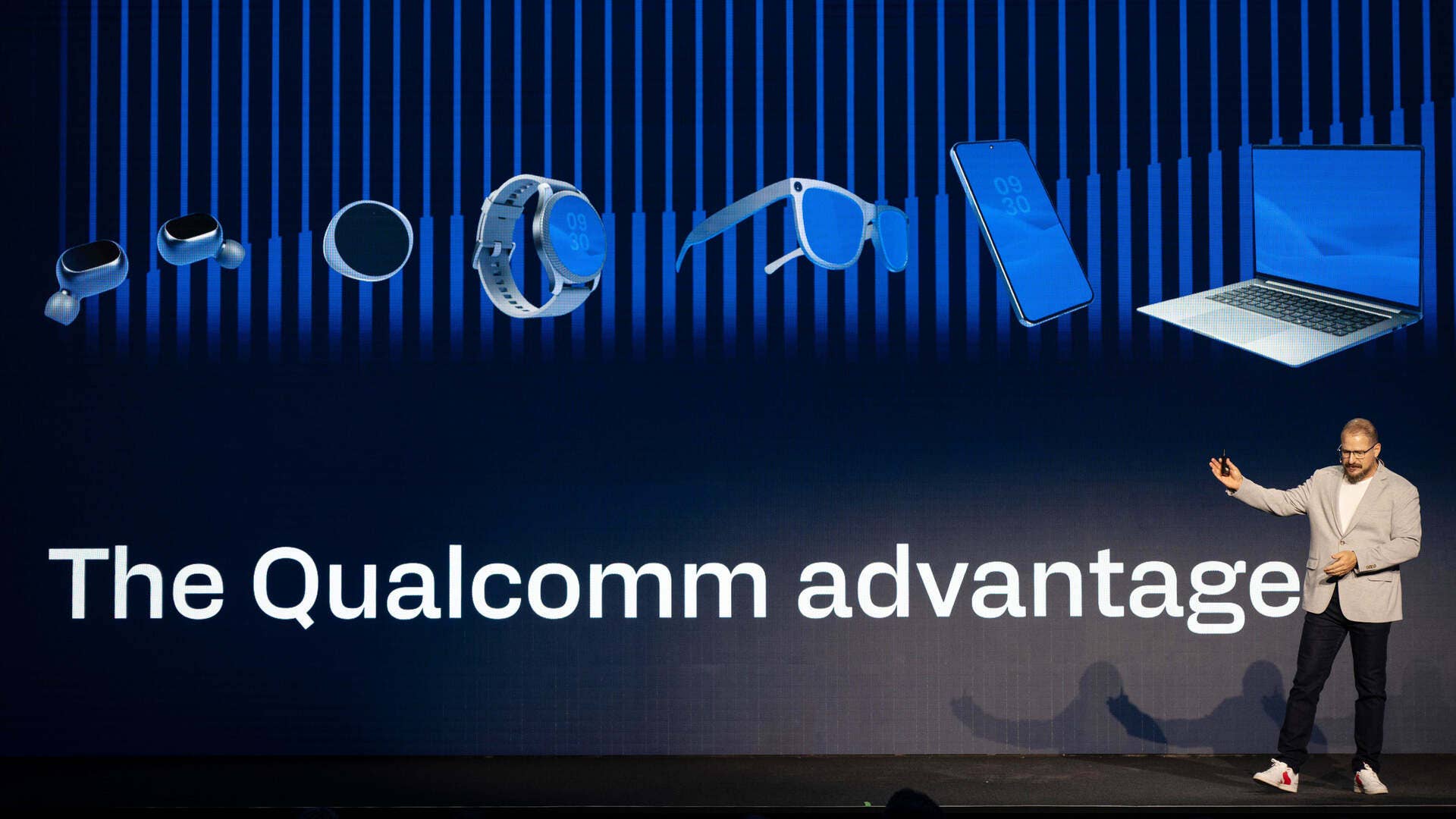
“We are defining Qualcomm’s next chapter as we accelerate our edge diversification strategy, introduce a comprehensive roadmap for next-generation AI data centers, and evolve into a platform company,” said Qualcomm CEO Cristiano Amon.
Also Read: Qualcomm Incorporated Latest News and Stories
Qualcomm unveils new computing paradigm within Dragonfly portfolio
The product portfolio Qualcomm introduced under the Dragonfly brand is ambitious in scope and specific in architecture.
At the center is a new computing paradigm called High Bandwidth Compute, or HBC. Data Center General Manager Tony Pialis described it as having six times the bandwidth per watt compared to traditional GPU-HBM-SRAM solutions.
“We have broken through the memory bottleneck,” he said, according to a Seeking Alpha report. “We have separated the HBM from the GPU. It uses lower energy per token and has more memory bandwidth.”
Commercial sampling of HBC Gen 1 with AI250 begins in mid-2027, according to Qualcomm‘s disclosures.
More Tech:
- Microsoft CEO sends a blunt warning on AI and the tech ecosystem
- Amazon CEO just made things uncomfortable for Anthropic
- Microsoft has bad news for a key AI partner
Microsoft’s Nadella appeared in person to say Azure data centers will deploy Qualcomm’s HBC solutions. Meta’s Zuckerberg confirmed a multi-generational CPU partnership.
“We’ve entered a multi-generational partnership with QCOM to use their CPUs in our data centers,” Zuckerberg said, referencing the Dragonfly C1000 — a 250-plus core chipset with 2TB per second PCIe Gen 7 and CXL connectivity, available for commercial production in the second half of 2028, Seeking Alpha reports.
An AI inference accelerator card and rack, the Dragonfly AI300, will integrate HBC Gen 2 for disaggregated inference deployments and is targeted for commercial sampling in 2028. HUMAIN was revealed as Qualcomm’s first full-stack data center customer.
Qualcomm’s revenue targets made Wall Street sit up
The financial targets announced on June 24 are what sent the stock surging. Qualcomm raised its fiscal 2029 non-handset revenue target to $40 billion, according to a Qualcomm press release.
That’s nearly double its prior projection of $22 billion. Within that, the data center represents $15 billion, the automotive industry $10 billion, and IoT more than $14 billion. Total non-GAAP EPS target for fiscal 2029 was set at above $18, versus the $15.26 analyst consensus tracked by LSEG, CNBC reports.
Related: Qualcomm CEO plans to kill app store with AI
My read of those numbers is that the market had essentially written off the possibility that Qualcomm could meaningfully diversify at this scale. The $40 billion non-handset target, if credible, transforms the investment thesis from “smartphone company with a growth problem” into “diversified AI compute platform with hyperscaler validation.”
CEO Cristiano Amon was direct about the timing question investors have been raising, CNBC reported.
“When people ask about whether it’s too late to enter the data center, you should think about scale and execution, engineering capabilities, or operations and supply chain,” Amon said.
He answers that Qualcomm already has relationships with nearly every hyperscaler, built over years of smartphone and edge-chip delivery. This is an extension of existing trust, not a cold call.
Qualcomm’s $3.9 billion Modular acquisition and the CUDA parallel
What stood out to me beyond the hardware was the software move. Qualcomm confirmed its $3.9 billion acquisition of Modular, a startup whose software enables AI applications to run efficiently across different hardware architectures.
Qualcomm explicitly framed Modular as its equivalent to Nvidia‘s CUDA ecosystem, according to a CNBC report.
That comparison is not accidental. CUDA’s lock-in is widely considered Nvidia’s most durable competitive moat — not the hardware, but the software layer that developers have built on for 15 years. Qualcomm is signaling it understands that winning data center share requires a software stack, not just a chip.
Qualcomm’s most recent second-quarter fiscal 2026, from April 29, showed $10.6 billion in total revenue and non-GAAP EPS of $2.65, with record automotive revenue of $1.3 billion, up 38% year over year, and a $20 billion share repurchase authorization.
The business entering Investor Day was already healthy. The business leaving it is pointed at a fundamentally larger opportunity. QCOM is up 16.58% year to date, according to Yahoo Finance.
If the $40 billion non-handset revenue vision converts to results, that number will look modest in hindsight.
Related: Qualcomm eyes $10 billion AI shortcut as smartphone growth slows