Retailers have spent years collecting information about their customers.
They know what shoppers buy, how frequently they shop, where they live, what they browse online and, in many cases, how they respond to promotions.
That data can be enormously valuable. It can help retailers stock stores, personalize marketing offers, and determine which products to put on sale.
But there’s a line that increasingly worries consumers, and it’s using that information to determine how much an individual shopper pays.
New Jersey has now decided that line has been crossed.
Governor Mikie Sherrill signed the Fair Price Protection Act in July, making New Jersey the third state to enact legislation restricting surveillance pricing.
Maryland and Connecticut passed similar laws earlier this year.
The New Jersey law prohibits grocery stores and third-party grocery delivery platforms from using personal data to set individualized prices for groceries and other covered products.
Electronic shelf labels are part of the controversy
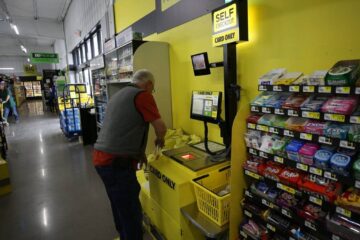
These days, more stores use electronic shelf labels to replace paper tags with wireless screens that update instantly. That makes surveillance pricing even easier to pull off.
New Jersey is also imposing a one-year moratorium on new electronic shelf labels as experts study the impact. Retailers that already use these systems, however, can continue to do so.
Of course, retailers may have legitimate reasons to want to use these systems.
Electronic shelf labels can make price changes faster, reduce the labor involved in changing thousands of paper tags, and potentially reduce errors.
The concern is what retailers might eventually do with that capability.
A digital label can change with a keystroke. That raises obvious questions about whether retailers could eventually move toward pricing that changes based on information about a given shopper.

Shutterstock
This could become a much bigger retail issue
New Jersey’s action is significant because it’s part of a rapidly developing patchwork of state laws.
Maryland’s law focuses on food retailers and delivery services, while Connecticut’s measure takes a broader approach covering retail sellers.
But taken together, the three states’ rules could create a potentially complicated environment for national retailers. And things could get even more complex if more states follow suit.
A company operating stores in dozens of states may eventually have to build pricing systems that comply with several different sets of rules. And if more states follow New Jersey, retailers may have to reconsider how they use customer data across their entire businesses.
Of course, the concept of prices changing to meet demand isn’t new. Airlines typically jack up prices during holiday weekends, and ride-sharing platforms like Uber use surge pricing to raise rates when driver supply is low and rider demand is high.
But surveillance pricing is fundamentally different.
“Dynamic pricing has been around for decades, and most shoppers grudgingly accept it,” John Andrews, founder of shopper-marketing company Collective Bias, told Retail TouchPoints. “Surveillance pricing is newer, quieter, and it breaks the basic fairness assumption that the price tag is the price tag.”
More Retail:
- Costco sees major shift in member behavior
- Retail chain shuts all locations as legal changes hit industry
- Costco makes major investment in online shopping for members
To put it another way, with dynamic pricing, all consumers are forced to pay more. With surveillance pricing, only some consumers might pay more. That’s where New Jersey is now drawing a line.
And with Maryland and Connecticut already on board, this may be less of a New Jersey experiment and more of an early warning for the entire retail industry.