Longer shipping routes have pushed freight rates higher, while disruptions to refineries and crude oil transportation have reduced supplies of refined products such as diesel.
Those conditions are creating opportunities for companies that can command higher prices for transportation or benefit from stronger refining margins.
Two companies benefiting from those trends are Star Bulk Carriers Corp. (SBLK) and Shell plc (SHEL).
Higher freight rates lift Star Bulk Carriers
Dry bulk shipping rates have climbed sharply this year as overseas tensions have contributed to longer and riskier shipping routes. Star Bulk Carriers Corp. (SBLK), one of the world’s largest dry bulk shipping companies, is benefiting from those higher rates.
The company operates 138 vessels that transport commodities including iron ore, minerals, grain, bauxite, fertilizer, and steel products. Star Bulk ships more than 80 million metric tons annually.
Related: Louis Navellier says AI fears are overblown
During the second quarter, the company earned an average time charter equivalent (TCE) rate of $24,486 per vessel. As a result, Star Bulk Carriers achieved earnings of $1.21 per share, up 1,000% from $0.11 per share in the second quarter of 2025 and topped analysts’ estimates by 30.1%.
For the third quarter, Star Bulk expects its fleet to earn an average TCE rate of $23,547 per day. Its Newcastlemax and Capesize vessels are expected to earn about $33,087 per day.
Analysts expect earnings of $1.18 per share and revenue of $301.72 million, representing year-over-year growth of 307% and 39%, respectively. Earnings estimates have also risen over the past two months.
My stock grading system rates SBLK as an A and is a good buy below $35.

Refining shortages support Shell
The global refining market is facing its own supply constraints. About 20 refineries in the Middle East have been damaged or temporarily shut down, reducing global refining capacity by about 3.52 million barrels per day. Attacks on Russian refineries have cut capacity further.
At the same time, disruptions to crude oil transportation have contributed to tighter supplies of refined products. U.S. diesel inventories fell to 107.9 million barrels on September 11, the lowest level for that time of year since 1982. The average U.S. diesel price also reached $6.29 per gallon.

Those conditions have helped keep diesel prices and refining margins elevated.
Shell plc (SHEL) operates six refining and chemical facilities globally with capacity to process about 1.65 million barrels of crude oil per day. In the second quarter, Shell reported its best quarterly profit in four years. Adjusted earnings climbed 131% year-over-year to $9.84 billion, while adjusted earnings of $3.52 per share topped estimates of $3.18.
Analysts have raised third-quarter earnings estimates by 30.5% over the past two months and now expect earnings to rise 86.6% year-over-year to $3.47 per share. Shell also paid an interim second-quarter dividend of $0.39 per share, and the stock currently yields 3.3%.
My stock grading system rates SHEL as an A and is a buy below $100.
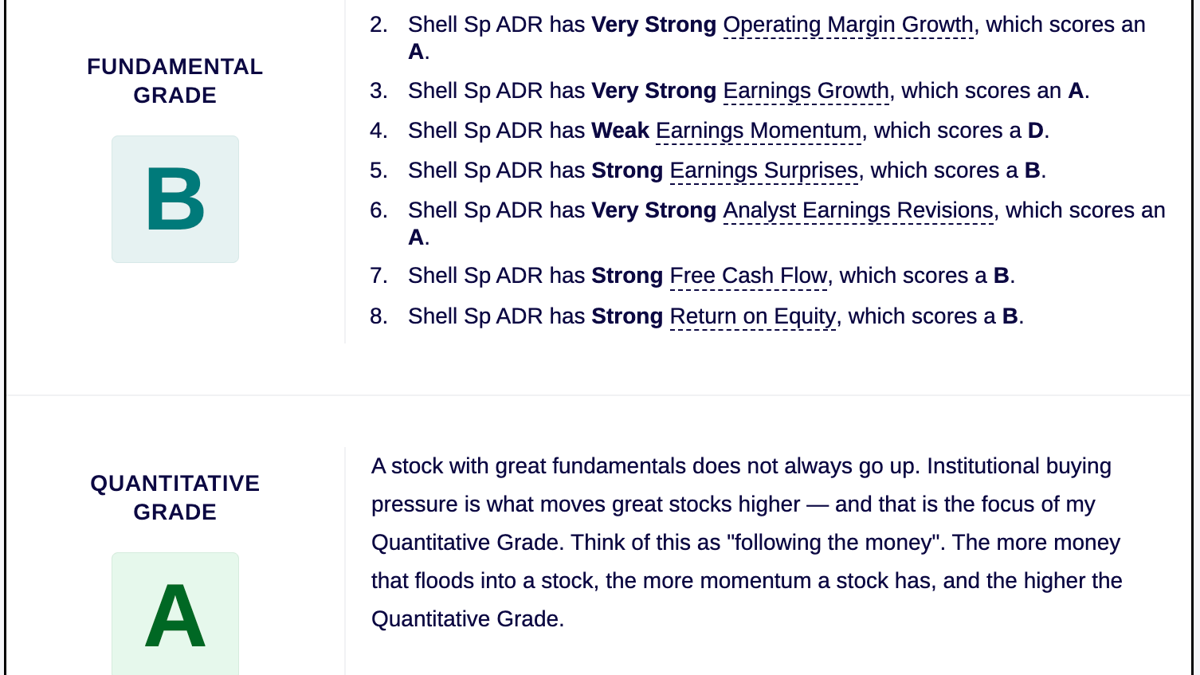
For more information about my stock grading system, click here.
Related: Hormuz closed in February; now France is running dry