American workers saving for retirement often treat choosing between a 401(k) and an individual retirement account (IRA) as an either-or decision, when both Vanguard and Fidelity encourage using both vehicles simultaneously — though they disagree sharply on the exact order in which savers should fill them up.
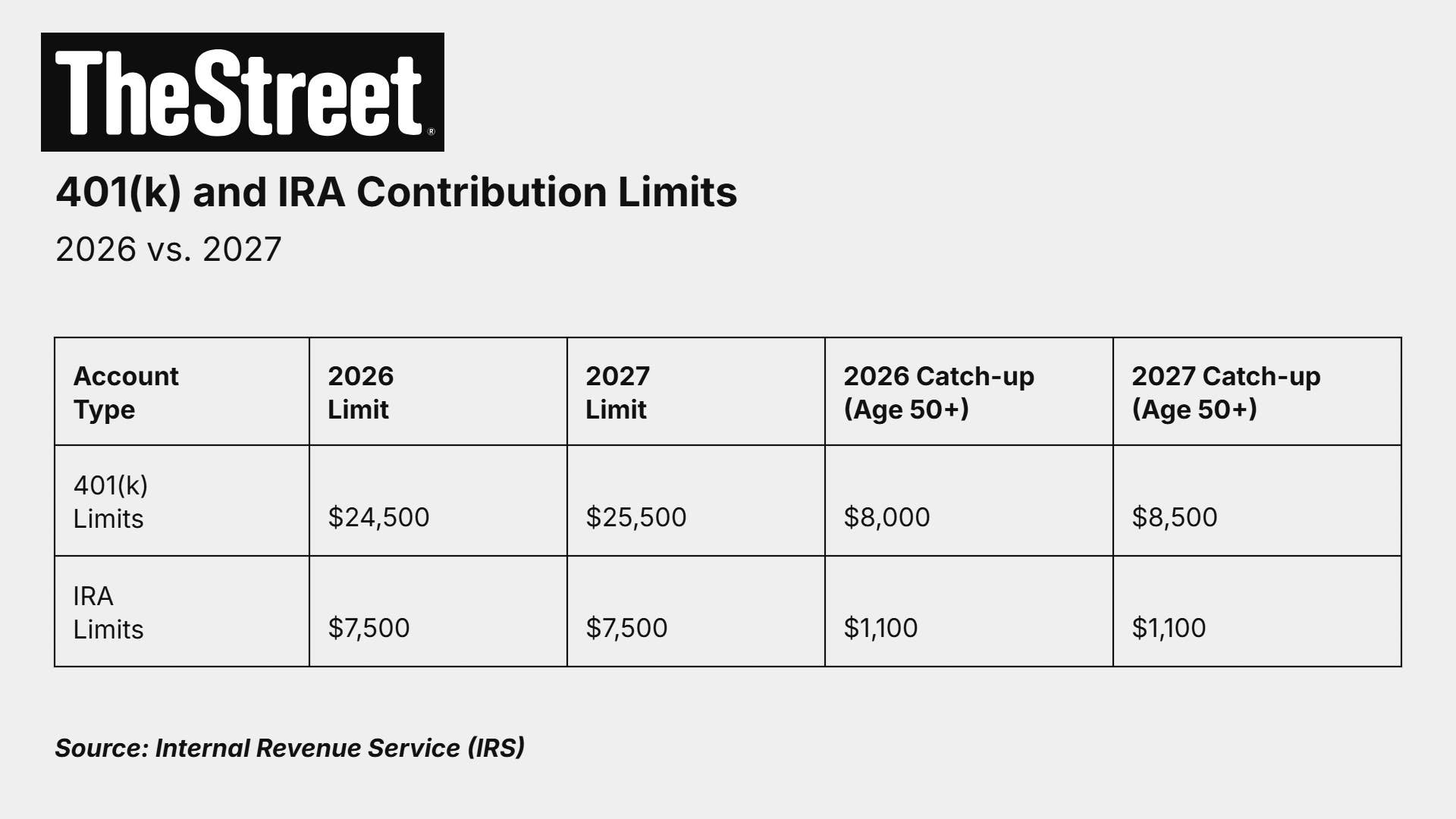
The timing of that debate carries fresh weight following the Internal Revenue Service’s Nov. 12, 2026 announcement raising the annual 401(k) employee contribution cap to $25,500 for 2027 while keeping the IRA limit frozen at $7,500.
There are also changes for workers with 401(k) plans who are aged 50 and over.
“The catch-up contribution limit that generally applies for employees aged 50 and over who participate in [401(k) plans] increased to $8,500, up from $8,000 for 2026,” wrote the IRS.
With the resulting wider $18,000 gap separating 401(k) and IRA contribution caps in 2027, knowing how to sequence those dollars is critical.
Vanguard champions a three-step 401(k) and IRA strategy
Rather than pitting workplace plans against individual accounts, Vanguard frames them as complementary tools that solve different problems — pairing the high contribution limits and payroll automation of a 401(k) with the broader investment menu and personal control of an IRA.
“You can have both a 401(k) and an IRA and use them together to save for retirement,” Vanguard wrote. “401(k) plans generally have higher contribution limits, while IRAs often offer a wider range of investment options and more personal control.”
To capture the advantages of both accounts, Vanguard outlines a three-step savings waterfall:
- Contribute enough to a workplace 401(k) to capture the full employer match.
- Contribute the maximum allowed to an IRA to broaden investment choices.
- Return to the 401(k) to contribute beyond the match up to the annual limit.
“We recommend following these steps for greater flexibility, control, and portfolio diversification,” Vanguard explained.
Vanguard also emphasizes tax diversification across both accounts. While traditional pre-tax contributions reduce taxable income today, Roth accounts provide tax-free income in retirement — and Vanguard notes that unlike Roth IRAs, “Roth 401(k) plans don’t have income limits, making them accessible to high earners.”
“Holding a mix of traditional and Roth accounts can give you more flexibility in retirement, allowing you to manage taxes strategically as you draw income over time,” Vanguard added.
Internal Revenue Service (IRS)
Fidelity reverses the order on 401(k)s and IRAs
Fidelity agrees that combining pre-tax and Roth accounts builds valuable retirement flexibility, particularly during a worker’s peak earning years in their 40s and 50s.
“Maximizing savings across taxable, tax-deferred, and tax-free accounts can improve flexibility when creating income and managing taxes in retirement,” Fidelity wrote.
However, Fidelity’s savings roadmap flips Vanguard’s sequence. After capturing the full employer 401(k) match, building three to six months of emergency savings, and maxing out a health savings account (HSA) if eligible, Fidelity advises workers to max out their workplace 401(k) before funding an IRA.
“Max out your health savings account (HSA), if eligible,” Fidelity wrote. “Then max out contributions to retirement accounts like a 401(k). Contribute the maximum to an IRA.”
Fidelity’s guidance underscores why high earners in particular may find maxing out a 401(k) first more practical than stopping at the match to fund an IRA.
“When income is high, your income tax may be too—making tax-deferred or tax-free accounts especially valuable,” Fidelity explained. “These years may offer your best opportunity to shift income out of what may be your highest-tax window and prepare for the future.”
IRS phase-outs and catch-up rules complicate the choice
High-income savers who follow Vanguard’s path into an IRA first can run directly into Internal Revenue Service income phase-outs that restrict traditional IRA tax deductions and direct Roth IRA eligibility.
The IRS adjusts those income phase-out thresholds annually for inflation, raising the limits slightly for the 2027 tax year.
“Taxpayers can deduct contributions to a traditional IRA if they meet certain conditions,” wrote the IRS. “If, during the year, either the taxpayer or the taxpayer’s spouse was covered by a retirement plan at work, the deduction may be reduced or phased out until it is eliminated, depending on filing status and income.”
For 2027, the IRS raised the traditional IRA deduction phase-out range to between $83,000 and $93,000 for single workplace plan participants, and between $133,000 and $153,000 for married couples filing jointly.
Direct Roth IRA eligibility phases out between $158,000 and $173,000 for singles and between $250,000 and $260,000 for joint filers.
More Retirement:
- Annuities can be a retirement safety net to prevent outliving savings
- Vanguard flags a retirement fear built into 401(k) plans
- Suze Orman has a serious retirement warning for 2027
When income exceeds those caps, Fidelity notes that super savers often turn to a “backdoor” Roth IRA by making a nondeductible traditional IRA contribution and converting it to a Roth IRA.
Meanwhile, older workers face a major rule shift when making catch-up contributions.
“If you’re 50 or older and your Federal Insurance Contributions Act (FICA) taxable earnings are $150,000 or more in the prior year with the employer offering the retirement savings plan, any catch-up contributions to your workplace retirement savings plan will have to be made to a Roth workplace retirement savings plan,” Fidelity noted.
“That means you’ll lose out on the upfront tax deduction you may have had previously, potentially reducing your take-home pay.”