Few investors have captured Wall Street’s attention quite like billionaire Stanley Druckenmiller.
For three decades, he spearheaded the hedge fund Duquesne Capital Management. Druckenmiller achieved roughly 30% average annual returns without a single losing calendar year, as reported by Yahoo Finance. He later shut the fund down in August 2010 and returned outside client money, Bloomberg noted.
Today, managing his own $8.9 billion fortune as founder and chairman of Duquesne Family Office, he has no outside clients, which makes his public warnings all the more telling.
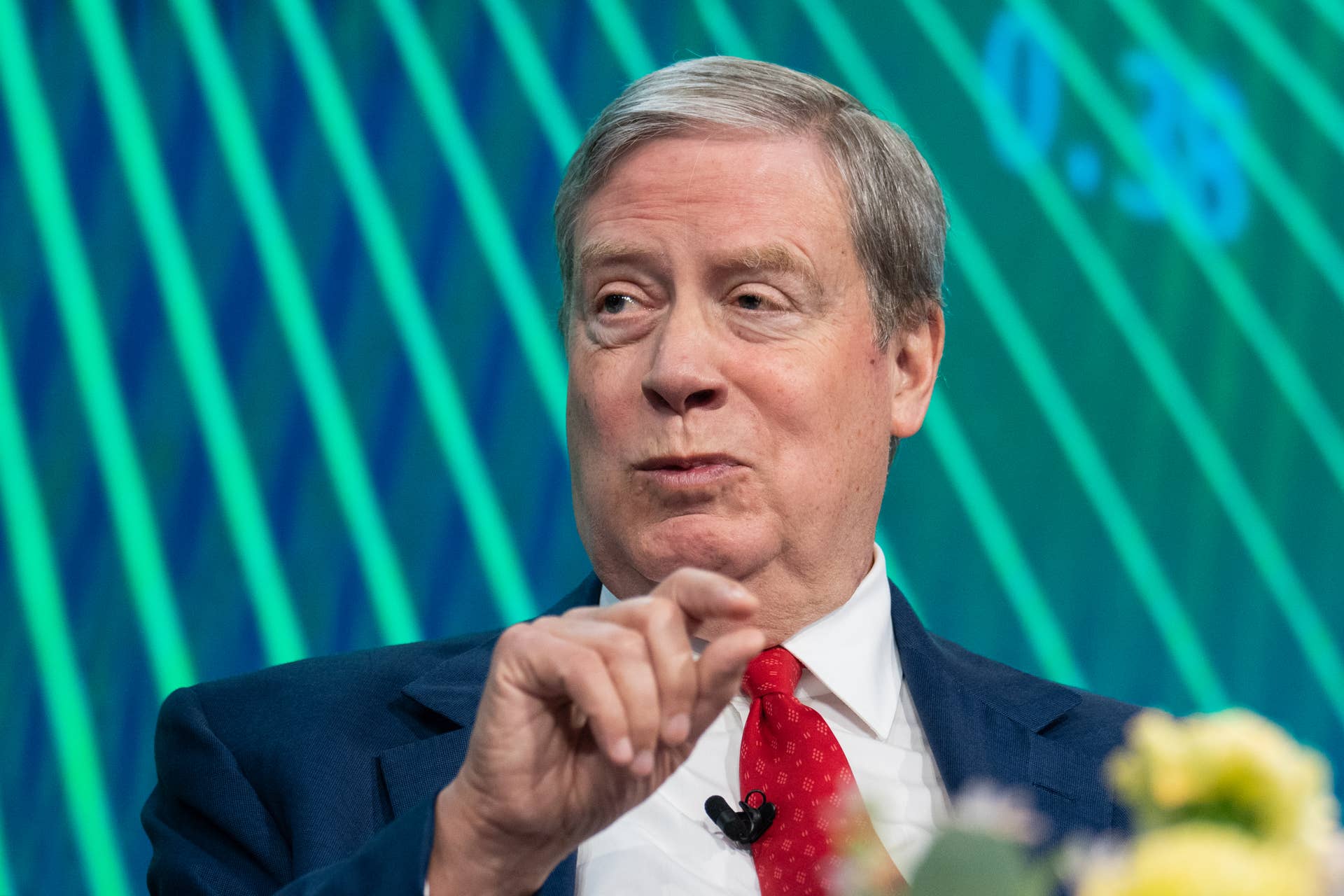
Speaking at the TomorrowX Summit in Austin, Texas, on Nov. 17, Druckenmiller delivered a sobering reality check for everyday investors banking on cheap money and nonstop gains in tech stocks.
As the Federal Reserve reversed course and raised rates, the macro legend took the stage with a stark message about U.S. stocks, and his latest regulatory filing suggests he’d already been acting on that view for weeks.
Why Stanley Druckenmiller is “staying away” from U.S. stocks right now
Druckenmiller didn’t mince words in Austin about how sharply the stock market backdrop has shifted since January.
“So now let’s look at today. The economy still is strong, but everything else I just talked about has completely flipped on its head,” he told attendees at the event. “The Fed is not cutting. They’re hiking. We’ve had regime change at the Fed.”
More Investing:
- How smart investors use ETFs to legally bypass IRS wash sale rules
- Vanguard renames key funds to highlight Morningstar benchmarks
- Popular ETFs carry hidden tax rules that surprise retail investors
That assessment carries a lot more weight when we consider that the current Federal Reserve Chair, Kevin Warsh, previously worked alongside Druckenmiller at Duquesne.
“A gentleman I know well, he sat next to me for 15 years,” Druckenmiller said of Warsh. “He is not happy that we had free money for 15 years while the deficit and everything else went through the roof. He’s even less happy that inflation’s been above target for five years. So we have monetary tightening going on.”
Moreover, with monetary policy tightening, credit spreads widening, and industrial demand cooling, Druckenmiller said he could barely foresee where the economy might be in a year.
With virtually no net equity exposure, he focused on preserving capital rather than chasing returns. He warned that the second half of 2027 could disappoint economically and said the commodity rally that started off in January appeared to have peaked.
He had already gone short copper. The next day, Nov. 18, front-month Comex copper fell 5.1% to $5.67 a pound, its steepest one-day drop in more than a year, with shares of Freeport-McMoRan dropping more than 6%.
How Duquesne’s $740 million Q3 13F retreat foreshadowed the warning
- The reported portfolio shrank by $740 million. Duquesne Family Office’s November 16 filing showed $4.47 billion across 65 positions as of Sept. 30, down 14.2% from $5.21 billion across 95 positions at the end of June.
- Duquesne dropped its broad-market calls. The firm exited calls linked to the S&P 500, Russell 2000, and an equal-weight S&P 500 fund. Those options covered $341 million in underlying fund shares at the end of June. It also halved the shares underlying its Tesla calls to 63,000.
- Chip stocks and copper took a hit. Duquesne cut its Taiwan Semiconductor share count by 94.5% and exited AMD, Alphabet, SanDisk, and Southern Copper. It opened stakes in three gold miners: Newmont, Barrick Mining, and Agnico Eagle Mines.
- Natera stayed on top. Duquesne trimmed its share count by 0.8%, but a roughly 50% quarterly stock gain lifted the position’s value to $1.31 billion, or 29.2% of reported holdings.
- The tech retreat wasn’t across the board. Duquesne increased its Seagate share count by 180% and its Amazon share count by 43%, while opening positions in AppLovin, SpaceX, and Palantir. Druckenmiller said he was looking for companies that use AI rather than build its infrastructure.
- Source: 13F.info
What Druckenmiller’s “capital preservation” shift means for your portfolio
It’s important to understand that a 13F carries one essential caveat, in that it reports only long U.S.-listed stocks and options as of Sept. 30, excluding shorts, bonds, commodities, and any trades made over the past seven weeks.
Even so, pairing that with his Nov. 17 warning and his Q3 retreat offers three clear lessons for everyday investors.
First, it’s imperative to stop counting on imminent Fed rate cuts to rescue expensive stocks, as monetary tightening squeezes both household borrowing costs and stretched multiples.
Second, investors need to look past crowded chipmakers toward durable healthcare compounders and businesses applying AI profitably.
Finally, it’s important to treat cash as an active position because when a macro legend refuses to force trades with low 12-month visibility, protecting your downside risk beats chasing the next rally.
Related: Peter Thiel makes new $161 million ETF bet, dethroning Amazon stock