Retirement savers trying to figure out whether their 401(k) balance is on track often look to Wall Street’s biggest brokerage firms for a magic number. But one cursory glance reveals that Charles Schwab and Fidelity Investments, for example, disagree sharply on how steep the climb actually is.
And Vanguard takes another approach entirely in its thinking about the subject.
So where do we begin dissecting all this?
Well, for one, it’s important to note that the gap between those competing targets takes on fresh urgency following the Internal Revenue Service’s Nov. 12, 2026 announcement raising the annual 401(k) employee contribution limit to $25,500 for 2027, alongside bigger catch-up allowances for older workplace savers.
“With the new adjustment in place now, the IRS is giving taxpayers and employers the information needed to make retirement planning decisions for the year ahead,” said IRS Chief Executive Officer Frank J. Bisignano.
While Schwab maps out a shifting, decade-by-decade playbook for your 401(k) that demands as much as 15 times your salary by age 66, Fidelity relies on a fixed ladder of savings checkpoints that tops out at 10 times your pay at age 67 — and Vanguard largely skips salary multiples in favor of annual 401(k) contribution habits.
Charles Schwab builds sliding 401(k) savings scale for each decade
Rather than handing savers a single rigid 401(k) formula from day one, Charles Schwab frames retirement readiness around shifting life stages, recognizing that a worker’s cash flow and competing priorities look dramatically different at 25 than at 55.
“Retirement planning isn’t a one-time decision but rather a series of choices you make based on where you are in your career and your stage in life,” Charles Schwab wrote in its decade-by-decade guide.
In your 20s, Schwab recommends aiming to save 10% to 15% of pretax income in your 401(k) — or at least enough to capture a full employer 401(k) match — while keeping high-interest credit card debt at bay and building an emergency fund.
By your 30s and 40s, which Schwab labels the “spread-a-little-thin decades,” the firm urges workers to avoid lifestyle creep and prioritize their own 401(k) nest eggs over funding 100% of a child’s college tuition.
“After all, you can’t borrow for retirement as easily as you can for college,” Schwab wrote.
When savers reach their peak earning years in their 50s — Schwab’s “double-down decade” — the firm pushes 401(k) catch-up contributions, health savings accounts, and Roth conversions to manage future required minimum distributions.
Those elevated IRS limits give older 401(k) participants more room to accelerate in 2027.
“The catch-up contribution limit that generally applies for employees aged 50 and over who participate in most 401(k), 403(b), governmental 457 plans, and the federal government’s Thrift Savings Plan is increased to $8,500,” the IRS noted, bringing their total annual 401(k) cap to $34,000, while workers ages 60 to 63 qualify for a higher $11,750 catch-up limit.
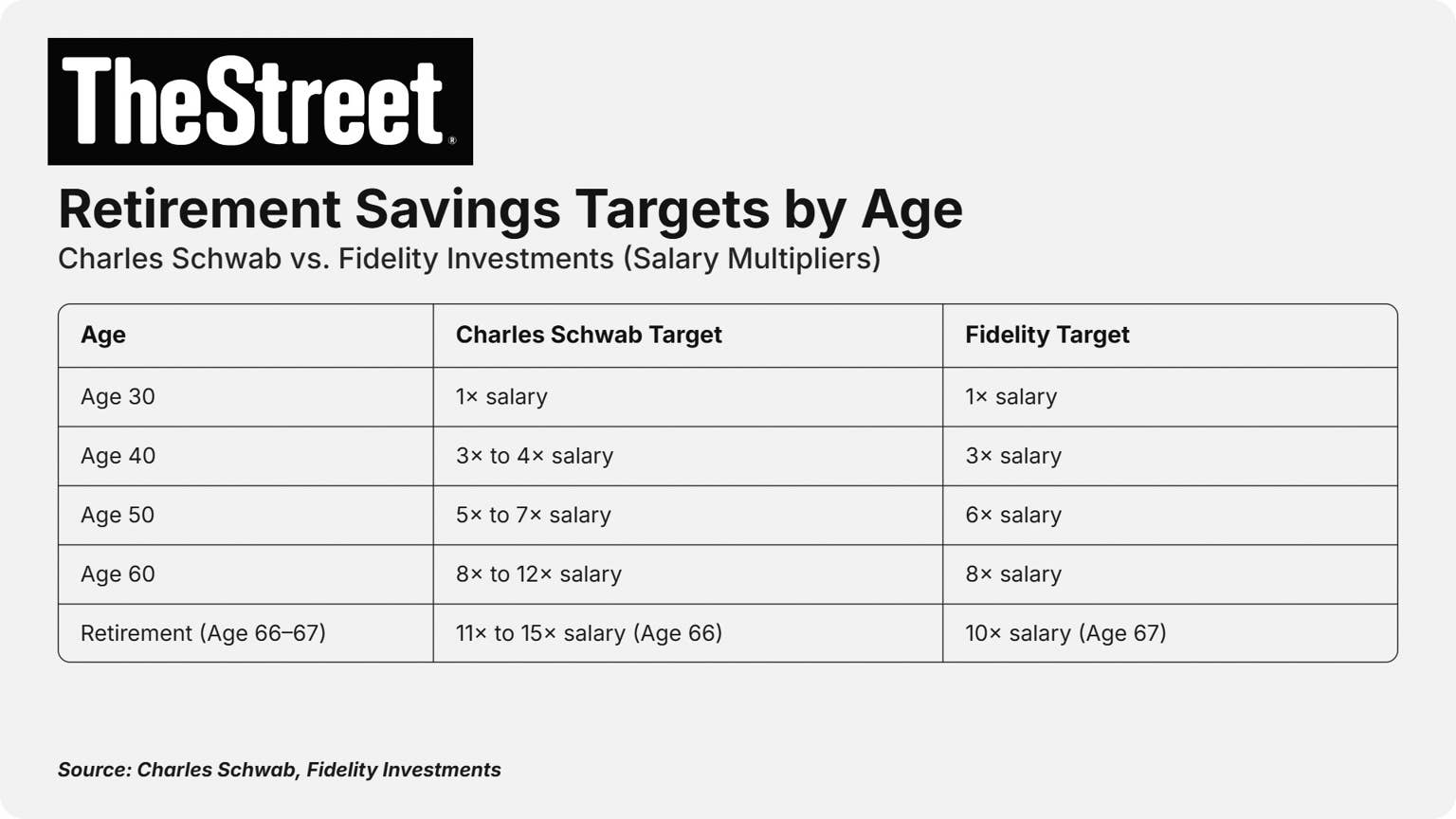
To measure progress across those decades, Schwab sets wide salary-multiplier ranges for your 401(k) and related savings: 1 times annual income at age 30, 3 to 4 times at 40, 5 to 7 times at 50, 8 to 12 times at 60, and 11 to 15 times by age 66.
Charles Schwab, Fidelity Investments
Fidelity sets lower, fixed 401(k) savings checkpoints
Fidelity Investments uses a similar salary-multiplier framework to gauge 401(k) readiness, but its math produces a noticeably lower finish line — and relies on a steady, flat savings rate from the start of a worker’s career, with less emphasis on ramping up in later decades.
“Fidelity’s guideline: Aim to save at least 1x your salary by 30, 3x by 40, 6x by 50, 8x by 60, and 10x by 67,” Fidelity wrote.
Fidelity’s targets assume a worker saves 15% of their income annually in a 401(k) or similar account starting at age 25, including employer matches, holds more than half of their portfolio in stocks over their lifetime, and retires at age 67.
More Retirement:
- Annuities can be a retirement safety net to prevent outliving savings
- Vanguard flags a retirement fear built into 401(k) plans
- Suze Orman has a serious retirement warning for 2027
“These milestones are aspirational. You likely won’t meet all of them,” Fidelity noted. “But they can serve as goalposts to help you make a plan to save enough to maintain your lifestyle in retirement.”
Where Schwab builds a wide 11-to-15-times band at age 66 to account for high earners and big spenders, Fidelity treats 10 times income at age 67 as its baseline — adjusting down to 8 times for frugal retirees or those who work until 70, and up to 12 times for early retirees at 65 or heavy travelers.
Vanguard skips salary multiples for savings habits
Vanguard takes a different tack altogether, steering clear of prescriptive age-by-age salary multiples and focusing instead on consistent annual 401(k) contribution rates and individual retirement spending needs.
“Vanguard’s general rule of thumb suggests saving 12% to 15% of your pay each year for retirement, including any employer contributions,” Vanguard wrote.
Rather than measuring savers against aspirational salary multiples, Vanguard benchmarks actual 401(k) participant balances from its How America Saves data — which show a median balance of $88,488 and an average balance of $272,588 for savers age 65 and older — while urging workers to calculate their own post-retirement expenses.
“The good news is that you don’t need to figure everything out right now. The most important thing to do is get started,” Vanguard added.
Related: Vanguard, Fidelity hold opposing views on 401(k), IRA choice