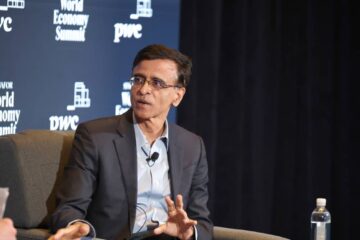
Jensen Huang spent 33 years building Nvidia into the company at the center of the artificial intelligence industry, but his departure unfolded within days.
The board accepted his resignation on Nov. 11, 2026, following allegations of personal conduct and foreign intelligence concerns that prompted an independent investigation, according to Nvidia’s 8-K filing.
Chief Financial Officer (CFO) Colette Kress became interim Chief Executive Officer (CEO), while Harvey C. Jones took over as board chair.
The leadership shake-up came as Nvidia was already shedding roughly $1.59 trillion in shareholder wealth, with shares down about 30% from their recent high, Axios reported.
Huang’s departure also highlights a wider pattern, with six other publicly traded companies losing their top executives over controversies since 2018.
Also Read: Jensen Huang sends bold message to Nvidia shareholders
Intel’s Krzanich set the semiconductor precedent for Nvidia
Nvidia’s leadership crisis has a close historical parallel at Intel, where a similar controversy forced the semiconductor giant to replace its chief executive eight years earlier.
Intel’s Brian Krzanich resigned in June 2018 after the company confirmed his consensual relationship with an employee violated its workplace relationship policy.
Krzanich had led Intel since 2013 and joined the company as an engineer in 1982, making his departure a significant leadership change. His resignation left Intel searching for a permanent replacement, while Chief Financial Officer Robert Swan stepped in as interim chief executive.
Both Krzanich and Huang led major semiconductor companies when personal conduct issues threatened their leadership, and neither company had a designated successor ready.
In both situations, the boards responded quickly by turning to their chief financial officers to provide temporary leadership during the transition.
Intel’s shares initially remained relatively stable after Krzanich resigned, but the company later struggled to maintain its competitive position against rivals.
Nvidia now faces a similar leadership challenge, with no publicly identified successor and an important earnings report approaching just days after Huang’s departure.
From Nestlé to BP, five more leaders fell to conduct and disclosure failures
Nestlé dismissed Laurent Freixe as CEO in September 2025 after finding his undisclosed relationship with a direct subordinate violated its code of conduct.
Freixe received no exit package after exactly one year as CEO, making his ouster the second time in 12 months that the Swiss food giant lost its top leader, Reuters reported.
Kohl’s fired CEO Ashley Buchanan on April 30, 2025, after finding he directed vendor transactions involving an undisclosed conflict of interest, its 8-K filing confirmed.
Buchanan lasted fewer than four months, was required to reimburse Kohl’s for a pro rate portion of his $2.5 million signing incentives, and had been the retailer’s third CEO in three years, AP News reported.
More CEO Exits:
- Air Canada CEO stepping down amid language scandal
- Home Depot hands CEO job to Richard McPhail as shares dip
- Jensen Huang eyes Nvidia return as board faces investor pressure
Norfolk Southern fired Alan Shaw as CEO for cause in September 2024 after his consensual relationship with the company’s chief legal officer violated corporate policy, the railroad noted in an SEC filing.
Comtech Telecommunications terminated Ken Peterman six months earlier, and the SEC later charged him with insider trading for selling stock during a blackout period.
BP’s Bernard Looney resigned in September 2023 after acknowledging that he had not been fully transparent about past relationships with company colleagues.
A subsequent investigation found Looney had knowingly misled the board, leading to his formal dismissal and the forfeiture of about £32.4 million ($41 million) in total remuneration, the company announced.

Personal misconduct has become the leading cause of CEO departures
Research from the University of Denver examined nearly 400 CEO scandals and found that personal misconduct has steeper consequences than financial fraud for the executives involved.
Most leaders facing allegations of personal misconduct were terminated swiftly, and the episodes frequently ended their careers.
Michael Nalick, an Assistant Professor at the University of Denver, told the university that boards need to look beyond operational competence when selecting executive leadership.
<strong>They really need to vet these CEOs to make sure that not just are they competent but moral,</strong>
The trend has accelerated sharply across corporate America, with outplacement firm Challenger, Gray & Christmas counting 17 misconduct-related CEO exits through September 2026, up from five in all of 2025 and more than double the eight recorded in 2024, the firm reported.
Andy Challenger, the firm’s chief revenue officer, said that executive personal conduct is “not just a question of romance or morality anymore.”
He warned that “when the CEO of the most valuable company in the world is tied to a counterintelligence investigation because of a personal relationship, every board in America should be paying attention.”
What 7 CEO departures reveal about corporate governance risk
When some of these CEOs left, their companies lacked formal succession plans, forcing boards to appoint temporary leaders while searching for permanent replacements.
Kohl’s faced a different governance problem, as its board failed to identify Buchanan’s conflicts before appointing him, SEC filings indicated.
At BP, the departure of Looney exposed weaknesses in how the company checked executive disclosures, with a deeper investigation uncovering information a 2022 review had missed, the company disclosed. That failure prolonged leadership uncertainty for more than a year, raising questions about whether stronger board oversight could have prevented the disruption.
Despite these governance problems, several of these companies reported strong financial performance around the time of the departure, making the warning signs less obvious to investors.
However, Challenger’s data suggests investors can identify governance risks by examining board oversight and succession planning alongside financial performance.
Related: Micron CEO’s Nvidia message comes with warning for 2027