Consumers love loyalty programs.
They also seem to love Trader Joe’s and Aldi, two major national retailers that don’t offer loyalty programs.
It’s not an accident at either chain.
Matt Sloan and Tara Miller, who were both on the marketing team for the chain, explained their skepticism of membership perks during a 2023 episode of the “Inside Trader Joe’s” podcast.
“Trader Joe’s is focused on reducing costs for customers, not investing resources into a loyalty program that might only amount to some ever-elusive discount on something I probably didn’t want in the first place,” Sloan shared.
Aldi once mocked the concept of memberships, sending out an announcement touting “a free ALDI+ program and a crown jewel membership with perks like USDA quality meat, fresh produce, and premium, budget-friendly wine, Progressive Grocer reported.
“We’re only kidding, unlike other retailers, exclusive memberships aren’t an ALDI thing,” the company shared.
New data from U.S. Grocery Shopper Trends 2026: Holidays, released by FMI, The Food Industry Association, suggests that Aldi and Trader Joe’s might be making a mistake.
Consumers want loyalty programs
“Loyalty programs are delivering exactly what shoppers need right now: everyday savings that help them stay on budget without giving up the holiday meals they love,” FMI CEO Leslie G. Sarasin said. “The opportunity ahead is making sure all shoppers, especially those in lower-income households and younger consumers, know these savings are available and find them easy to use.”
Here are some of FMI’s key findings on loyalty programs.
- Shoppers see them as essential. 72% strongly or somewhat agree that their primary store’s loyalty program is essential to helping them save money on groceries and stay within their budgets.
- Members find real value. 71% of shoppers have joined the loyalty program at their primary store when one is offered, and 95% of members find their program at least somewhat valuable (74% extremely or highly valuable).
- Savings are the top benefit. The most valued benefits all help shoppers save money: general everyday savings and discounts (95% find at least somewhat valuable), personalized savings and discounts (91%), points to use on a variety of items (90%), and gas savings or points (86%). General everyday savings are also the most frequently used benefit.
- Loyalty members enjoy shopping more. Shoppers who see their loyalty program as essential rate their primary store higher (85% vs. 79%) and are more likely to love or like grocery shopping (50% vs. 37%).
- Demand outpaces availability. Among shoppers whose primary store does not offer a loyalty program, 68% are extremely or very interested in having one.
It’s easy to see why Aldi and Trader Joe’s don’t have loyalty programs, but both companies are making a mistake.
People like to feel like they’re part of something, and Aldi and Trader Joe’s already have cult-like followings. They could build loyalty in a way that rewards members without a complicated discount plan.
Either chain could offer merchandise (special tote bags would work for Trader Joe’s) or other tokens to show loyal customers they are valued. A bonus holiday shopping hour, or even a free cup of coffee or other minor perks, could enhance the bond between these chains and their customers.
More Retail:
- Struggling home goods chain closing more stores
- Verizon makes changes to be more like T-Mobile used to be
- Home Depot drops generous offers as customers grow harder to win
It might also make sense for Aldi or Trader Joe’s to offer their best customer a simple added discount — maybe 1% off — if they hit a certain threshold.
As someone who used to run a very popular independent toy store, we gave top customers a discount, but they actually seemed to respond better to non-cash perks. Things like barbecues and other by-invite events went as far as offering lower prices in many, but not all, situations.
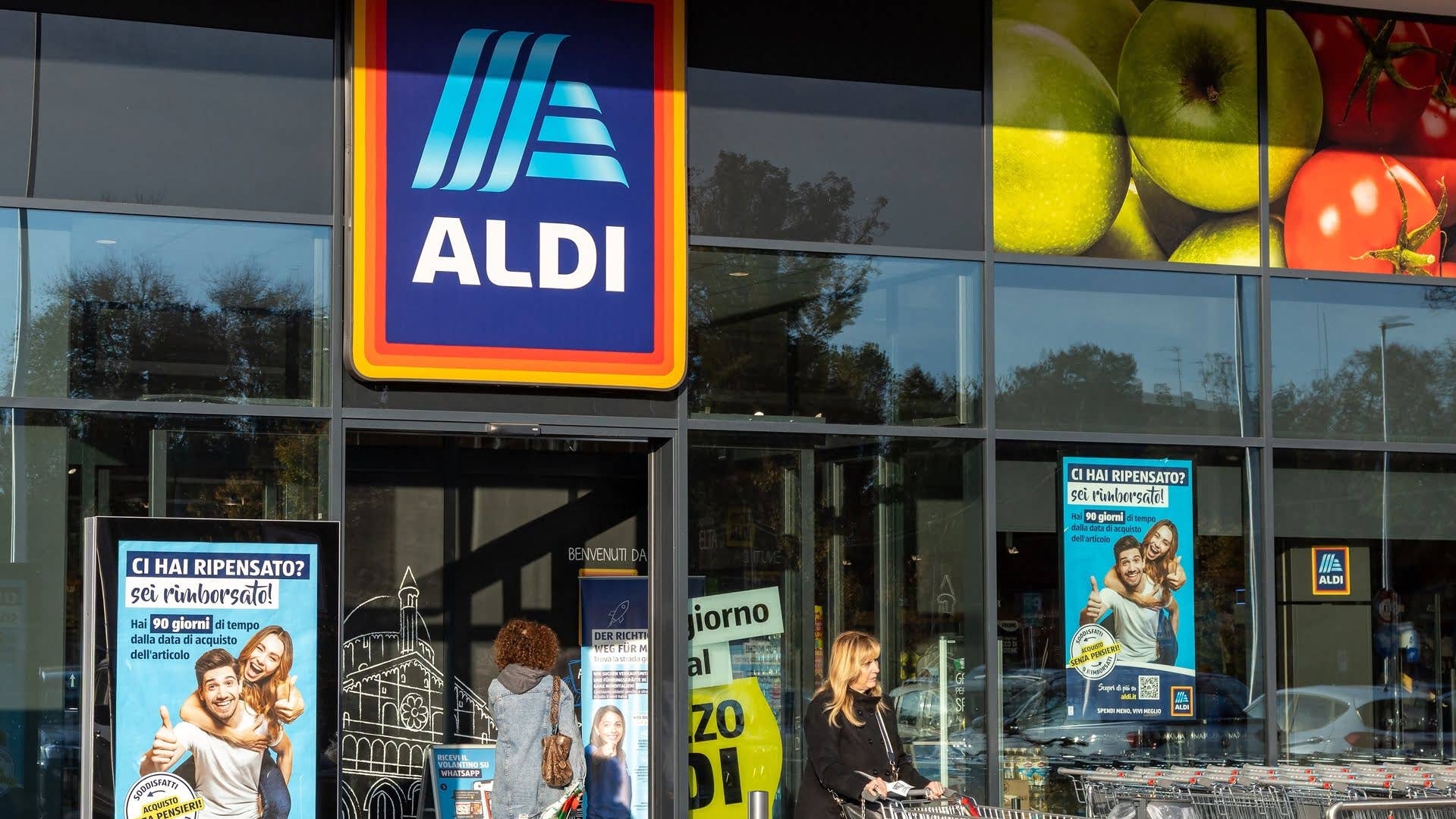
Shutterstock
Aldi and Trader Joe’s are outliers
RTM Nexus CEO Dominick Miserandino thinks Trader Joe’s doesn’t need a loyalty program, but he’d still like to see the company add one.
“I’m actually not sure if Trader Joe’s needs any more loyalty than the paper brown bags and the other branding. Trader Joe’s has such a unique product that people become fans of it because of what it offers,” he told TheStreet.
That doesn’t mean the chain might not do well if it added one.
“It might be interesting to see it have a loyalty program, but it’s kind of amazing how they’ve done it basically a master class in how to get people loyal to a brand,” he added.
For Aldi, a loyalty program would be counter to its overall brand positioning, GlobalData Managing Director Neil Saunders shared.
“Aldi’s biggest strength is its price leadership. It’s a key point of difference in the market and part of its promise to consumers. It’s what Aldi is known for,” he told Frozen & Refrigerated.
“However, Aldi deepens this by delivering value. It’s not just one of the cheapest retailers; it also tries to provide great products and a pleasant shopping experience.”
One loyalty lesson all retailers need to remember
While not having a loyalty program may hurt a chain, taking away discounts, even if it’s under the guise of lowering all prices, has historically been a disaster.
“In 2011, JCPenney tried to do the logical thing. They hired the genius behind the Apple Store, Ron Johnson, and got rid of every coupon, gimmick, and fake sale in the store. The result? A freefall that almost burned the company to the ground,” CaseHQ reported.
Time magazine explained why the move failed.
“Johnson thought it made sense to cut to the chase by listing realistic prices from the get-go and foregoing nonstop sales. It does make logical sense, after all. But shoppers aren’t purely logical creatures. They’re often drawn to stores not by the promise of fair pricing, but by the lure of hunting for deals via coupons and price markdowns,” Time shared.
Consumers, it noted, like the illusion of feeling like they have saved.
“It’s all a game, and a contrived one at that. But it’s a game that shoppers are accustomed to playing, and that many — consciously or not — like playing, with the “How Much You Saved” line at the bottom of the receipt serving as a score,” Time added.
Before its bankruptcy, Bed Bath & Beyond tried something similar and scaled back its famous coupons. The results were similar.
“We just took too severe action…. So I think what we want to do is just rebalance that equation. Coupon is a great tool for customer engagement and traffic. It’s not a drug, it’s an opportunity. We just need to manage it better. And so we kind of need to create the balance in that. So still committed to coupon as a strategic advantage in our business,” former CEO Mark Tritton said during the chain’s third-quarter earnings call in 2021.
Related: Forget Kroger, Target and Best Buy moved thousands of jobs to India