Millions of American families are watching their grocery bills climb while their stock portfolios wobble this holiday season. The prospect of another interest-rate hike hits very close to home if short-term borrowing costs on credit cards and private student loans increase.
Financial markets are increasingly betting that the Federal Reserve will raise interest rates again in December to cool persistent inflation, especially if the October Personal Consumption Expenditure price index comes in hot on Nov. 25.
A high PCE, the Fed’s preferred inflation gauge, will all but cement another rate hike at the Fed’s last meeting of the year, and perhaps even forewarn of additional hikes in early 2027.
But billionaire hedge fund manager Bill Ackman is warning that the Fed is poised to push the U.S. and the global economies into a recession if policymakers persist in raising interest rates to chase its 2% inflation target.
In a recent X post, the Pershing Square CEO argues that financial conditions have already tightened “massively.”
Citing SpaceX as an example, Ackman said fellow billionaire Elon Musk’s investment-grade company noted that it recently raised secured debt financing at an 8.259% interest rate, compared with below 6% for its unsecured bond offering at its initial public offering.
Equity capital has also grown more expensive amid raucous stock market volatility, Ackman said.
“The Fed will put the U.S. and world in recession if it continues to raise rates in a failed attempt to drive inflation to 2%,’’ Ackman said in the Nov. 22 post.
It should be noted that monetary policy alone can’t lower inflation, especially shocks caused by fiscal policies like this year’s tariffs and Iran war. But higher rates can help drive the price-stability side of the Fed’s dual mandate.
Ackman: More Fed rate hikes could push economy into recession
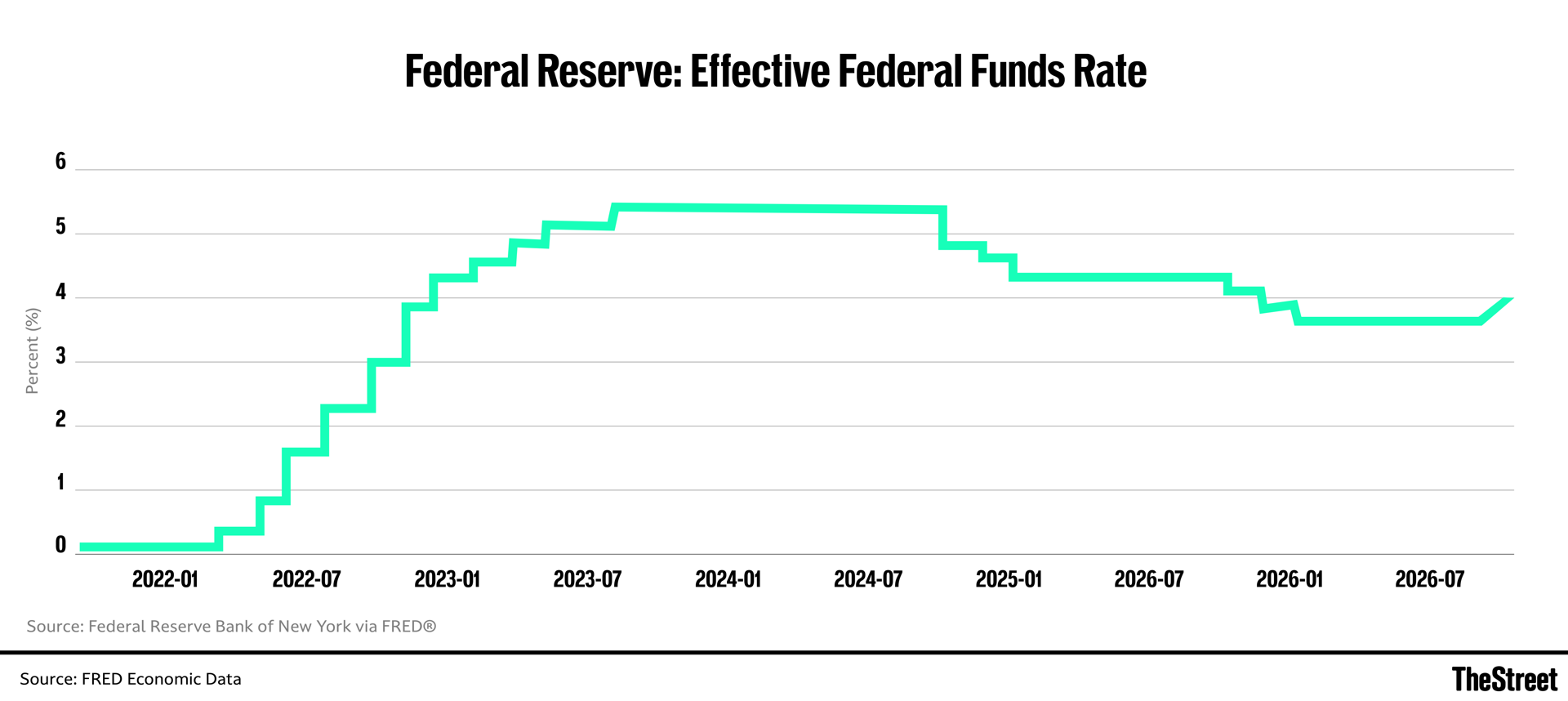
The CME FedWatch Tool has futures traders pricing in a near-100% probability that the Federal Open Market Committee will vote to raise the benchmark federal funds rate by a quarter point to a range target of 4.0% to 4.25% at its Dec. 8-9 meeting, following a pause in October.
Wall Street banks, including giants J.P. Morgan, Bank of America, and Deutsche Bank, are also calling for a quarter-point hike in December plus additional quarter-point increases in January and March due to sticky inflation from tariffs, the Iran war energy shock, and the AI demand-supply dynamic.
Ackman said the Fed’s 2% inflation target, which it has missed for nearly six years, is outdated in an era shaped by geopolitical risk, rising global military spending, deglobalization, tariffs, and massive investments in energy and AI infrastructure.
A more realistic target for the U.S. central bank is 3%, he said, adding that continued increases in the benchmark federal funds rate would spark a downturn.
Note: Ackman has a personal stake in lower rates, which could lift the prices of stocks he holds, including Microsoft and Netflix, as well as SpaceX.
TheStreet
Fed officials voice a definite hawkish shift due to sticky inflation
Ackman’s warning came the same day Treasury Secretary Scott Bessent criticized the recent hawkish comments from multiple Fed officials, who expressed concerns about persistent price pressures. Bessent warned that policymakers could make a mistake by overtightening.
Fed Chairman Kevin Warsh vowed before and after taking over the role in May that price stability is the independent central bank’s top commitment.
Four Fed governors — Vice Chair Philip Jefferson, Michael Barr, Lisa Cook, and Christopher Waller — signaled decidedly hawkish tones recently, expressing that further tightening of policy was necessary to bring inflation back to its 2% target.
President Donald Trump and his allies have repeatedly called for lower interest rates of 1% or less for years, with the president blasting the independent Fed’s most recent actions as political retribution, the Times of India noted.
The president has said the lower rates will help the depressed U.S. housing market plus reduce the interest the government pays on its $40.71 trillion debt.
Related: Nvidia’s stunning comeback delivers new shock to Fed rate-hike bets
The Fed made three quarter-point cuts during its last three meetings of 2025 to stabilize the softening labor market. Those “insurance” cuts need to be reversed, as inflation data shows higher prices not only in energy, but also broadening into other sectors, including services, the Fed’s hawks say.
And New York Fed President John Williams, a voting member of the FOMC, said Nov. 23 that the central bank “has work to do” to cool inflation and achieve its 2% target in 2028.
“We must take actions over time that will ensure that we get inflation back to our 2% goal in a timely manner and on a sustained basis,” Williams said in prepared remarks.
October PCE estimates show inflation ticking up
The Cleveland Fed estimates that October 2026 headline PCE will be 3.81% year over year and that core PCE inflation will be 3.21% year over year or 0.27% month over month.
The September PCE rose 3.6% year over year with core PCE at 3.1%. The October Consumer Price Index rose 0.4% month over month after a 0.6% gain in September. Core CPI, excluding food and energy, increased 0.3% for the third straight month.
The FOMC held its benchmark rate at 3.75% to 4% in a divided 10-2 vote in October, with minutes released Nov. 18 showing several participants calling the pause a “close call.” Both dissenters favored a quarter-point increase to combat inflation.
Looking past December, futures traders continue to price in tightening momentum into early 2027, including a probability of a roughly 68.9% cumulative hike at the Jan. 27 meeting and a 55.6% probability of another one at the March 17 meeting.
Related: J.P. Morgan prices in stunning shift in Fed rate-hike call