Costco has a famously liberal return policy.
There are exceptions, like electronics and events, but the warehouse club will take back almost anything. That has led to members bringing back everything from used furniture to clearly worn clothes, and produce that has gone bad because it’s so old.
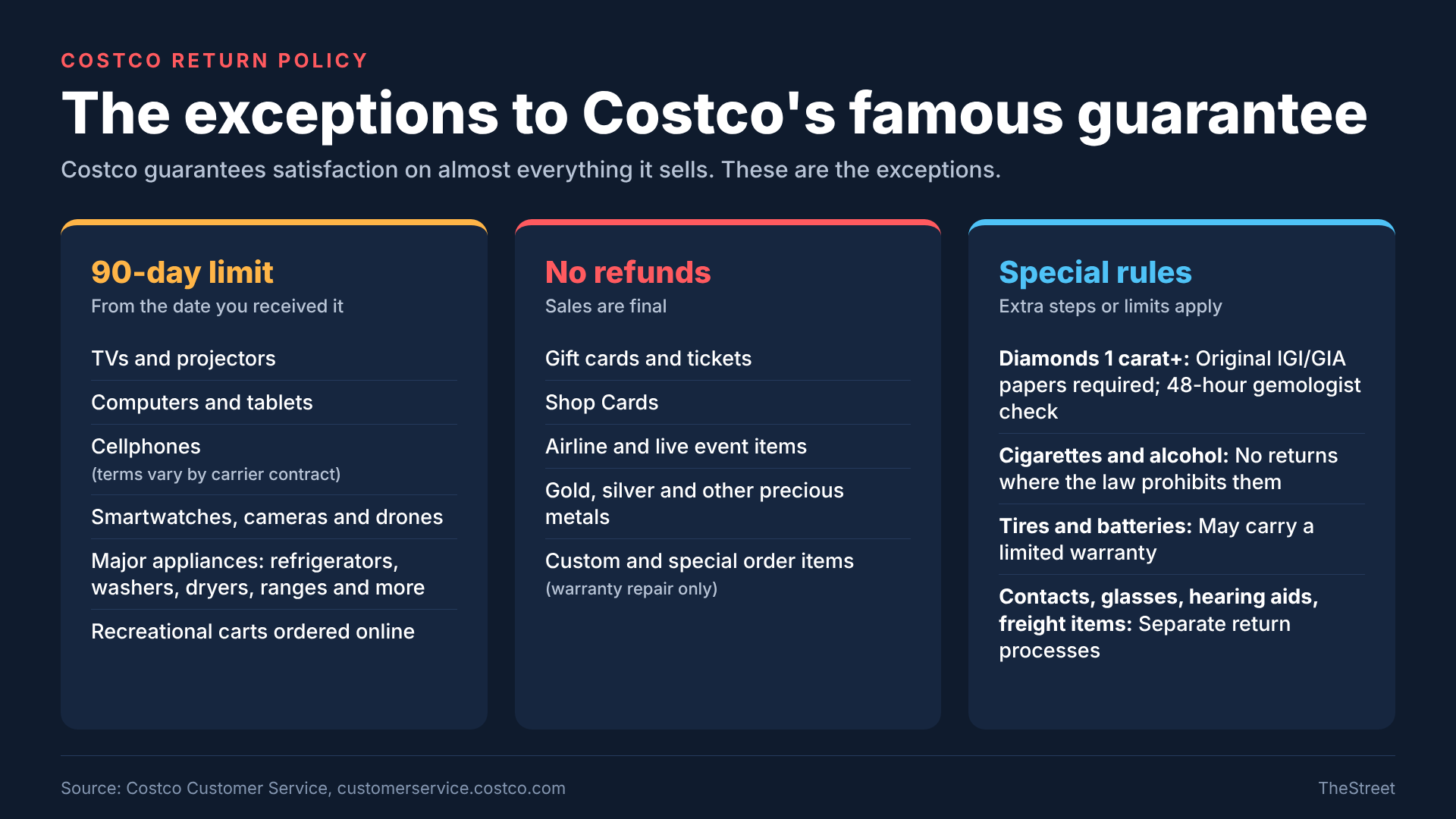
The retailer doesn’t really spell out the policy on its website, but offers some broad directions.
“Products purchased at a Costco location need to be returned at the returns counter at any Costco warehouse. Items ordered online can be returned at any Costco warehouse -or- you can initiate a return through Costco.com,” the company shared.
It also offers a pretty broad assurance.
“We guarantee your satisfaction on every product we sell and will refund your purchase price,” the company added.
There are many exceptions like electronics, tickets, and travel, but most physical merchandise can be returned with no time limit and no questions asked.
That’s great for members, but challenging for Costco’s vendors because the warehouse club’s vendors actually carry the cost of its returns.
One of those vendors, Toronto rug manufacturer Amskor Corp., has sued Costco over its policy, alleging that the chain’s willingness to take items back has pushed it to the brink of bankruptcy.
Shutterstock
Costco has leverage with vendors
Shelf Strategy, a retail consultant, wrote about Costco’s returns policy and how some members see it on Substack.
“Have you ever stood in line at Costco waiting to return an item and heard someone talk about how awesome it is that Costco will take back anything? They might even boast about beating the system by returning a vacuum for the third time,” they wrote.
And while the post acknowledges that the number of people brazenly bringing back used items to simply replace them is small, Shelf Strategy also noted that few people realize that the vendors, not Costco, carry the cost of those returns.
“Guys, there is no special math here. No wizardry that allows Costco to offer value, accept returns, and provide exceptional member service all at the same time. It is their business model, and as a vendor, you can either make it work or you can’t,” they added.
More Costco:
- Walmart takes aim at Costco with a new shopping perk
- Aldi cuts prices in a move that could pressure Costco
- Costco makes a seasonal food court change
The company offered clear advice to any vendor considering working with Costco.
“In the Costco programs I’ve worked on, vendors bear the cost of returns. You need to understand exactly what your agreement requires and account for that cost before you commit. Leaving returns out, or assuming they will match your current return rate, can be the difference between making money and losing it,” they wrote.
That’s a lesson Amskor Corp. may not have taken fully to heart.

Rug maker sues Costco
Amskor Corp. has been working with Costco for around a decade.
Now, the company has filed a lawsuit in an Ontario court against the warehouse club.
“They preach that they are really loyal to their vendors and everything and we really, truly believed it, but our experience tells us that it’s really nothing more than marketing,” Saeid Korhani, a third-generation carpet salesman who’s been in the industry for 44 years, told CTV News.
The lawsuit alleges that Costco’s return policy has put its entire business at risk.
“The claim, a clear example of how commercial contract litigation can unfold between suppliers and retailers, seeks about $9 million in damages for breach of contract, negligent misrepresentation and unjust enrichment. None of the allegations have been tested in court,” UL Lawyers shared.
In the lawsuit, the company shared that it was selling the rugs to Costco well below its normal wholesale rates.
“The company says its production facilities in Turkey could only supply rugs at or near cost if Costco sold high volumes and did not process a high number of returns,” according to UL Lawyers.
Returns, however, became a large problem.
“Amskor claims Costco led it to believe returns would stay within a manageable range of about four to five per cent, and asked it to open a West Coast distribution center in Vancouver to support the expanded business. The company also alleges Costco never disclosed the specifics of a return program Amskor now describes as ‘limitless,’ the law firm shared.
Costco pushed the return cost to vendors
“When products are returned, Amskor alleges that Costco charges suppliers by subtracting the value of returns from payments owed. The retailer then chooses — often without suppliers knowing — whether to restock, discount or dispose of the products brought back,” the company’s statement of claim said.
Costco can make vendors accept those terms because doing business with the warehouse club can be a game-changer for a business, and the company’s limited selection makes it very hard to get shelf space.
“The curation is intense. Costco carries around 3,700 SKUs per warehouse. The average grocery store? Over 30,000. Their buyers aren’t just selective. They’re looking for reasons to say no,” retail writer Lucas Ballasy wrote.
A deal from Costco can be impossible for a vendor to turn down.
“The most immediately visible dimension of the Costco effect is revenue. A single Costco placement, even at a regional or limited number of locations, can generate sales volume that dwarfs what most emerging brands achieve through all of their other channels combined,” Mojo Sales and Branding wrote.
The returns policy, however, can turn that dream into a nightmare.
It cuts into the already thin profit margins Costco leaves its vendors, according to Amskor.
“The company alleges it has had to close two distribution centers and cut staff because the supplier and return terms became untenable. Its head said the company had genuinely believed Costco’s message about vendor loyalty, but its experience has led it to see that message as little more than marketing,” UL Lawyers shared.
Costco and its lawyers did not respond to requests for comment and have not filed a statement of defense.
The warehouse club is pushing for the case to go to arbitration “instead of being heard by the courts, saying the lawsuit was improperly launched because both sides had contractually agreed to arbitrate disputes arising from their contract.”
Costco’s return policy is good for Costco
“Costco’s return policy takes a lot of the anxiety out of buying something expensive—or something you’re just not sure about. You know that if it doesn’t work out, Costco isn’t going to make you feel like you’re appearing before a parole board just to return it,” RTM Nexus CEO Dominick Miserandino told TheStreet.
The warehouse club gets to make its members feel better while passing the consequences on to its vendors.
“That kind of trust is a real membership benefit. People may occasionally abuse a generous policy, but Costco understands that making millions of loyal members feel comfortable buying is worth far more than winning every argument at the returns counter,” he added.
Related: Walmart bets shoppers won’t notice its holiday price increases