After months of market expectations of rate cuts this year, Federal Reserve Governor Christopher J. Waller signaled a major hawkish shift and warned that the U.S. central bank may need to raise interest rates due to the inflation risks from the Iran War.
The central bank’s current “wait-and-see” approach to holding rates steady is appropriate for now, but Waller said he expects longer term tightening may be necessary for the U.S. economy if supply-shock inflation doesn’t prove transitory.
“I can no longer rule out rate hikes further down the road if inflation does not abate soon,” Waller said in May 22 prepared remarks for a central banking conference in Frankfurt, Germany.
Waller said the Fed’s current stance keeping the benchmark Federal Funds Rate steady is appropriate until the true impact of the Iran War on U.S. inflation becomes more focused.
“Inflation is not headed in the right direction,” Waller said, adding that high oil prices could dissipate quickly pending the length of the Middle East.
Bond yields rattled by inflationary shocks from Iran War
The bond market, as I’ve reported, has been preparing for higher inflation risks since the Iran War began in late February.
The yield on the two-year Treasury note was trading near 4.08% on May 22. The benchmark 10-year Treasury note yield had eased slightly to 4.55% and the 30-year Treasury bond yield was hovering around 5.08% — its highest level since the late 1980s.
Economists and markets are not forecasting any rate cuts for this year, a sharp reversalfrom their pre-war expectations at the beginning of 2026.
Following Waller’s remarks, traders hiked bets for higher interest rates by next year.
The widely watched CME Group FedWatch Tool priced the probability of a 25-basis-point rate hike at 43% at the Federal Open Market Committee meeting in December.
“If I believe inflation expectations start to become unanchored, I would not hesitate to support an increase in the target range for the Federal Funds Rate,’’ Waller said. “But at this point that action is premature.”
Fed’s mandate requires a tricky balance
The Fed’s dual mandate from Congress requires maximum employment and stable prices.
- Lower interest rates support hiring but can fuel inflation. This risks fueling further inflation, potentially leading to an inflationary spiral.
- Higher rates cool prices but can weaken the job market. This increases the cost of borrowing and further stifles economic activity.
Fed holds rates steady in historic April vote
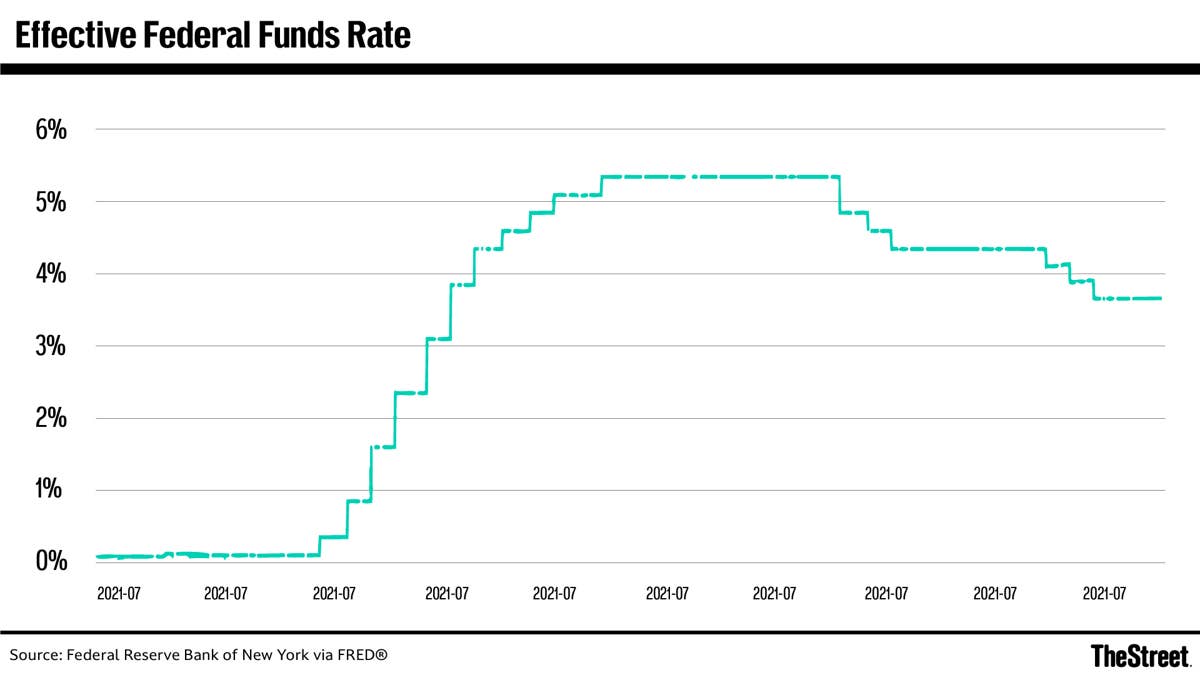
The FOMC, in a decisive 8-4 vote on April 29, held the benchmark Federal Funds Rate at 3.50% to 3.75%.
It was the first time in more than 30 years the FOMC vote reflected four dissents.
It was the FOMC’s third pause after cutting rates by 75 basis points during its last three meetings of 2025 to boost a weakening labor market.
Outgoing Fed Governor Stephen I. Miran voted against the “wait-and-see” approach, preferring to lower the target range for the funds rate by 25 basis points.
Cleveland Fed President Beth M. Hammack, Minneapolis Fed President Neel Kashkari, and Dallas Fed President Lorie K. Logan also dissented, citing the post-meeting’s statement for not including language that supported “inclusion of an easing bias in the statement at this time.”
Fed April FOMC minutes show strong hawkish interest-rate shift
But the minutes of the April FOMC meeting, released May 20, showed an even more hawkish shift from policy markers with rising concerns about inflation risks.
- “A majority of participants” highlighted…that some policy firming would likely become appropriate if inflation were to continue to run persistently above 2%.
- As a result, “many participants indicated” that they would have preferred removing the language from the postmeeting statement that suggested an easing bias regarding the likely direction of the committee’s future interest-rate decisions.
The minutes do not mention the names of the 19 participants.
Inflation data reflects real-time energy shocks
U.S. consumer sentiment fell in May to a record low and long-term inflation expectations worsened notably due to the Iran War, according to the University of Michigan’s final May sentiment index released May 22.
Economists are broadly forecasting that the April Personal Consumption Expenditures inflation report — the Fed’s preferred inflation gauge due May 28 — will remain elevated and reinforce expectations that the central keeps the benchmark Federal Funds Rate higher for longer.
The Bureau of Labor Statistics on May 13 said the April Producer Price Indexjumped 6%, the biggest year-over-year increase since 2022.
Related: Morgan Stanley resets Fed interest rate cut path for 2027
The April Consumer Price Indexalso came in hot May 13, jumping to 3.8% on a year-on-year basis, outstripping workers’ earnings for the first time in three years and marking the highest inflation print since the post-pandemic recovery in May 2023.
Despite the rising energy costs fueled by the Iran War, U.S. employers added more jobs than expected for a second month in April and the unemployment rate held steady at 4.3%, the Bureau of Labor Statistics reported.
“Fortunately, the labor market seems to have stabilized in recent months, and while it could be negatively affected by higher prices, unless it dramatically deteriorates, I do not expect it to be a major factor driving my view of the appropriate stance of monetary policy in the near term,’’ Waller said.
Waller noted inflation’s sticky path in last 13 months
Waller said inflation was within a quarter percentage point of the Fed’s 2% target in April 2025, “before tariffs moved inflation in the other direction.”
Inflation has not been at the 2% level in five years, mainly due to shocks from the pandemic.
Waller said “that fact raises the risk that the recent escalation of inflation that we are experiencing ends up unanchoring expectations of future inflation.”
“While I am not predicting this and I don’t believe it is likely, it is a risk I cannot dismiss and one that I must consider in weighing policy decisions,’’ he added.
June FOMC meeting expected to hold rates steady
The next FOMC meeting is June 16-17 and will be the first with Kevin Warsh as Chair.
The CME Group FedWatch Tool has a near 100% probability that the central bankers will vote to hold rates steady then.
“The next move, whether it is a hike or cut, will depend on the data,’’ Waller said, adding that either option at this point is “premature.”
“Waller’s latest remarks confirm the hawkish shift at the Fed,” Evercore ISI head of economics and central bank strategy Krishna Guha said in a note reported by Bloomberg. “His discussion of inflation was across-the-board hawkish.”