Billionaire investor Ray Dalio just spoke his mind on one of the most pressing issues facing the U.S. economy.
The founder of Bridgewater Associates warned in a recent interview with Bloomberg that the country’s ballooning debt load is getting increasingly difficult to reverse.
He argues that as debt-servicing costs begin to compete sharply with other government priorities, the problem begins to reach far beyond Washington.
For years, investors have simply accepted that arrangement, and Dalio argues that the math is becoming virtually impossible to ignore.
For context, the U.S. national debt is currently about $39.20 trillion, according to the latest Treasury data.
Over the past five years, total U.S. public debt has skyrocketed from nearly $28.53 trillion in Q2 2021 to about $39.2 trillion today, an increase of $10.67 trillion, or 37.4%.
That said, his warning comes at a point when markets are still fixated on AI, earnings, and the Federal Reserve policy.
Regarding the Fed’s policy, I recently reported that Goldman Sachs cautioned against expecting early rate cuts, arguing that meaningful developments may not come until the end of the year.
Nevertheless, Dalio’s warning is far more urgent, centering on an economic issue that could potentially trigger a wide-ranging collapse.
Who is Ray Dalio?
Billionaire Ray Dalio earned his chops the hard way.
The legendary investor founded one of Wall Street’s most credible hedge funds, Bridgewater Associates, in 1975, shaping it into a global macro giant.
In his illustrious 47-year run, he served as CEO, CIO, and Chairman, among other major roles, overseeing assets under management of more than $92 billion.
More AI:
- Micron sits at the center of a red-hot chip rally
- IBM CEO sends blunt message on AI and quantum computing
- Anthropic CEO makes shocking admission about AI
Mind you, Forbes estimates Dalio’s personal fortune at nearly $15.4 billion.
However, Dalio has since stepped away from Bridgewater, with his departure taking place in stages. Dalio ended his term as CEO in 2017, then gave up his chairman and co-CIO roles between 2021 and 2022, Reuters indicated. In 2025, Reuters reported that Dalio sold his remaining stake in Bridgewater, marking the final step in his exit from the hedge fund he had built.
These days, he is more of a market statesman, sounding the alarm on the economy, AI, gold, debt levels, and other major risks impacting investors.
Heck, Dalio was even working on an AI clone of himself, hoping to educate the next generation of investors.
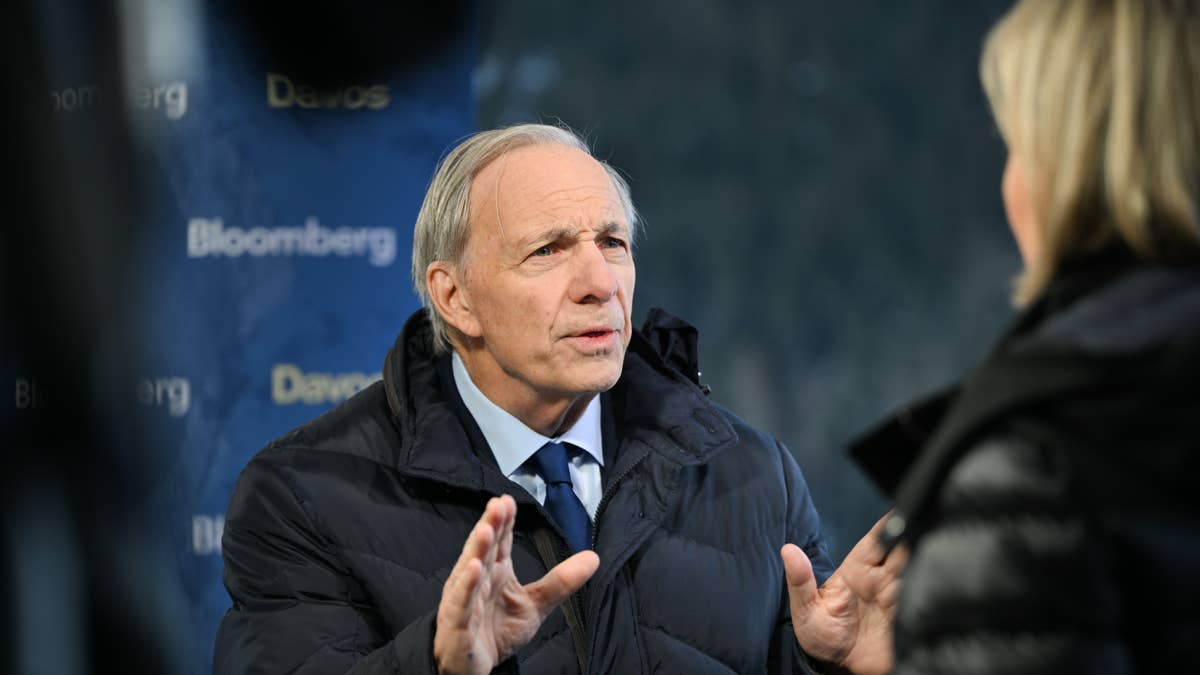
Dalio warns the U.S. debt problem is getting harder to solve
Dalio believes the U.S. has effectively entered a dangerous debt-service trap.
The government is shelling out $7 trillion while collecting just $5 trillion in revenue, he said, leaving a financing gap that must be covered by more debt.
“We’re past the point of no return, meaning when debt service payments squeeze out spending, like plaque in the circulatory [system] squeezes out the flow of money, the flow of blood, it’s the same kind of thing.”
The first part of the conundrum is that the U.S. needs to issue more bonds. At the same time, though, investors will demand higher returns to continue buying them.
Dalio feels this is more of a supply-and-demand problem.
Bigger deficits signal greater Treasury supply. However, if buyers do not see attractive returns, they might avoid holding those bonds. As he puts it, “one man’s debts are another man’s assets,” and those assets will have to offer enough compensation after accounting for inflation.
That tremendous pressure can surface in multiple ways. One warning sign is the difference between long-term and short-term interest rates, especially if the government is looking to keep short-term rates on the lower side.
A sluggish dollar and stronger gold could also spread the pressure beyond bonds. In other words, if long-term yields jump while stocks remain expensive, stocks will look a lot less attractive.
That leaves the Fed in a precarious spot, where it might have to tighten to impact growth or ease, risking higher inflation.
Gold price performance
- Over the past 30 days, gold returned -4.73%.
- Over the past six months, gold returned +6.88%.
- Over the past year, gold returned +35.17%.
- Over the past five years, gold returned +136.94%.
- Over the past 20 years, gold returned +609.05%.
Source: Goldprice.org
Dalio sees trouble no matter what the Fed does
Another major issue Dalio points to is what happens when policymakers can’t tolerate the market-clearing interest rate.
This is how it works.
If we see bond buyers hunting for higher yields, that directly leads to higher servicing costs, worsening the fiscal problem. And if we see efforts to keep yields down, Dalio feels the results can look more like “financial repression.”
The Treasury and the Fed will look to work much more closely to keep borrowing costs artificially low through measures such as asset purchases and other measures.
Though that cuts financing costs, if real returns are pushed down too low, bonds become unattractive.
In that situation, investors are compelled to look for alternatives, which include gold, foreign assets, and other stores of value.
So, effectively, the system is boxed in, where bonds need higher yields to attract buyers, which also makes debt much more expensive to service.
Dalio feels that America needs to continue borrowing, but that works only if investors trust U.S. debt, the dollar, and the returns they’re getting.
Related: Citi has a blunt message for investors worried about inflation