When Ron Baron believes in a company, he does not dabble. He commits. He held Tesla through every dip, every controversy, every moment Wall Street laughed at him, and eventually generated billions for his investors.
He has been saying the same thing about SpaceX (SPCX) for years. Fast forward, his latest Q2 13F filing shows he really means it.
Baron Capital reported 145,775,000 SpaceX shares valued at $24.9 billion as of June 30, 2026, making SPCX the single largest position in its $66.64 billion portfolio at 37.38% of total assets, according to GuruFocus statistics. His average reported cost basis totals approximately $170.86 per share.
SPCX closed the week ended August 21 at $136.97, meaning Baron is currently underwater on the position by roughly $34 per share. But with the time I have been a trader, I have been reminded several times that the market is a device for transferring money from the active to the patient.
In fact, the market pays you to wait. Not the other way around. For a man who held Tesla through a 50%+ drawdown, that is unlikely to change his conviction. But it does make the filing fascinating reading.
Also Read: SpaceX Latest News and Stories
Who Ron Baron is and why his SpaceX bet is in character
Ron Baron founded Baron Capital in 1982, managing about $10 million. The firm now manages tens of billions. His investing philosophy is among the most clearly defined on Wall Street: buy growth companies with defensible niches, hold for at least five years, ignore short-term volatility, and trust the fundamental thesis until it breaks.
He became famous for Tesla. He stuck with it when the shorts were loudest, when production was failing, when Elon Musk was tweeting the company private. He made extraordinary returns for his investors.
More SpaceX:
- Elon Musk’s startling claim to SpaceX investors
- Citi sends a powerful sign to SpaceX investors
- Beaten-down stock lets you buy SpaceX below market price
Baron attended Tesla’s IPO roadshow in 2010 and was impressed by Musk, though he initially made only a small investment while waiting to see if production goals were feasible, according to his Dec. 2025 CNBC interview.
In the same interview, Baron mentioned that between 2014 and 2016, Baron Capital poured $400 million into Tesla shares at an average cost of around $43 to $50 per share, after seeing strong demand for the Model S. The Payoff? Baron’s firm reaped an estimated $8 billion in realized and unrealized profits from its Tesla holdings.
Related: Legendary fund manager makes aggressive SpaceX prediction
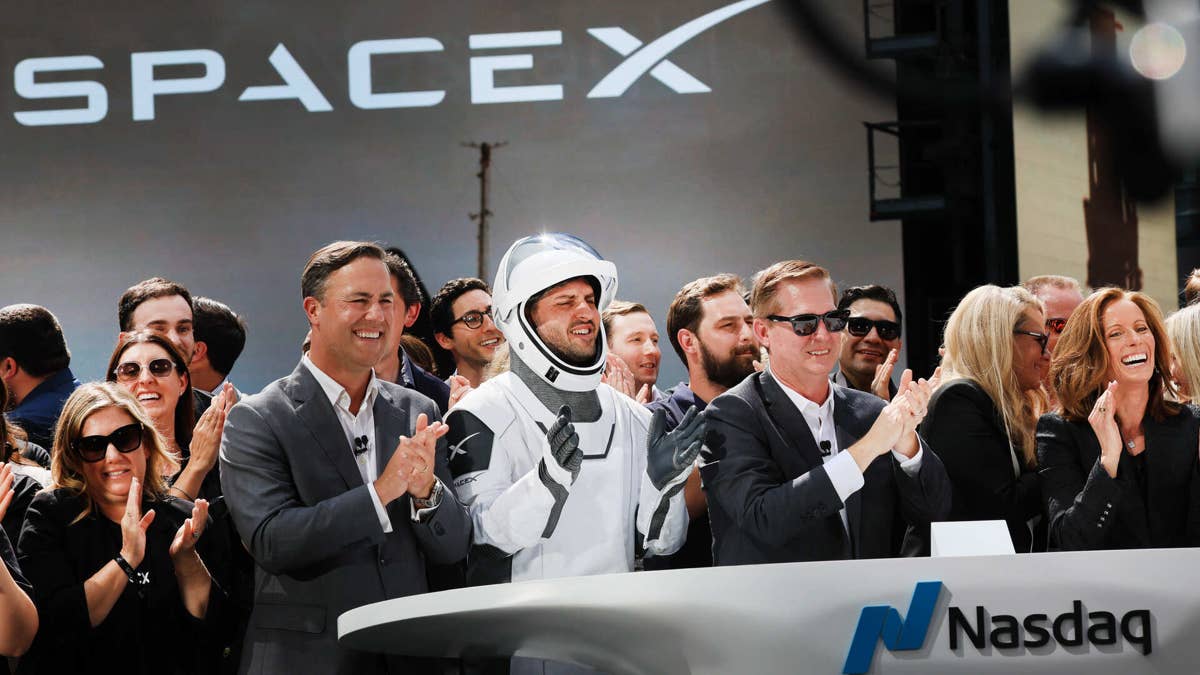
SpaceX is definitely a duplicate of Tesla, but in a different sector. Baron has been a SpaceX bull for years through private market exposure, and the June 12 IPO was the moment that position appeared in public 13F filings for the first time.
His top five holdings, according to GuruFocus, are SPCX at 37.38%, Tesla at 7.90%, MSCI at 2.70%, Arch Capital at 2.31%, and Hyatt Hotels at 2.12%.
SpaceX is not in a modest position. It is nearly five times his second-largest holding. That says something, right?
The case for SpaceX that Baron is making with $24.9 billion
SpaceX’s Q2 2026 earnings, reported August 4, showed what the underlying business actually looks like, without the noise.
- Revenue of $7.8 billion, representing growth of 92% year over year (YOY)
- Net loss narrowed to $541 million from $1 billion in the prior year period
- Adjusted EBITDA of $3.5 billion grew 191%
- The connectivity segment, which includes Starlink, grew 66% in revenue and 79% in operating income, driven by a doubling of Starlink subscribers
- Closed $14.1 billion in contracted Cloud Services Agreements
- It was awarded over $6 billion in multi-year U.S. government contracts for Starshield.
- Cash, cash equivalents, and marketable securities ended Q2 at $100 billion, with a $47.5 billion backlog.
The Cursor acquisition, announced at $60 billion, adds an AI coding platform with 2.5 million developers to a company that already operates one of the largest private AI compute buildouts in the world. Q2 capital expenditure reached $18.4 billion, with $15.8 billion directed toward AI investments.
Baron is not buying launch vehicles. He is buying the argument that SpaceX is becoming one of the world’s dominant AI infrastructure companies. That’s with a satellite internet business that is already profitable and growing at 66% per year as the collateral.
The valuation debate and why I think the bears also have a point
Here is where intellectual honesty matters. Baron’s $24.9 billion position is underwater at current prices, and the valuation concerns I covered in previous articles are real. But also, don’t forget Baron’s bet is long term.
Short seller Peter Andersen described a price-to-sales ratio of around 50 times as “very high for a company like this” in my previous SPCX coverage. Morningstar estimates fair value at $63 per share, less than half its price at recent trading levels.
Related: Top analyst sees trouble looming for SpaceX stock
The bear case is not about Starlink’s growth or SpaceX’s engineering capability. It is about what happens when a stock that debuted at $135, surged to $225.64, fell more than 50%, and now trades at $136.97 gets layered with $18.4 billion quarterly capex, eight tranches of insider share unlocks through January 2027, and a $60 billion acquisition that has not been proven out.
My read of the Baron position is that he is not pricing SpaceX on 2026 earnings. Just like his investing philosophy says, he is pricing it on what Starlink and the AI compute business may look like in 2030 and beyond.
Related: Warren Buffett’s Berkshire makes backdoor SpaceX play
Baron projects SpaceX will be worth “at least $40 trillion” within 10 to 15 years, starting from a $2 trillion IPO valuation, TheStreet reported.
That is a defensible framework with a five-plus-year holding horizon. It is also a framework that requires patience through significant near-term volatility. He knows the game when it comes to that.
Baron named his dog Big Mac after his first successful stock call. He held Tesla through years of doubt. He is the last person to be rattled by a 20% drawdown on a position he has held since before the IPO.