If you’ve ever wondered who makes the machines that build the chips powering artificial intelligence (AI), Applied Materials (AMAT) is a good place to start your education. It doesn’t make chips. But it manufactures the equipment that enables chipmaking, and right now, the world can’t get enough of both.
Citi analyst Atif Malik reset AMAT’s price target. And buried inside his analysis was something bigger: a wild card involving Tesla (TSLA) and SpaceX that Malik says could add tens of billions of dollars in equipment demand that isn’t even in his base case yet.
Applied Materials CEO Gary Dickerson had already signaled the company’s momentum. “The need for higher performance and more energy-efficient chips is driving high growth rates for leading-edge logic, high-bandwidth memory, and advanced packaging,” he said in a company statement during the first quarter 2026 earnings release. “These are areas where Applied is the process equipment leader.”
AMAT shares were up over 1.5% in premarket trading on Wednesday, May 13, after the upgrade.
Citi upgraded AMAT’s stock price target to $520 from $420
Citi analyst Atif Malik raised his price target on AMAT to $520 from $420 on Tuesday, May 12, citing a surge in wafer fab equipment (WFE) spending that he expects to accelerate through 2027, according to SEMI.
Malik’s upgrade rests on a top-down framework linking hyperscale data center capital expenditure (capex) directly to WFE demand. His bull case numbers are significant.
- 2026 WFE bull case: $145 billion
- 2027 WFE bull case: $190 billion
- CY27 silicon revenue growth estimate: 31% year over year
- Updated CY27 EPS estimate: $15.72, up 12% from prior estimates
Source: Seeking Alpha
According to the note, Malik also expanded AMAT’s valuation multiple from 30 times to 33 times price-to-earnings (P/E), reflecting “extending WFE spend visibility” and favorable end-market mix, particularly in DRAM and front-end of line (F/L) spending in 2026 and 2027.
My review of the data suggests AMAT’s multiple expansion is already telling a story. The stock’s P/E has moved from 23 times to 27 times year to date, according to the Citi note, meaning the market was already repricing the stock before Malik formalized it.
AMAT is up 68% year to date and 158.98% over the past year, according to Yahoo Finance data as of May 12, 2026. The S&P 500 is up 8.11% and 26.64% over those same periods.
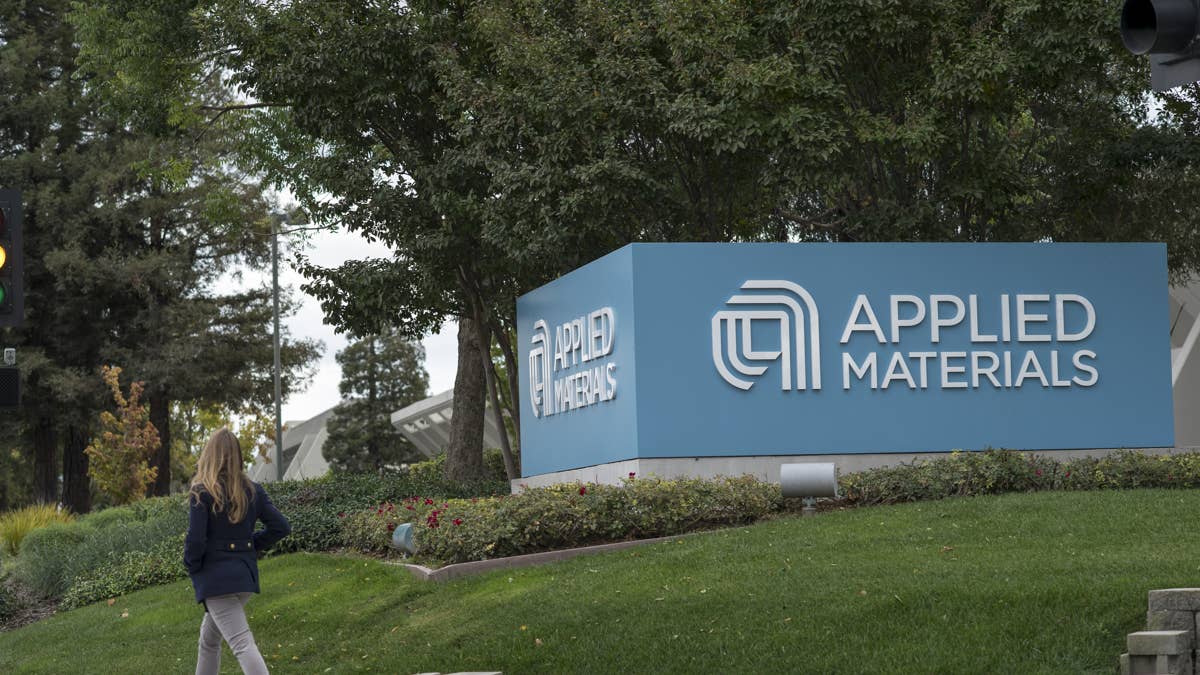
Morris/Bloomberg via Getty Images
The Terafab wild card that isn’t in anyone’s model yet
Here’s where the story gets genuinely interesting. In March 2026, Tesla and SpaceX unveiled plans for a chip manufacturing facility called Terafab, targeting leading-edge 2-nanometer (nm) chips and designed to ultimately support up to one terawatt of compute capacity annually, according to TheStreet.
Malik was direct about what this could mean for WFE spending, writing: “We view the Terafab as positive and upside case to our 2027/28 WFE spend.”
I did the math using the framework he laid out.
- TSMC spent roughly $100 billion in cumulative capex from 2023 to 2025 and guided approximately $56 billion for 2026 alone, according to Forbes.
- Assuming WFE represents about 60% of total capex investment, a Terafab investment of $55 billion to $119 billion could generate $30 billion to $70 billion in incremental WFE opportunity, The New York Times reported.
The timeline remains unclear. But Malik’s point is that this isn’t in his model. His $520 target itself may therefore be conservative if Terafab moves forward.
How Applied Materials became the top DRAM play in chip equipment
AMAT’s positioning in the current AI spending cycle isn’t accidental. The company has the highest DRAM exposure among major semiconductor equipment peers, with DRAM-related sales projected to account for roughly 31% of revenue in calendar year 2026, according to Morgan Stanley data shared with TheStreet on May 6.
That exposure matters because AI infrastructure runs on high-bandwidth memory (HBM), a form of advanced DRAM that requires increasingly complex manufacturing steps. More complexity means more demand for Applied Materials’ specialized tools.
Key AMAT partnerships driving that position:
- Micron and SK Hynix: Co-developing next-generation HBM and DRAM with Applied Materials
- TSMC: Awarded Applied Materials its 2025 Excellent Performance Awards for technology development and green manufacturing
- Samsung: Joining Applied’s new EPIC Center in Silicon Valley, designed to accelerate the commercialization of breakthrough chip technologies
In fiscal Q1 2026, Applied Materials reported revenue of $7.01 billion and record DRAM revenue in its Semiconductor Systems segment, according to AMAT’s statement. GAAP earnings per share (EPS) were $2.54, and non-GAAP EPS were $2.38, up 75 percent and flat year over year, respectively.
What to watch when AMAT reports fiscal Q2 earnings May 14
Applied Materials is scheduled to report fiscal Q2 2026 results on May 14, after market close. The company’s own guidance calls for:
- Revenue: $7.65 billion, plus or minus $500 million
- Non-GAAP diluted EPS: $2.64, plus or minus $0.20
Source: AMAT first quarter 2026 earnings results
CEO Gary Dickerson guided the company’s semiconductor equipment business growth of more than 20% in calendar year 2026, with demand weighted toward the second half of the year and momentum expected to carry into 2027, according to a company statement.
CFO Brice Hill noted that Applied has “nearly doubled” its system manufacturing capability over the past several years and increased inventories in preparation for accelerating demand, the statement shared.
With Citi’s revised $520 target now on the board and Terafab sitting as unmodeled upside, the Thursday, May 14, earnings call could either validate the bull case or introduce the kind of nuance that reminds investors why chip equipment stocks don’t move in a straight line.
Related: Morgan Stanley adjusts Applied Materials stock price target pre-earnings