Every dominant company eventually meets the competitor it decided not to take seriously.
The pattern is boring by now. The incumbent has the brand, the cash and the head start, so the upstart gets filed under interesting rather than dangerous, right up until the quarter it stops being either.
Elon Musk has spent three years telling investors that Tesla (TSLA) is not a car company. It is an artificial intelligence company that happens to build cars, one whose real value sits in humanoid robots, driverless taxis, and the software stack running underneath both.
Wall Street bought the pitch. Tesla’s market capitalization sat at roughly $1.43 trillion in mid-July, according to Morningstar, or about 200 times normalized earnings.
That multiple only holds if nobody else can do what Tesla says it is doing. Not eventually, and not in a lab. Now, on a factory calendar, with dates attached.
It’s why a recent piece by Automotive News deserves more attention than it will get. XPeng (XPEV), the Guangzhou automaker that delivered about one vehicle for every five Tesla moved last quarter, told the trade publication it wants to stop being a carmaker entirely.
It is chasing Musk on humanoid robots and robotaxis. It is also chasing him onto a third front he has barely touched.
Why the XPeng pitch sounds so familiar to Tesla shareholders
XPeng has rebranded itself a “physical AI” company, the same phrase Musk uses, built on the same argument that a machine trained to drive a car can be retrained to walk, lift, and fetch.
The company designs its own Turing inference chips and its own vision language action model, or VLA, which converts what a camera sees directly into steering and throttle commands. Tesla’s Full Self-Driving software works on a similar principle.
More Automotive:
- Top Toyota exec urges Japan’s automakers to unite
- Struggling EV maker reels as Chapter 11 bankruptcy rumors swirl
- Ford’s SUV profits are fueling its future
Where the two diverge is ownership. Tesla keeps everything in-house. XPeng is building its robotaxi network on top of Alibaba’s Amap navigation app, sells vehicles jointly developed with Volkswagen, and has said its VLA model will be open sourced.
“For us, it’s all about physical AI,” said Sven De Smet, XPeng’s head of brand and product in Europe, in comments to CGTN at the Munich launch of the company’s L03 sport utility vehicle on July 16. European pricing on that model undercuts the Tesla Model Y by as much as $10,000.
What the robot and robotaxi calendars actually show
I lined up the two companies’ spending before I lined up their timelines, because that is usually where these comparisons collapse. Tesla guided to more than $25 billion in 2026 capital expenditure covering AI infrastructure, batteries, Cybercab, and Optimus, Reuters confirmed. XPeng plans to spend 7 billion yuan, roughly $1 billion, on physical AI this year.
So Tesla is outspending its Chinese rival by something close to 25 to one on the exact technologies that justify its valuation. What struck me is how little separation that money has bought on the calendar.
- Tesla’s Optimus line at Fremont was scheduled to begin limited production in late July or August, according to Electrek.
- XPeng targets large-scale mass production of high-level humanoid robots by the end of 2026, XPeng confirmed.
- XPeng began employee testing of its robotaxi platform in Guangzhou on July 10, with CEO He Xiaopeng taking the first end-to-end ride himself, according to PR Newswire.
- XPeng delivered 40,126 vehicles in June, its strongest month of 2026, CnEVPost reported.
Musk has been unusually candid about the robot ramp. Optimus production will be “extremely slow at first, as everything is new,” he posted on X (the former Twitter) on July 1, as reported by Electrek.
Tesla’s Robotaxi picture is similar. Tesla launched driverless service in Miami on July 3, its first market outside Texas and California, in a service zone of about 14 square miles.
The flying car front where Tesla has no product
Here is the part that does not show up in any Tesla comparison, because Tesla has nothing to compare.
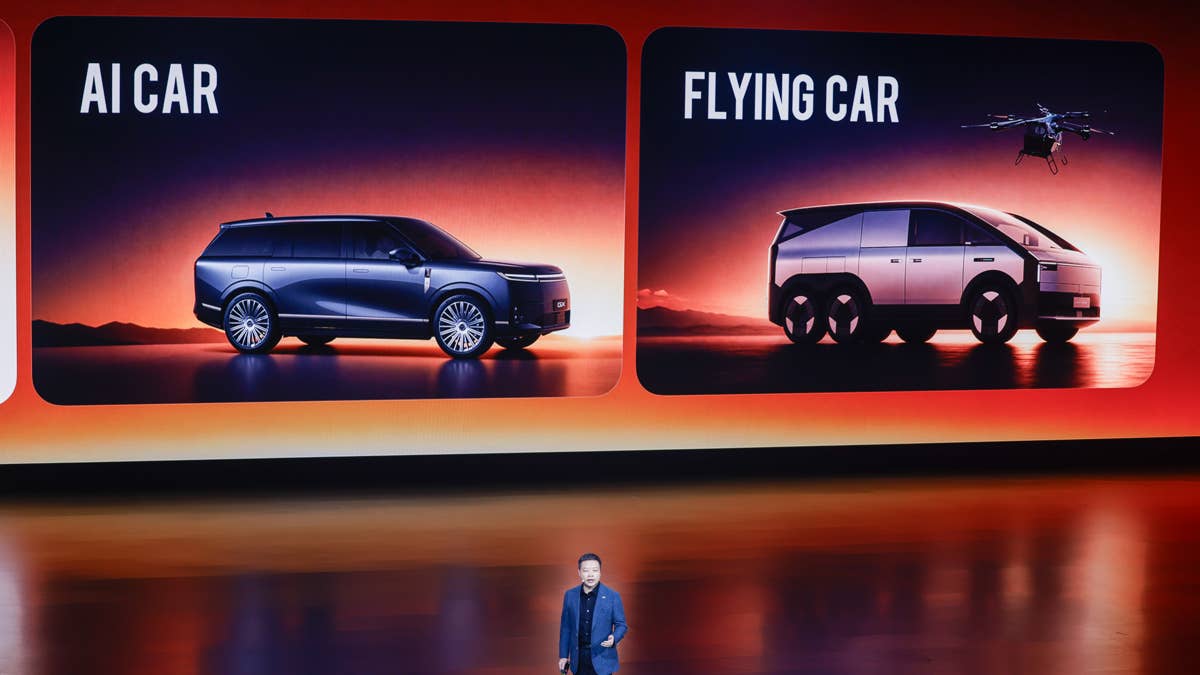
XPeng’s affiliate Aridge is building a modular flying car, and the program had taken more than 7,000 orders as of April, most of them domestic, pending sign-off from Chinese aviation regulators.
Related: Tesla now has a serious software rival
Xiaopeng believes “safe and cost-effective flying cars” will be operating globally in specific use cases within five to 10 years, he told Automotive News.
Musk has floated a Tesla flying car prototype. There is no program, no order book, and no regulatory filing.
The strategic point is not the aircraft. It is that XPeng gets three independent shots at proving embodied AI works, and each one can fail without killing the others. Tesla’s valuation currently rests on two, and Musk has already retired the Model S and Model X production lines to make room for robots.
What a second physical AI story does to your Tesla position
None of this makes XPeng a winner. Its robotics unit has lost two senior leaders in a month, with Xiaopeng personally taking over the division, according to KrAsia. Chinese automakers earned a 1.5% profit margin over the first five months of 2026, an industry low.
The company is also worth about $14 billion, roughly 1% of Tesla, companiesmarketcap.com noted. It cannot lose a decade-long spending war.
But that framing misses what actually moves a Tesla position, and Tesla is one of the 10 largest weights in the S&P 500, so most American readers hold it, regardless of whether they picked it.
Tesla does not trade at 200 times earnings because it builds robots. It trades there because investors believe it is the only company that can build robots, taxis, and the driving intelligence in between, and can therefore charge whatever it wants for all three later.
XPeng is not attacking Tesla’s margins. It is attacking that belief, at 4% of the budget, with the same dates on the wall.
Watch the open source decision most closely. If XPeng licenses its VLA model to other automakers, Tesla’s autonomy edge stops being a product and becomes a commodity that anyone can install, which is the one outcome Musk’s valuation cannot survive.
Tesla reports second-quarter results on July 22. The deliveries were strong, and Bank of America has already raised its estimates.
The number worth listening to is not revenue. It is how many Optimus units actually came off the Fremont line, because for the first time, somebody else is answering that question on the same day.
Related: Tesla rival says Elon Musk still has one major edge