SpaceX (SPCX) and Nvidia (NVDA) stocks have taken different roads of late, but there’s still plenty of interest in where their AI stories go next.
SpaceX shares are trading at around 12% higher than their $135 June IPO price, Reuters reported, despite some wild swings since going public, while Nvidia has gained 7% over the past three months and 16% this year.
Now both companies are tied together through one of Elon Musk’s more ambitious AI bets. SpaceXAI chose Nvidia’s Vera Rubin platform for growing its compute infrastructure, with plans to take that architecture beyond Earth. CEO Elon Musk is now doubling down.
SpaceX is already pitching that its AI business could become much larger than a side business.
It’s important to note that in an August all-hands meeting, he told employees, “Probably our AI revenue — not probably, definitely — our AI revenue will exceed all other SpaceX revenue probably in September, like next month.”
He added that AI sales should “significantly exceed all other SpaceX revenue in Q4.”
Having said that, Musk’s latest comments just took that idea further. He is no longer being vague about putting AI infrastructure in space someday. His latest exchange on X puts a firm timetable around the plan, suggesting that he thinks Nvidia’s most advanced systems would reach orbit a lot sooner than many investors might expect.
Musk puts fresh weight behind SpaceX’s orbital AI timeline
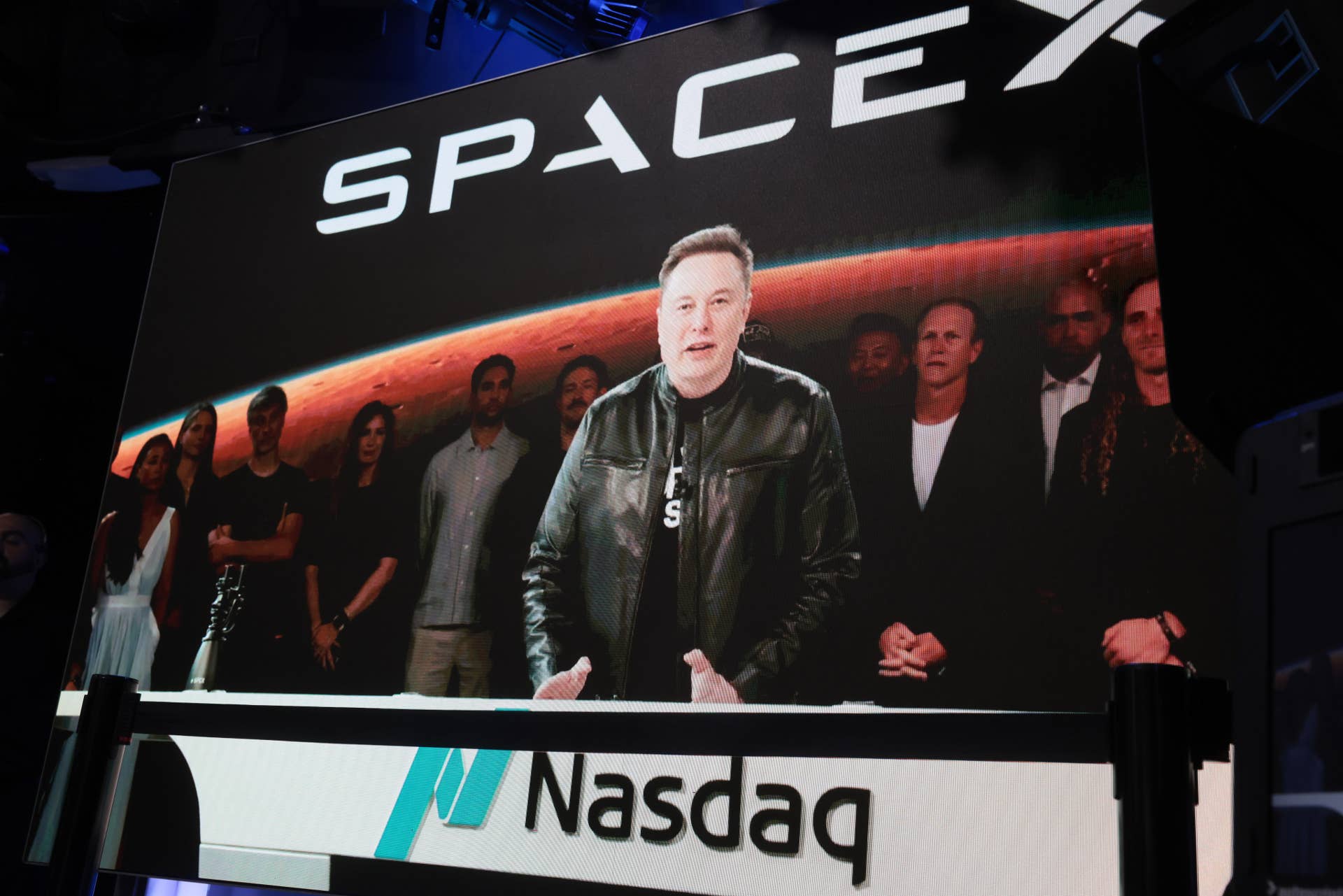
“I am highly confident that SpaceX will be launching Nvidia VR NLV72 AI computers in space next year,” Musk wrote on X, as cited by Seeking Alpha.
The serial entrepreneur has already laid out the broader plan during the company’s August earnings call, with expectations that launches could potentially begin in 2027.
Now, Musk is publicly reinforcing that timeline, suggesting SpaceX sees next year as a clear, achievable launch window rather than a distant ambition.
More Elon Musk:
- Elon Musk makes bizarre claims about money, future of AI
- Elon Musk sends blunt verdict on the future of humanity and AI
- Elon Musk’s startling claim to SpaceX investors
The big implication is that SpaceX sees orbital computing as an extension of its existing AI infrastructure strategy rather than an isolated science project. If it can launch Nvidia-powered systems into orbit, it could combine launch capability, satellites, and compute infrastructure into a single platform.
Interestingly, it comes at a point when the company’s terrestrial AI business is starting to show real commercial weight.
On Sept. 10, as reported by Seeking Alpha, SpaceX announced it had assigned an AI hosting agreement worth $1.11 billion a month, or $13 billion in annual recurring revenue, with service set to begin on Dec.r 1. CFO Bret Johnsen said that the deal gave management “even more conviction” in reaching their lofty $100 billion ARR run rate by year-end.
Why SpaceX’s Nvidia partnership matters
The Nvidia partnership gives SpaceX’s orbital-computing pitch much more substance.
On Aug. 24, Nvidia announced that SpaceXAI would adopt its Vera CPUs and expand its AI infrastructure around the Vera Rubin platform. The companies are working in tandem to efficiently adapt that architecture for SpaceX’s first-generation Starmind AI satellite.
The Starmind system is expected to be used as an optimized version of Nvidia’s Vera Rubin NVL72 platform, which, in its standard form, combines 72 Rubin GPUs, 36 Vera CPUs, ConnectX-9 networking, and BlueField-4 DPUs.
The big challenge, though, for SpaceX is to turn that rack-scale AI computer into hardware capable of operating in orbit.
That would require solving multiple complex sets of constraints around energy, thermal management, bandwidth, reliability, and physical integration. Nvidia specifically underscored those key areas as part of the partnership.
SpaceX is betting that Nvidia’s architecture could become the computing layer for AI infrastructure on Earth and, eventually, in space.
What it means for SpaceX and Nvidia stock investors
For SpaceX stock investors, Musk’s latest comments add more weight behind the argument that the company is looking to become more than a rocket and satellite operator.
Its terrestrial AI infrastructure is emerging as a significant growth engine already, while Starmind might add an entirely new layer by combining SpaceX’s rockets, satellite manufacturing, Starlink network, and AI computing infrastructure.
Wall Street expects nearly $100 billion of SpaceX revenue in 2027, including $60 billion from AI, according to estimates cited by Barron’s.
That said, AI computing in space could be a possible future growth opportunity, but investors shouldn’t count on it to boost profits anytime soon. If Starship can cost-effectively carry large numbers of AI systems into orbit, SpaceX might be able to meet AI’s huge demand for electricity and computing power.
However, delays or failures might still matter as SpaceX says the bulk of its long-term growth depends on Starship.
For Nvidia stock investors, the read-through is perhaps even simpler.
SpaceX is another enormous Nvidia customer, even if it takes the space-data-center thesis multiple years to mature.
The bigger implication is that Nvidia might not merely supply chips to today’s terrestrial hyperscalers. If orbital AI eventually becomes economically viable, Nvidia will be positioning its computing architecture to follow the AI data center into an entirely new physical market.
For now, funnily enough, investors should probably assign more value to SpaceX’s expanding Nvidia purchases on Earth than to GPUs that haven’t reached orbit.
Related: Apple CEO rejects biggest fear over iPhone Duo launch