For two years, the question surrounding Tesla’s long-term value has been less about electric vehicles and more about one specific project that Elon Musk says could become the company’s most valuable business.
That project has been moving closer to production with limited serious competition from the names that matter most in AI.
That changed on May 31. And Tesla stock fell nearly 5% the following day.
OpenAI launches robotics division
OpenAI CEO Sam Altmanrevealed on May 31 that the company is launching a dedicated robotics division. The division grew out of an internal world-simulation research program led by Aditya Ramesh, the researcher behind DALL-E and Sora, and is actively hiring full-stack hardware, operations, systems, and machine-learning engineers.
OpenAI co-founder Greg Brockman said the division is “making rapid progress towards building AI that can help people in the physical world,” according to Yahoo Finance. The near-term target is robots for skilled workers building data centers, power grids, and factories.
More Tesla:
- Elon Musk’s Terafab bet: what it means for Tesla investors
- Bank of America revamps Tesla stock price
- UBS has a message for Tesla stock investors
The longer-term goal is a personal robot for home use.
This is OpenAI’s second attempt at robotics. The company shut down its first robotics division in 2021, citing the difficulty of training algorithms for physical tasks.
The relaunch reflects confidence in newer neural-network architectures, and it puts OpenAI directly in the path of Elon Musk’s most ambitious long-term bet.
Why OpenAI’s robot push threatens Optimus, Tesla’s long-term growth
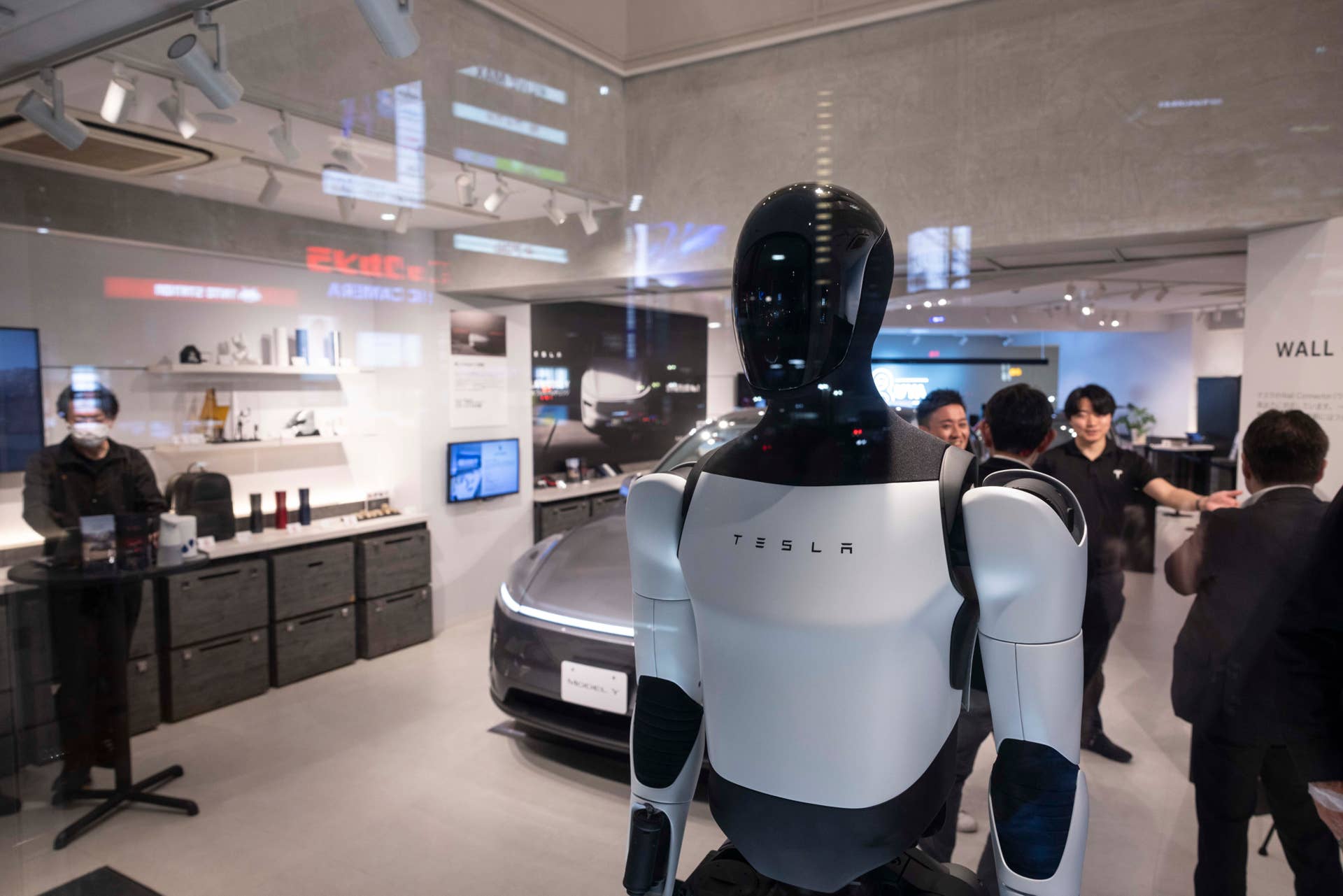
Optimus is no longer a side project at Tesla. Musk has repeatedly described the humanoid robot as potentially the company’s most valuable product, arguing it could eventually outnumber cars and generate revenue that dwarfs the automotive segment.
Tesla is currently converting part of its Fremont factory to manufacture Optimus, shutting down Model S and Model X production lines to install the equipment.
The robotics business has become the primary justification for Tesla’s premium valuation at a moment when its core automotive business is under genuine pressure. EV demand growth has slowed, pricing competition has intensified across global markets, and TSLA shares have underperformed through much of 2026.
Without Optimus, the bull case for Tesla becomes substantially harder to construct.
OpenAI entering the field does not eliminate Tesla’s head start. But it does something more immediately damaging to investor confidence: It confirms that the humanoid robotics market is attracting the best-resourced competitors in AI, and that Tesla’s window to establish an unassailable position may be shorter than previously assumed.
Kogiku/Getty Images
The Altman-Musk robotics rivalry enters a physical dimension
Altman and Musk have been fighting over software terrain for years. Musk helped co-found OpenAI in 2015 before departing. He has since filed legal challenges against the organization, launched his own AI venture in xAI, and publicly clashed with Altman over OpenAI’s corporate structure and direction.
OpenAI’s robotics announcement extends that rivalry into hardware. Both organizations are now pursuing overlapping goals across foundation models, AI infrastructure, and physical machines that operate in the real world. The competition is no longer theoretical.
Key figures on OpenAI’s robotics launch and the Tesla Optimus competition:
- OpenAI announcement: Sam Altman announced OpenAI Robotics on May 31 via X; the division is led by Aditya Ramesh, creator of DALL-E and Sora; there were 11 open roles at the time of the announcement; the near-term focus is robots for data center, power grid, and factory construction, according to Yahoo Finance.
- Second attempt: OpenAI shut its first robotics division in 2021; the relaunch reflects advances in neural-network architectures and hardware-software co-design, Yahoo Finance confirmed.
- Leadership complication: Caitlin Kalinowski, OpenAI’s hardware lead who joined from Meta in November 2024, resigned on March 7, 2026, citing concerns about the company’s Pentagon deal and lack of guardrails around surveillance and lethal autonomy, CNBC reported.
- Tesla impact: TSLA stock fell nearly 5% on June 1 as investors reacted to the OpenAI announcement; Tesla is already converting Fremont factory space for Optimus production, shutting down Model S and Model X lines, CNBC confirmed.
- Market size: Morgan Stanley projects humanoid robots as a $5 trillion market by 2050; Google DeepMind, Nvidia, and now OpenAI are all moving aggressively into physical AI alongside Tesla, according to Yahoo Finance.
- Tesla’s Optimus timeline: Musk said the production version will be unveiled closer to the start of production to avoid copies; Tesla is targeting a production ramp in 2026, Yahoo Finance noted.
What the OpenAI robotics push means for Tesla investors
Tesla’s advantage in this race is real. It has the most advanced humanoid robot approaching production scale and years of computer vision development from its autonomous driving program.
Those advantages do not disappear because OpenAI posted a job listing.
What does change is the competitive calculus investors use to value Optimus. A market where Tesla is the only serious large-scale entrant is worth a different valuation premium than a market where Tesla competes against OpenAI, Google DeepMind, and Nvidia-backed platforms simultaneously.
The $5 trillion market Morgan Stanley projects by 2050 is large enough for multiple winners. It is also large enough to attract every major player in AI.
For investors, the June 1 selloff may have been an overreaction to a hiring announcement with no hardware yet behind it. But the direction of the signal is correct.
The window in which Optimus would face limited serious competition from the best-resourced AI organizations appears to have closed. Whether Tesla’s head start is large enough to matter in a market this early is the question the next several quarters of production data will begin to answer.
Related: Elon Musk’s new Tesla update is a joy for customers and investors