AI poster-child Nvidia (NVDA) has jumped 14% year to date, but the ride’s been noticeably bumpy according to Seeking Alpha data.
The stock’s down nearly 6% in just one week and around the same amount over the past month, a pullback that has coincided with fresh questions over whether the breakneck AI buildout could finally lose momentum.
Consequently, that debate followed calls from some of the biggest names in AI to slow the development of frontier models for safety reasons. But on his latest “Mad Money” broadcast from Dreamforce, veteran analyst Jim Cramer made clear he’s viewing Nvidia stock through a very different lens.
That’s not hard to fathom because Nvidia continues giving bulls ammunition. Fiscal Q2 revenue more than doubled to $96.2 billion, with its Data Center business reaching $89 billion, as it pushes deeper into enterprise AI, including Salesforce’s (CRM) new Koa reasoning model built on Nvidia Nemotron.
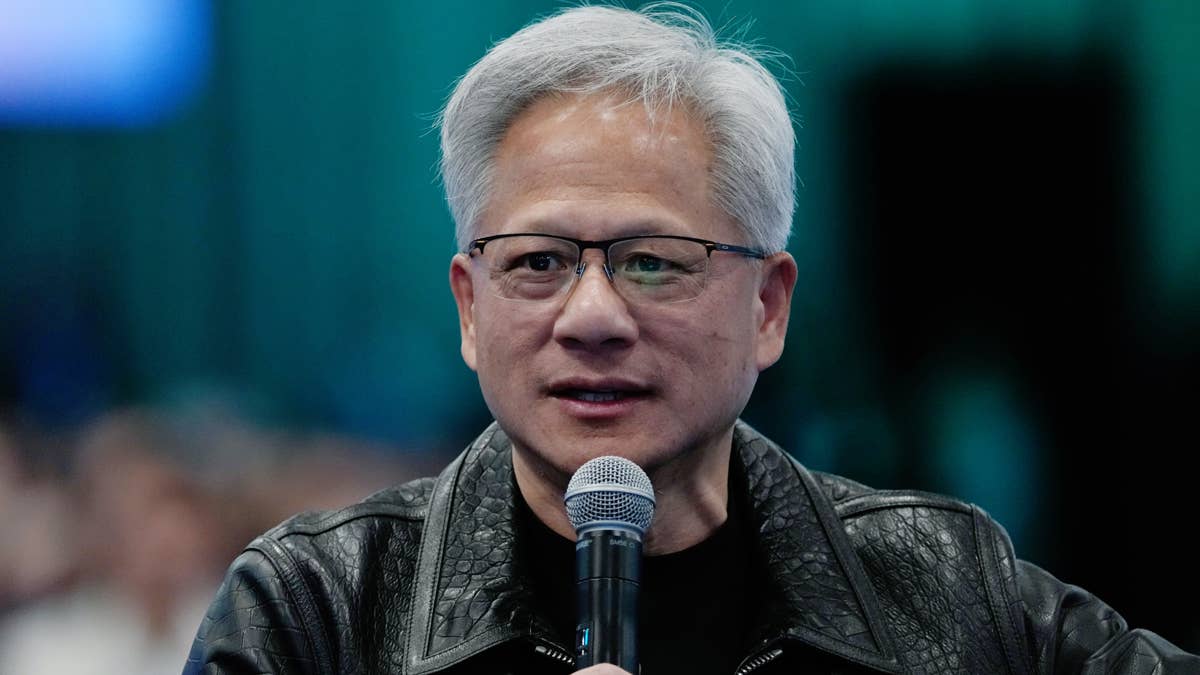
Cramer’s takeaway after a sit-down with CEO Jensen Huang was hardly cautious, though. Instead of treating the latest AI scare as a reason to jump in and out of Nvidia, he framed the stock as something investors need to hold through the noise instead of trade.
Cramer says Nvidia’s AI flywheel is still accelerating
“Own it. Don’t trade it.”
That was Cramer’s five-word verdict on Nvidia stock, after a lengthy discussion with CEO Jensen Huang about whether the latest AI slowdown debate changes the company’s investment case.
According to Cramer, the recent volatility might be tempting investors to trade around Nvidia, but he believes the underlying economics of AI infrastructure still argue for staying invested.
Cramer had already gone further earlier in the interview, calling Nvidia “the best investment in the world” and pushing back against concerns that slower frontier-model development could derail demand.
More AI:
- Nvidia just made a move Wall Street wasn’t ready for
- Microsoft just took sides in AI policy fight
- OpenAI just disclosed something genuinely alarming
Huang’s numbers help explain that confidence.
He argued that building one gigawatt of Nvidia AI-factory capacity costs $50 billion to $60 billion, while renting that capacity can generate $50 billion annually. On Huang’s math, that puts the return on invested capital at roughly one year, an unusually powerful incentive for customers to keep building.
The demand signals are also moving higher. Huang said token-generation demand has jumped 25-fold in less than a year, while the share of tokens generated by open models climbed from nearly 30% to almost 70%.
Moreover, pricing reinforces that argument.
Huang said Grace Blackwell GPUs can now rent for about $16 per GPU hour, versus $5 on some year-old contracts. As those cheaper agreements expire, operators are raising prices, sales forecasts and infrastructure spending.
For Cramer, the real debate is about how quickly frontier AI should advance.
Cramer broadens AI case beyond Nvidia
Cramer’s broader takeaway from Dreamforce was that the AI spending cycle is extending well beyond Nvidia and into software, enterprise applications and model development.
His conversation with Salesforce CEO Marc Benioff centred on if the fears of a software “SaaS-pocalypse” have gone too far.
Benioff dismissed that idea as “total nonsense,” while Cramer pointed to Salesforce’s latest quarter and its expanding web of AI partnerships as evidence that software companies can still monetize the buildout.
Salesforce is also experimenting with a more aggressive pricing model. Benioff said the company is willing, in some cases, to build AI systems upfront, and then taking a percentage of the customer’s revenue, profit or savings. That effectively ties Salesforce’s economics more directly to whether its AI products generate measurable returns.
Cramer also revisited Salesforce’s $26 billion Slack acquisition. Benioff called Slack “the greatest acquisition in the history of software” and said it posted triple-digit bookings growth last quarter, while naming Nvidia, Anthropic and OpenAI as major users.
The show then turned to OpenAI CFO Sarah Friar, who acknowledged that frontier-model development could be paced for safety reasons. But she argued that even today’s existing AI intelligence is already powerful enough to drive meaningful real-world applications, suggesting a slowdown at the frontier would not necessarily mean a slowdown in commercialization.
Nvidia’s valuation makes Cramer’s case more interesting
For investors, Cramer’s “own it, don’t trade it” call becomes more compelling when Nvidia’s valuation setup is pitted against its strong growth rates.
At $212.17, Cramer noted Nvidia is trading at around 14 times fiscal 2028 earnings, a remarkably restrained multiple for a company whose latest quarterly sales jumped 106% to $96.2 billion and whose adjusted EPS climbed 120%.
Nvidia also maintained a 75% gross margin, showing that extraordinary growth hasn’t compromised bottom-line strength.
The near-term numbers remain strong. Nvidia expects fiscal Q3 sales of nearly $108 billion, another 12% sequential increase, while guiding gross margin to about 74%.
That makes valuation less demanding, but the catch is that a 14-times multiple relies on much higher fiscal 2028 earnings actually arriving. Any sustained AI spending slowdown will likely hit those estimates and make Nvidia look more expensive.
For long-term investors, that argues against chasing short-term swings. Holding existing positions and adding selectively on meaningful pullbacks looks more sensible than trading every AI scare.
Related: Elon Musk sends strong signal for SpaceX, Nvidia stocks