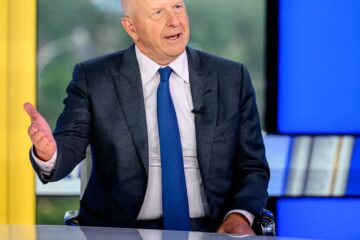
It’s no secret on Wall Street that Federal Reserve Chair Kevin Warsh was President Donald Trump’s answer to Jerome Powell’s Fed. He wanted somebody sensitive to a mission of reducing interest rates. Now, just five months into his job, the central bank is raising rates for the first time since Jun. 2023.
He has an explanation. In remarks provided after the quarter-point hike, Warsh credited three reasons for higher yields: a “strong economy” and “competition for capital” were the first two. A third, “geopolitics”, was wildly undersold. But in essence, you could blame this whole shuffle at the central bank on one big reason: bad policy decisions.
Warsh hides the football
Let’s unpack the real reason that the Fed had to raise rates: Inflation is up, and it’s up because of policy decisions.
The first is tariffs, which started to push up the price of consumer-goods inflation in 2025. But more recently, the Trump Administration has undertaken a controversial excursion in the Middle East, impacting regional stability and causing upheaval in the global energy markets.
Brent Crude Oil is over $100/bbl. Diesel in the U.S. is the most expensive it has ever been. Higher energy costs bleed into the rest of the economy in higher prices for goods and services. It happened during the exogenous energy shock post-Covid and it is happening again, turning back the clock on the Fed’s inflation progress.
None of this, of course, is the Federal Reserve’s fault. Its job is to call balls and strikes. But while it’s one thing for rates to rise because economic indicators are strong and borrowing is competitive, these are not the primary drivers of the recent rise in yields. If anything, they’re secondary to a persistently strong economic backdrop in the U.S. since the Covid-19 pandemic.
Sugarcoating the situation
Long before the FOMC settled on today’s decision, the market called its shot and said the Fed would raise rates. The Fed’s July minutes even get to the core of this: nominal rates “rose largely on expectations of higher policy rates.”
Yields rose the fastest at the front half of the curve as a growing chorus of analysts anticipated action on higher energy costs and tariff inflation.
After all, the bias of the Fed was to lower rates even as the economy appeared strong. So in essence, Warsh’s commentary seems to do a lot to distance the central bank from politics that are actively forcing its hands.
Warsh says “stay in your lane”
Warsh offers a prescription for why in his commentary. He simply says: “Part of the independence of the Federal Reserve is we stay in our lane.”
He adds that the Fed should let officials be responsible for trade and fiscal policy and “stay in their lane.” In other words, Warsh seems to indicate that the Fed will remain reactive, and not comment on politics.
Warsh’s central-bank-independence philosophy might be hard to maintain when fiscal, trade, and geopolitical decisions alter the environment, though. Especially when Warsh is able to offer up private-sector capital demand as a reason for higher bond yields, but did not expound on policy or the government’s own borrowing behavior.
Where things get expensive
The Fed’s recent rate hike is an example of how bad policy decisions can be expensive for the government, and eventually, the taxpayers. The U.S. has lacked fiscal discipline, especially over the last ten years during which both parties have supported sweeping and unsustainable tax cuts and special treatment for favored parties like the wealthy, seniors, and interest groups.
The result is that this country’s working class is not just paying higher prices on inflation, but facing an increasingly dire fiscal situation. The deficit this year is expected to eclipse $2 trillion. The only other times it has done that were in 2020 and 2021, during the Covid-19 pandemic.
With rates this high and a huge hole in our budget, the U.S. is paying a pretty penny to borrow from its future. One that, absent intervention, will rise further if the Fed continues to raise rates or keep them at elevated levels.
The national debt just crossed $40 trillion, and our second-largest line item year-to-date is interest payments on that debt, about 15% of the budget. It’s second to only Social Security. It’s an increasingly pesky problem for the U.S. and its future.
But the future is paying us a visit in the present, since Fed policy expectations aren’t the only ingredient in higher yields. Higher expected debt is helping push up yields even further through the term premium.
Those higher yields themselves are a commentary on American policy. And while some might be getting tax breaks, but with yields like this, higher borrowing costs might be an even bigger “tax” on Americans.