At a moment when half of corporate America is talking about replacing workers with AI, Jamie Dimon flew to Philadelphia and said something different. The country doesn’t have enough welders. It doesn’t have enough electricians. And the ones it does have are getting old.
Dimon spoke from the Philadelphia Navy Yard on July 15, where JPMorgan Chase announced a $24 million investment into the city’s shipbuilding and maritime manufacturing sector. The money matters, but what he said about the workforce is the bigger story.
What Jamie Dimon said about America’s skilled worker shortage
“We need 300,000 electricians, welders, etc. to build ships in the next five or 10 years,” Dimon told CNBC.
“We hear from clients all the time, they don’t have the workers they need. That could be welders, electricians. A lot of those folks are near retirement age,” he added, according to The Wall Street Journal.
JPMorgan’s own research arm puts the demand at 250,000 new skilled shipbuilding workers over the next decade, according to JPMorgan. McKinsey looked at Labor Department data and got a similar number. And 27% of people currently doing these jobs are already 55 or older. The pipeline coming behind them is nowhere near big enough.
This is the part of the labor market that doesn’t make many headlines. AI gets the attention. The skilled trades shortage is quieter, but in industries that depend on physical work, it’s just as serious.
Why skilled trades pay $80,000 to $100,000 without a college degree
Dimon made a specific pitch on July 15 that went beyond the workforce crisis. He described skilled trades as a path to real money without a college degree or college debt.
“It fits what we call the American dream,” he told reporters. “Getting kids skills or all workers’ skills that they have jobs that could pay 80-, 90-, $100,000 a year after you know a year or two of training. This lifts up America. It helps build the defense industry.”
More Layoffs:
- Meta layoffs take disturbing turn in new lawsuit
- Major snack brand closes plant, cuts 345 jobs
- JPMorgan Chase pushes fraud division layoffs, despite rising revenues
Apprenticeships in the skilled trades often pay workers while they train. That’s the opposite of college, where you pay tuition while you learn and hope the job offers afterward justify the debt. A welder or electrician who completes an apprenticeship program can reach six figures in their mid-twenties with no student loans.
The comparison to white-collar careers has gotten more relevant as AI continues to displace knowledge work. Programming, data analysis, writing, basic legal work, all of these are being automated or compressed. A welder is still a welder. The job is physical, it requires skill that takes years to develop, and no language model can do it remotely.
Why America is running out of welders, electricians and skilled trade workers
The shortage didn’t happen overnight. Baby boomers filled the shipyards through the late 20th century. As that generation aged, fewer younger workers followed them in. Millennials were pushed toward four-year degrees. The perception that trades were blue-collar, unstable, and less prestigious drove a generational exit from exactly the careers the economy still needs most.
The numbers show how far it’s gone. The American merchant fleet is down to fewer than 190 flagged vessels from a peak of nearly 3,000 in the 1960s. Hampton Roads in Virginia currently has a shortage of 10,000 shipyard workers. That figure is expected to grow to 40,000 by 2030, according to Yahoo Finance.
Huntington Ingalls Industries, the largest military shipbuilder in the country, invests more than $110 million annually in workforce development just to keep up. HII hired over 1,600 shipbuilders in Q1 2026 alone and said its apprentice schools are now at full enrollment. That pace of hiring reflects genuine demand, but also how thin the existing pipeline is.
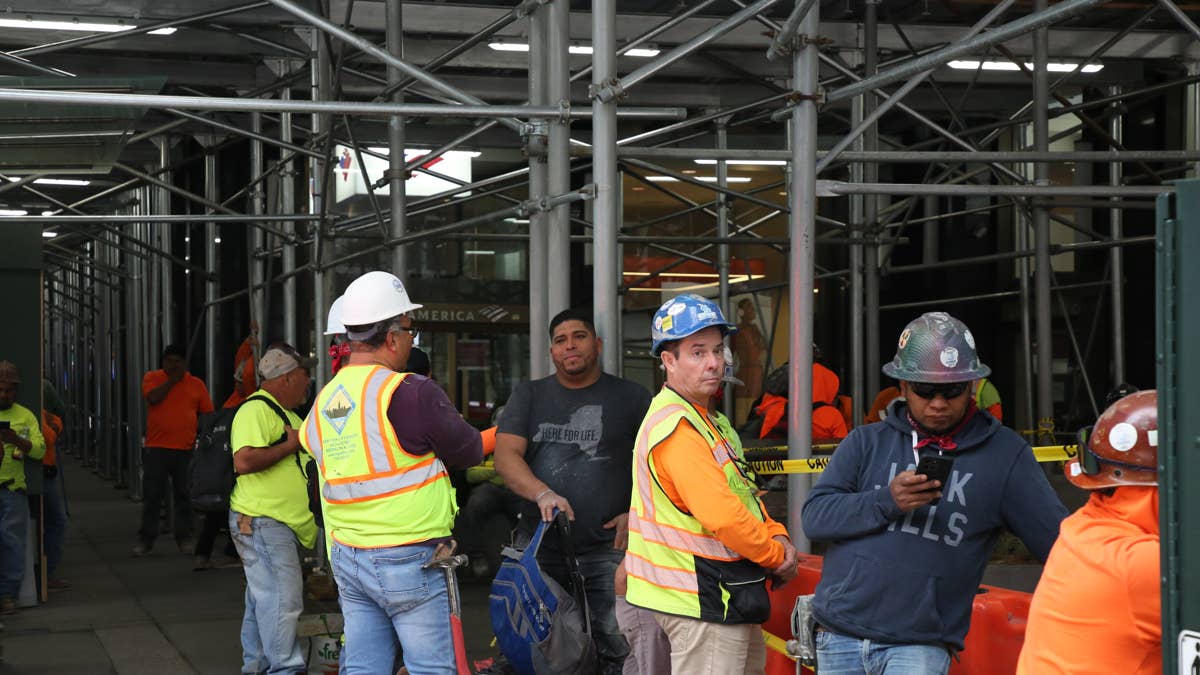
Fengguo/Getty Images
JPMorgan’s $24 million workforce investment and what it funds
Of the $24 million JPMorgan committed on July 15, $18 million comes in the form of loans and investments and $6 million as philanthropic grants. The largest piece is a $13 million New Markets Tax Credit equity investment in Rhoads Industries, which supplies General Dynamics Electric Boat’s submarine program, to fund a new 95,000-square-foot manufacturing and assembly facility at the Philadelphia Navy Yard.
The remaining $6 million in grants goes to three organizations: $2.4 million to the Greater Philadelphia Growth Partnership to build a regional employer and training collaborative, $2 million to the Skills Initiative at University City District to expand non-degree workforce pathways for roughly 300 people, and $1.5 million jointly to PIDC Community Capital and the Delaware Valley Industrial Resource Center to help up to 100 maritime suppliers, according to Yahoo Finance.
Jay Horine, who oversees JPMorgan’s Security and Resiliency Initiative, said Philadelphia is a starting point for expanding support to other U.S. shipyards. The firm also expanded the program into Europe this year.
Why skilled trade jobs are now more attractive than college degrees for many Americans
The workforce story Dimon is telling isn’t just about shipbuilding. It’s about a broader realignment that’s already underway. The jobs that AI is most disrupting are the white-collar ones that a college degree was supposed to protect. The jobs that AI can’t touch, and that the economy urgently needs, are increasingly in the skilled trades.
A welder at a Navy shipyard making $90,000 a year with no student debt is, by some measures, in a better financial position than a knowledge worker who spent four years and $120,000 getting a degree, according to College Board data, that now competes against a chatbot.
Dimon’s point at the Philadelphia Navy Yard wasn’t subtle. The country needs workers. The jobs are there. The pay is real. And the generation that’s supposed to fill those roles is largely unaware the opportunity exists. That’s the gap JPMorgan is trying to close with its $24 million, and that Dimon is trying to close by standing in front of a camera and saying it out loud.