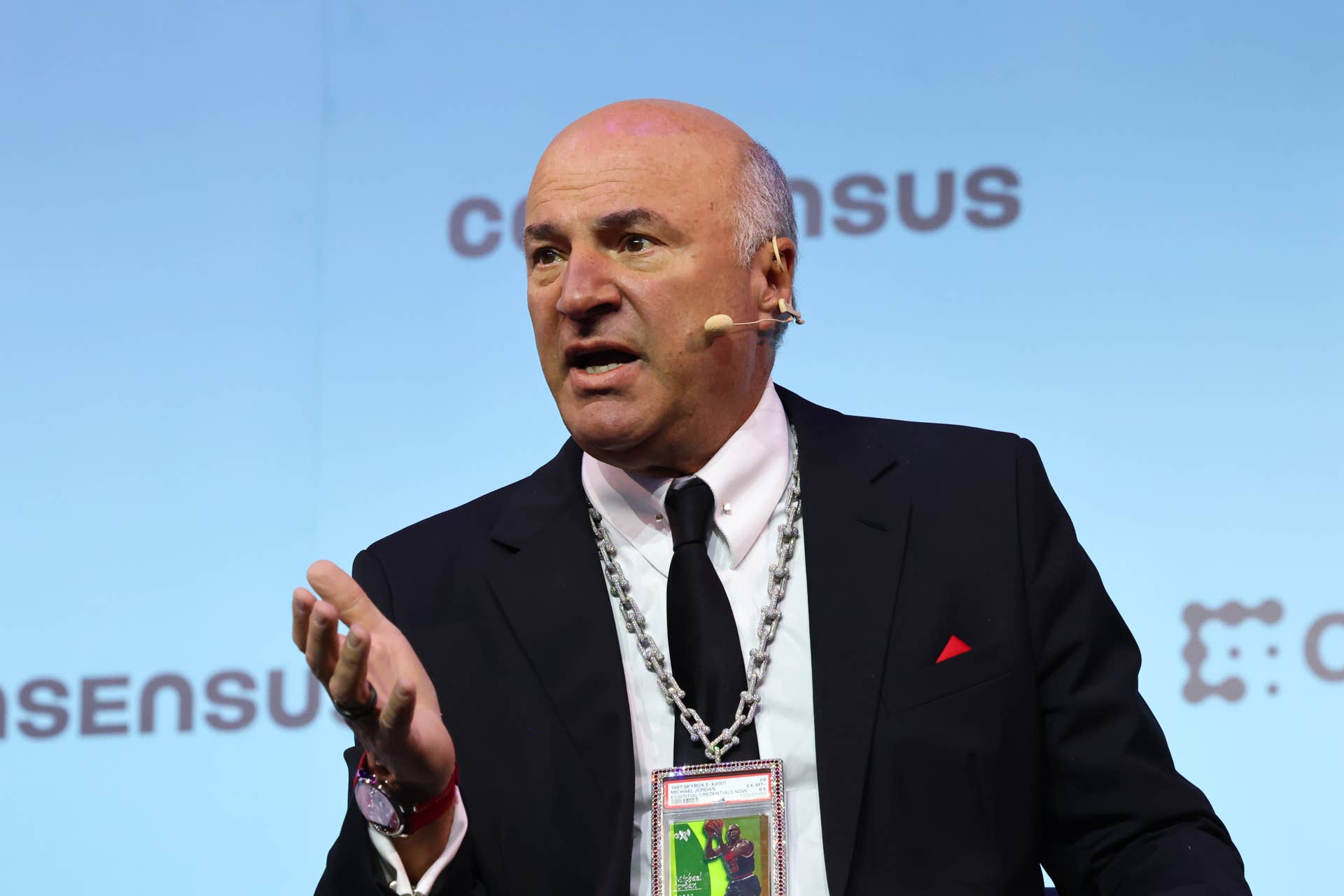
Kevin O’Leary has a new way to make his investment pitch: he wears it. The “Shark Tank” star showed off a $2.1 million Michael Jordan trading card hanging from a Tiffany chain and told The Hill that “nothing has outperformed that as an asset class,” as reported by Moneywise.
The timing makes the comparison sting for one of his other favorite bets. Bitcoin fell below $60,000 on Nov. 20 for the first time since July. For an investor who has spent years talking up crypto, a small piece of cardboard is now the star of the show. And he isn’t shy about saying so.
The card around Kevin O’Leary neck and its worth
The card is a 1997-98 SkyBox Metal Universe Precious Metal Gems Jordan, and only 100 were made, with 10 green and 90 red. O’Leary owns No. 12, which he says he bought for $690,000 and now values at $2.1 million, according to Moneywise. He also says he treats the card as part of a broader collection, not a one-off trophy.
Also read: Kevin O’Leary’s 3 ‘big’ economic predictions for 2027: ‘I’m going out on a limb here’
Cards are a real part of his portfolio now. O’Leary is an investor in Secure, a collectibles company built around a group of high-end cards, and he said cards make up about 2.5% of his holdings, a share he’d consider raising to 5% or more.
His biggest card bet really made the headlines in 2025. A one-of-a-kind Michael Jordan and Kobe Bryant dual-autograph card was sold at a Dallas auction in August 2025 for a record $12.9 million. The buyers included O’Leary, according to CBS News. That made it the priciest sports card ever sold at the time. O’Leary also bought it as part of a small group of investors.
O’Leary says that card has already paid off on paper. In May, he said it drew a $20 million bid, adding, “So tell me an asset class that does better than that, that’s liquid.” That’s roughly a 54% jump from the purchase price, if a sale ever happens at that level.
How stocks and Bitcoin stack up
The S&P 500 hasn’t been a slouch. It closed at 7,175 on Nov. 19, and Goldman Sachs, Morgan Stanley and Barclays all see it reaching 8,700 by the end of 2027. That’s still a strong run for a plain index fund that anyone can buy and sell in seconds.
Stocks have hit a rough patch lately, though. On Nov. 20, the S&P 500 dropped 3.7% for its seventh straight losing day, while the VIX briefly touched 40. That is the kind of week that makes a collectible’s steady paper value look calm.
Bitcoin has had it much worse. It closed Thanksgiving 2025 at $91,285 and traded at $59,720 on Nov. 25, 2026, a drop of about 35%, according to TheStreet. Anyone who bought last Thanksgiving is sitting on a painful loss heading into this year’s holidays.
O’Leary’s own math favors the card by a wide margin. By his figures, the Jordan card gained more than 200% over two years, compared with about 20% for the S&P 500. Those numbers are his own estimates, though, and haven’t been tested by an actual sale of his card, which is a big difference from a stock price anyone can check.
Bitcoin’s regulatory waiting game
O’Leary still thinks crypto’s big unlock is coming. He predicted the Clarity Act, which would set clearer rules for digital assets, would pass in 2027. Arguing that “tokenization is a good idea to streamline the financial services system,” he sees the bill as the key to bringing larger institutional capital into crypto markets.
He has been pushing that message for months. Back in May, he said the chance to pass the bill was “now,” with the November midterms putting the timing at risk. The bill didn’t pass before the elections, and Bitcoin has struggled since.
Crypto-linked stocks have felt the pain, too. Strategy, the biggest corporate Bitcoin holder, closed at $77.80 on Nov. 20 and is down about 54% over the past year. That’s a rough stretch for anyone using Bitcoin proxies to ride the trade.
More Mark Cuban:
- Mark Cuban warns investors to brace for an eventual market turn
- Mark Cuban says your 401(k) is part of the healthcare problem
- Mark Cuban tells workers stuck in a 9-to-5 with $1,000 saved how to get ahead in life
O’Leary doesn’t see cards and crypto as opposites. He told an interviewer earlier this year that “this asset class is an alternative, no different than gold or crypto,” Sports Illustrated reported. In his view, both belong in a small slice of a diversified portfolio, not at its center.
What investors should weigh
Collectibles come with real trade-offs. They are generally harder to sell than stocks. A 2024 report found that many sports card shares on Rally traded above the value of the cards themselves because few buyers would pay the asking prices. NFT sales have also collapsed from their 2022 peak. A reminder that hot collectible markets can also cool fast.
O’Leary’s own rules point to caution, too. His list of investing rules starts with “never get too concentrated” and includes staying liquid, so you’re never forced to sell under pressure, as reported by TheStreet. Rare cards don’t always fit neatly with that second rule, since finding a buyer at the right price can take time.
There is a longer-term case for luxury collectibles. Knight Frank’s Luxury Investment Index, which tracks art, classic cars, whiskey and other collectibles, gained 38.6% over the past decade despite falling for three straight years through 2025. For most investors, that’s a reason to keep collectibles small, not to swap out the S&P 500.
Related: Kevin O’Leary spots a real estate play hiding in plain sight