When an entire industry sprints for the same exit, following the crowd looks like the safe move. Carmakers are herd animals. They chase the same buyers, copy the same bets, and retreat in the same direction when those bets sour.
For two years, that direction has been away from electric vehicles. U.S. automakers spent the early 2020s promising an all-electric future, then spent 2025 walking it back.
The federal government pulled the $7,500 buyer incentive on Sept. 30, demand cratered, and Detroit started writing down the factories and contracts it no longer needed.
General Motors (GM) and Ford (F) alone have booked more than $25 billion in EV-related charges, according to Automotive News. Honda (HMC), Jeep, and Ram have quietly dropped models from their U.S. lineups.
One luxury automaker is doing the opposite. Mercedes-Benz Group (MBGAF) is widening its electric lineup just as its American rivals shrink theirs.
Why U.S. automakers are retreating from electric vehicles
To understand why that matters, you have to see how fast the U.S. market turned.
The $7,500 federal tax credit for electric vehicle buyers expired Sept. 30 under the Trump administration’s tax and spending law. Buyers rushed to beat the deadline, then disappeared.
More Automotive:
- Hyundai admits deadly defect caused more injuries than previously known
- Consumer Reports names 5 popular EVs with the best real-world range
- Uber targets 50,000 robotaxis in major Rivian, Nvidia deals
That whiplash is the backdrop for the broader trend laid out in U.S. auto giants’ mixed messages to car buyers about their EV plans, as covered by TheStreet.
Electric vehicle sales fell to 234,000 units in the fourth quarter, down 46% from the third quarter and 36% from a year earlier, according to Cox Automotive. The electric share of new-car sales dropped to 5.8%, from a 10.5% peak the prior quarter.
“Sales of EVs and plug-in hybrids are now collapsing after tax credits expired,” Cox Automotive senior economist Charlie Chesbrough said.
Detroit reacted with its checkbook. GM disclosed a roughly $6 billion charge in January to unwind part of its EV investments, though it “did not announce that it would be discontinuing any particular electric cars,” according to CNN.
The cuts were not just accounting. GM had already idled a shift at its Factory Zero plant in Detroit and paused battery output at two joint-venture sites.
Ford went further. The company said it “no longer plans to produce select larger electric vehicles” where the business case had eroded, citing weak demand, high costs, and regulatory changes, in a December statement. Its EV-related charges run to about $19.5 billion.
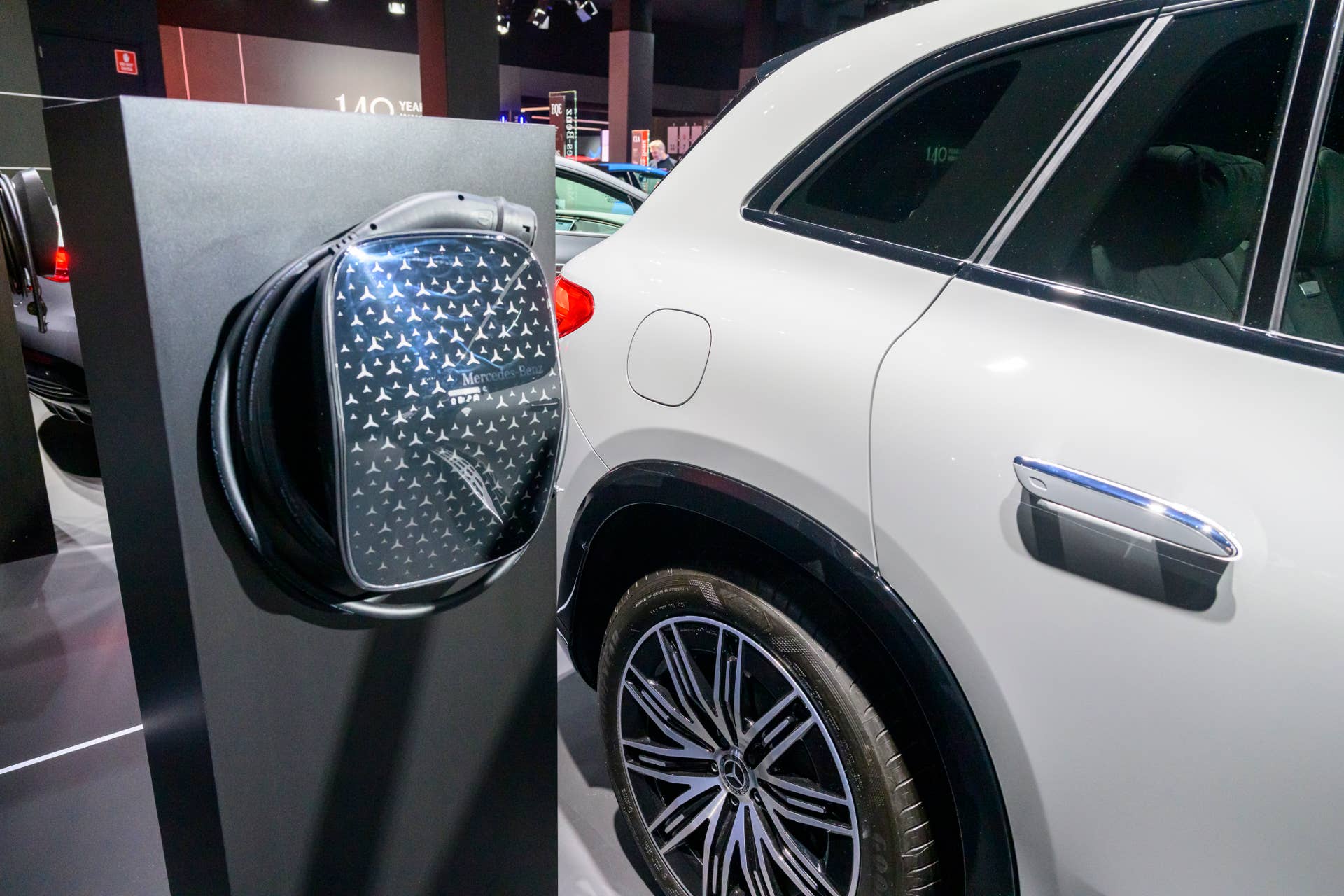
How Mercedes is widening its electric GLC lineup
Mercedes is reading the same data and placing a different bet.
The automaker will reportedly open orders June 9 for two new versions of its electric GLC SUV, with first deliveries before the end of the year, according to Electrive.
The two additions, a rear-wheel-drive GLC 250 EQ and an all-wheel-drive GLC 300 4MATIC EQ, slot in below the GLC 400 4MATIC flagship that launched last October. Mercedes has not officially confirmed the lineup, and Electrive based its report on enthusiast outlets.
Related: President Trump’s 25% tariff is gut punch to German carmakers
The electric GLC is the first model on Mercedes’ new MB.EA-M platform, an architecture built specifically for midsize electric cars. The same underpinnings will carry the coming electric C-Class.
The strategy is plain. Cheaper variants widen the funnel and pull in buyers who balked at the flagship’s roughly 71,000-euro German sticker.
And it is landing. Demand for the electric GLC is “significantly exceeding” the company’s expectations, Mercedes sales chief Mathias Geisen said, according to Electrive. Chief executive Ola Källenius has framed the company’s electric push as a commitment it has no intention of softening.
Be careful not to oversell it, though. Mercedes delivered fewer battery-electric cars worldwide in 2025 than the year before, and this rollout starts in Europe. U.S. deliveries of the GLC do not begin until late 2026, with the cheaper version following in early 2027.
So “doubling down” here means product and commitment, not volume. My read is that Mercedes is stocking the shelf now so it is full when the buyers come back.
The EV retreat by the numbers
- GM took a roughly $6 billion fourth-quarter charge to unwind EV investments, according to CNN.
- Ford booked about $19.5 billion in EV-related charges after canceling programs, CNN reported.
- U.S. electric vehicle sales fell 46% from the third quarter to the fourth, according to Cox Automotive.
- The electric share of new-car sales dropped to 5.8% from a 10.5% peak, Cox Automotive noted.
- The third quarter, before the credit lapsed, was the best-ever for U.S. EV sales, Cox Automotive shared.
What the EV divide means for buyers and investors
Here is where it hits home.
If you are shopping for a premium electric SUV, the timing is strange. Just as U.S. brands trim their electric ambitions, a German rival is about to hand you more choices, including cheaper ones.
There is a catch, though. The new GLC variants are still premium cars, so “more affordable” is relative. The real question is whether Mercedes prices the U.S. versions aggressively enough to matter without a federal credit doing the heavy lifting.
Because that subsidy is gone. Without the $7,500 credit, an EV that once roughly matched a gas model on monthly cost now sits well above it, especially with interest rates still high.
When I lined up the writedowns against Mercedes’ order book, the divide looked less like confidence versus panic and more like two different clocks. Detroit is timing the market. Mercedes is timing the product cycle.
For investors, that divergence is the whole story. GM and Ford are protecting earnings now. If you own their shares, the retreat is meant to defend your dividend, not signal surrender. Mercedes is spending to be ready later, betting that today’s slump is a pause, not a verdict.
Cox Automotive expects electric vehicles to recover to roughly 8% of U.S. sales in the year ahead as new models arrive and charging improves.
The first test comes June 9, when those GLC order books reportedly open in Europe. The bigger one comes in 2027, when the cheaper variants reach U.S. driveways and we learn whether American buyers were truly done with electric cars or just waiting for the right one at the right price.
Watch the sticker. Watch the share data. The automaker that guessed right about when demand returns will own the next decade of the luxury market.