Nvidia’s main issue may no longer be AI chip demand. Washington wants to know whether any of those chips went to the wrong clients.
The issue is critical for investors.
Nvidia (NVDA) just reported another record quarter, with revenue more than doubling from a year earlier. Yet its shares plunged 14% on Nov. 20, extending a sell-off that has shaken confidence in one of Wall Street’s most influential companies.
The pressure intensified Sunday when Treasury Secretary Scott Bessent demanded answers about Nvidia’s chip sales to China and the executives responsible for ensuring compliance with U.S. export restrictions.
“We do need to see who was in charge of compliance there,” Bessent told CBS’s “Face the Nation” on Nov. 22, according to Reuters.
The comments followed founder Jensen Huang’s departure but predated his Nov. 23 reinstatement, amid new government limitations aimed at preventing Chinese businesses from acquiring superior American computer technology.
Still, Nvidia’s new financial estimate has a key twist.
The chipmaker estimates $130 billion in quarterly revenue without China data-center computing sales.
Normal shareholders may wonder: If Nvidia can expand without Chinese data-center income, why is the Trump administration’s inquiry still risky?
Also read: Nvidia stock soars 30% after brutal selloff as Jensen Huang returns
Bessent’s Nvidia warning raises a different kind of financial risk
Nvidia’s latest troubles extend beyond slowing technology stocks. The company faces questions about whether intermediaries delivered advanced chips to China despite American export restrictions.
Reports about Huang’s personal contacts sparked national security and corporate governance inquiries, intensifying the scandal.
Huang resigned as Nvidia’s CEO on Nov. 12. Chief Financial Officer Colette Kress was serving as interim CEO until the company reinstated Huang effective Nov. 23.
Bessent told CBS that the government had contacted Nvidia’s interim management, directors, and lawyers, trying to determine whether staff or upper management knew about compliance issues.
The allegations do not prove that Nvidia or its officials deliberately violated export laws.
Related: David Tepper’s Micron bet raises a $32 billion question
However, the government has tightened limitations. On Nov. 16, the Commerce Department imposed new limitations on offshore data centers that may provide Chinese enterprises with superior processing capacity.
Under the rule published in the Federal Register, certain advanced chip shipments and data-center arrangements require additional export licenses. The regulation took effect Nov. 19.
The limits boost examination of imports to Singapore, Malaysia, Thailand, Indonesia, and Brazil, with exclusions.
Washington worries that Chinese enterprises may acquire restricted American technology via foreign corporations or computer infrastructure.
Nvidia’s concerns go beyond whether a consumer can buy another CPU. Stricter compliance might delay shipments, raise operational expenses, or limit overseas sales. Regulatory inquiries may cost the firm money and result in fines if violations are found.
These are possible effects, not Nvidia results. The difference is noteworthy because Nvidia’s financial performance relies on consumer, regulator, and investor trust.
Nvidia’s $130 billion forecast contains an important China detail
Nvidia’s recent earnings indicate robust technological demand.
The company reported third-quarter fiscal 2027 revenue of $115.8 billion, an increase of 103% from a year earlier. Data-center sales rose 110% to $107.6 billion, accounting for 93% of total sales.
Nvidia also anticipates fourth-quarter sales of $130 billion, plus or minus 3%.
The prediction assumes no Chinese data center computing revenue. So management predicts another quarter of solid growth without direct contributions from a market that is becoming harder to service.
However, a major constraint exists.
Excluding Chinese data center computing sales from a projection does not answer issues about past transactions or guarantee that export restrictions won’t affect other clients, shipments, or companies. It also doesn’t erase the long-term opportunity cost of not selling certain items in China.
Nvidia’s gross-margin forecast is another important metric. Third-quarter adjusted gross margin was 74.9%; fourth-quarter gross margins are expected to be 71% to 72%.
A three-percentage-point gross margin differential would provide $3.9 billion in quarterly gross profit at $130 billion in sales.
That is an example, not a regulated loss projection. Still, it highlights why investors must consider profitability and sales growth.
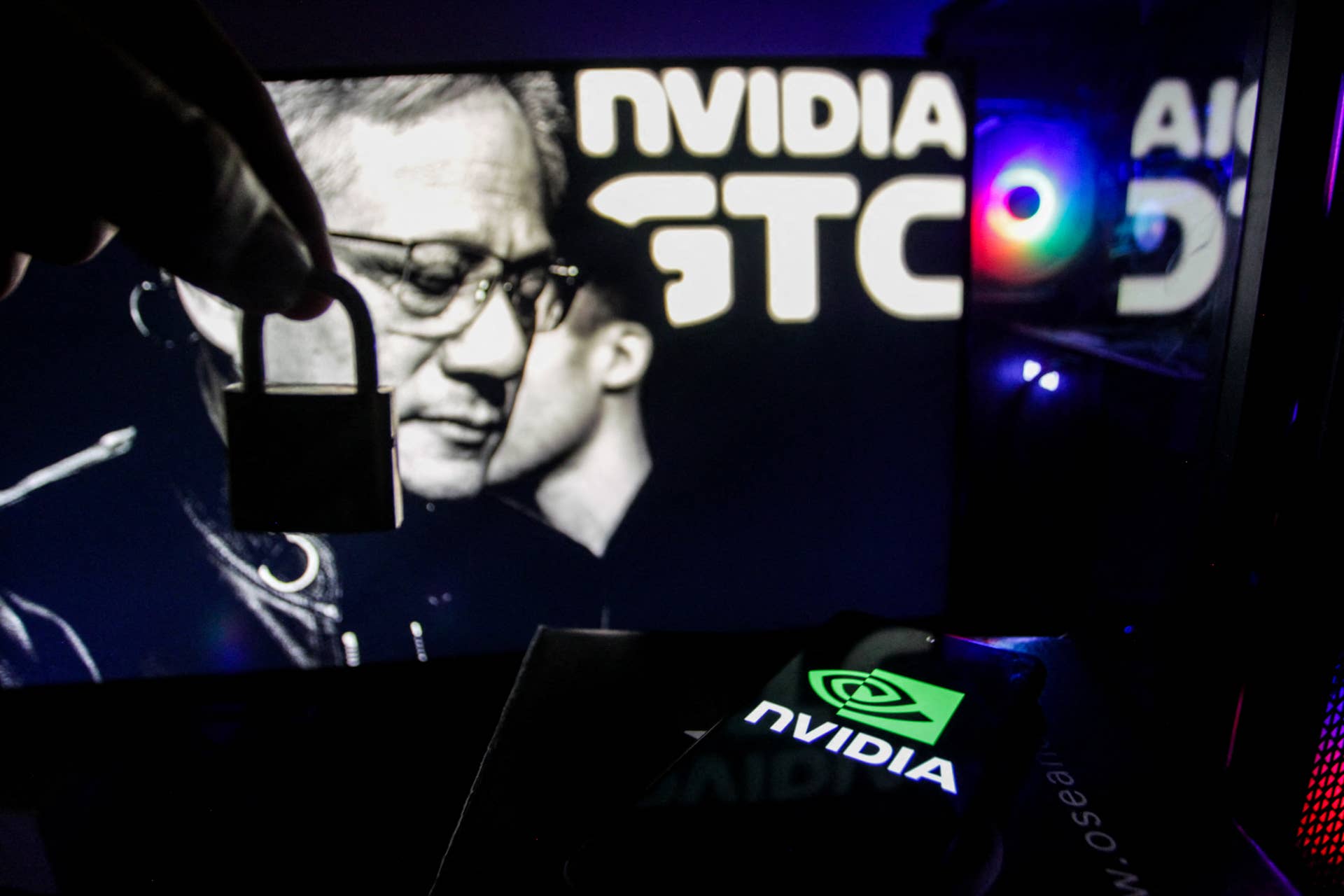
Nvidia’s leadership overhaul faces a Washington test
On Nov. 17, Nvidia announced a new National Security and Export Control Oversight Committee to manage national security, export compliance, and global trade risk.
Nvidia’s national security and trade compliance teams and outside experts will also provide reports.
More Nvidia:
- Microsoft just gave Nvidia shareholders a reason to pay attention
- Nvidia has a stake in SpaceX that came from an unexpected place
- Nvidia’s $12.9 billion deal could shape the AI apps you use
The changes represent a significant shift for a company that has long been closely identified with its founder.
Creating a committee does not always resolve issues about past transactions or internal controls, and Bessent’s recent statements suggest the government wants to know who was in charge of compliance and whether top executives knew about issues.
The decision may affect shareholders’ assessments of the company’s leadership and governance risks.
Processor demand remains high, despite managerial turmoil. Still, investors must watch Nvidia’s financial future and government monitoring.
A reliable description of its compliance practices might alleviate ambiguity, while unresolved issues, further limitations, or proof of infractions may keep the stock under pressure.
What the White House’s Nvidia scrutiny means for shareholders
The company anticipates $130 billion in quarterly revenues, has seen unprecedented growth, and supplies AI infrastructure.
However, its stock has fallen significantly. Nvidia closed at $125.53 on Nov. 20, down approximately 14% for the session.
The decrease indicates a market more vulnerable to dangers outside the company’s control. These include regulatory scrutiny, export limits, and sustainability concerns about AI spending.
Although Nvidia’s recent sales prediction suggests that demand outside China is sufficient to fuel significant growth, resolving regulators’ concerns will be essential for reducing share price uncertainty.
Investors should differentiate between two hazards:
- Export restrictions cost money in missed sales, compliance fees, and shipping delays.
- Inquiries that challenge leadership, internal control, or previously disclosed transactions may erode investor trust.
Watch Nvidia’s reaction to the administration’s queries, its new oversight committee’s performance, and whether federal probes yield further results.
Management’s $130 billion fourth-quarter sales projection and 71% to 72% gross margins offer financial benchmarks.
The more difficult issue is accountability.
Nvidia has proven that its technology can create high demand without Chinese data center computer sales. It must now show that its business practices can withstand scrutiny after that achievement.