Leather Daddy lasted a full Scaramucci before going back to work as CEO of Nvidia, and the market rewarded his return after 11 scandal-ripe days with a great big rebound in the tech sector Nov. 23.
As a result, traders revived the nearly 100% probability of an interest-rate hike when the Federal Open Market Committee meets Dec. 8-9.
The CME Group FedWatch Tool rose to a 95.3% probability that the FOMC will raise rates by 25 basis points, but took a 50-basis-point hike off the table. Futures traders also penciled in at least two more 25-basis-point hikes into July 2027.
Why? Because Jensen Huang’s victory tour at Nvidia’s Silicon Valley headquarters fueled the pro-hike tailwinds trailing the streaming hot mess at the intersection of politics, corporate governance and national security.
“As I live and breathe, I’ve never seen anything like it,’’ is how CNBC’s resident stock guru Jim Cramer described the Nov. 23 rally’s timeline after the market closed.
President Donald Trump, in a nearly hour-long phone call with the cable network earlier in the day, called Huang a “national treasure” and claimed his personal intervention with the Nvidia board paved the way for Huang’s return.
It was a stunning, shocking revelation (frankly, I was gobsmacked while watching it), especially after the Nvidia board of directors said late last week that Huang would not be returning to the chipmaker leading AI computing, GPUs, data centers, graphics, and robotics.
By the end of the day on Nov. 20, Nvidia lost roughly $491 billion in market value, with shares plunging 14.01% to close at $125.53 and bringing its market cap down from ~$3.52 trillion to ~$3.03 trillion.
Nvidia stock rebounded to close at $165.05 Nov. 23, surging 31.48% or $39.52 per share from the Nov. 20 close but still roughly 31% below its record close of $239.24 on Oct. 6.
Hence the frothy market reaction to the unprecedented presidential move to influence a publicly traded company that shocked politicians, government officials, corporate accountability leaders, and even market experts.
But the volatility has a price to pay. And that’s where higher interest rates come in because, as most American consumers and businesses will tell you, prices are just too damn high.
A tech-stock rally does not, by itself, cause the Fed to raise interest rates. Future traders are responding to broader inflation expectations, economic resilience, AI-related investment, and hawkish Fed commentary.
TheStreet
Nvidia rally triggers new Fed rate-hike bets
Fed Chair Kevin Warsh has repeatedly said since taking over the role in May that the Fed is committed to its dual mandate: use interest rates and balance-sheet policy to keep prices stable and the labor market at full employment.
The labor market has been solid for months, but inflation has missed the Fed’s 2% target for nearly six years.
The alleged “Fed put” — investor confidence that the U.S. central bank will be there to rescue if the S&P 500 sells off — was MIA.
A put option gives investors downside protection if a stock falls below a certain level.
While the Fed wouldn’t sit by indefinitely, it may have waited until something closer to a 20% bear market decline as it did back during the 2018 rate-hiking cycle.
As the S&P 500 rocked after the Huang announcement, traders penciled in nearly a 100% probability of a 25-basis-point rate hike in December, then walked those odds back on Nov. 20 after Nvidia.
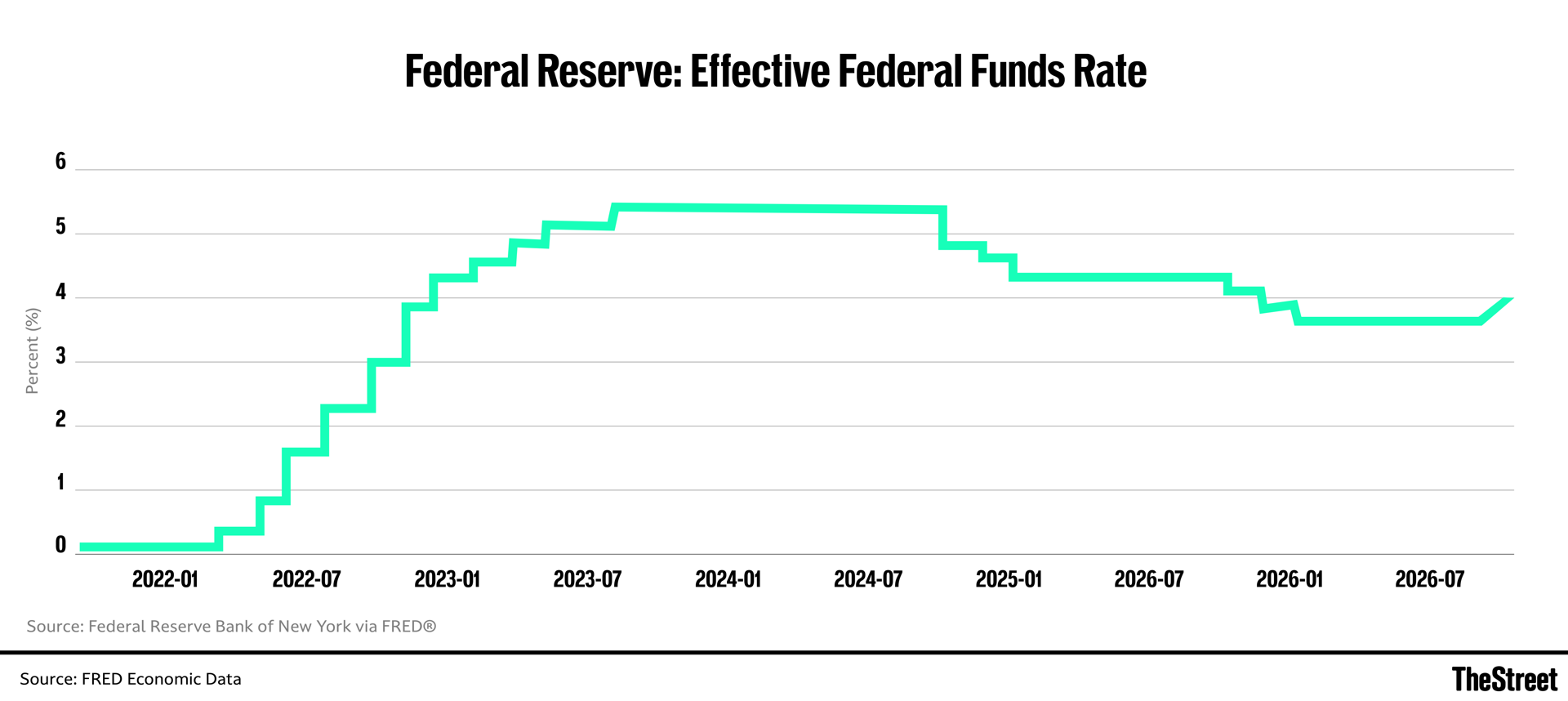
Odds of a further quarter-point rate hike by the Jan. 27 Fed meeting climbed to 69% from 49% on Nov. 20. That would raise the target for the Fed’s benchmark rate to a range of 4.25% to 4.5%.
But wait, there’s more. Odds of another 25-basis-point hike to a 4.5% to 4.75% range by the June 9 Fed meeting rose to 62.5% from 41% on Nov. 20.
FedWatch probabilities reflect futures market expectations and are neither an official Fed forecast nor a guarantee that the FOMC will raise rates.
December FOMC meeting to focus on sticky inflation
October PCE, the Fed’s preferred inflation gauge, will be released Nov. 25 and the November jobs report will come Dec. 4, giving the 12-member FOMC the latest data to weigh how monetary policy can best meet its dual mandate: price stability and maximum employment.
As New York Fed President John Williams said Nov. 23: sticky inflation boosted by tariffs, the energy shock from the Iran War, and the artificial intelligence supply-demand dynamics mean the central bank has work to do to cool inflation by extending its tightening cycle.
“We must take actions over time that will ensure that we get inflation back to our 2% goal in a timely manner and on a sustained basis,” Williams said in prepared remarks. “There is still work to do to get that done.’’
Rate-hike impact on wallets and retirement portfolios
For consumers, businesses and investors, the message from Wall Street is becoming increasingly difficult to ignore: The era of waiting for lower interest rates may take longer than anyone wants.
This means consumers and businesses can expect interest rates on credit cards, private student loans, and home-equity loans to rise through early 2027, and, indirectly, mortgage rates and Treasury bond yields will also be influenced.
As for investors, higher interest rates ripple through the stock market and investor portfolios via several core channels ranging from discounted cash flows and corporate borrowing costs to shifts in asset allocation.
Fed rate-hike pause may be temporary as inflation flares
As I reported, minutes from the Federal Open Market Committee October meeting released Nov. 18, along with some very pointed public remarks from top Fed officials, show the U.S. central bank is becoming increasingly alarmed that price pressures are moving away from its 2% target, but there’s a wide range of opinion within its ranks as to the best approach to lower price pressures.
In fact, when the FOMC held its benchmark short-term interest rate steady at 3.75% to 4% in October with a divisive 10-2 vote, the minutes show several participants described the pause as a “close call.”
Fed Governor Lisa Cook, one of the two FOMC members who voted to raise rates by 25 basis points in October, said Nov. 20 that the October pause threatened to put the Fed behind the curve in its battle to tame persistent inflation.
Related: J.P. Morgan prices in stunning shift in Fed rate-hike call
“In a different environment, the (Federal Open Market) Committee could afford to be patient, but I continue to believe that in this economic climate we do not have that luxury,” given how high inflation is and for how long it has been above the Fed’s 2% target, Cook said.
Cook said the AI buildout is a global undertaking, and it is reshaping economies in ways that are only beginning to be understood.
“In the U.S., labor markets appear resilient to date, but AI adoption is still in its early stages, and I think it is too soon to feel comforted. We do see that some workers have already been affected by AI,’’ she said.
Fed governors send definite hawkish signals
Cook was one of four Fed Governors — including Vice Chair Philip Jefferson, Michael Barr, and Christopher Waller — signaling decidedly hawkish tones last week.
Waller doubled down on his comments earlier this month, saying that rising price pressures call for a jumbo 50-basis-point rate hike in December.
“You might need to, like, shock people,” he said.
The Nov. 23 market rally took a possible 50-basis-point hike off the table for many Fed watchers.