Many retirees have carefully planned for what will happen to their homes, investments, and other assets when they die.
But what about their pets?
Unlike children or other family members, pets cannot inherit money directly, and even a well-intentioned relative may be unprepared to assume responsibility for their care.
That can create both a financial problem and an emotional one, particularly when illness, incapacity, or a move to assisted living makes it impossible for an owner to continue caring for an animal.
In a recent interview with me, Erin Itkoe, CPA/PFS, CFP(r), president of Luminescent Wealth Management, said pet owners need to think beyond who might take the dog or cat.
Itkoe, who is also a member of the American Institute of CPAs (AICPA) Personal Financial Planning Executive Committee and serves as chair of the AICPA’s PFP Champions task force, said they also need to consider legal arrangements, ongoing expenses, emergency instructions and backup caregivers.
And because veterinary and medical costs can rise as animals age, pet ownership belongs in the retirement spending plan, too.
Below is a transcript of my interview with Itkoe, edited for brevity and clarity.
Why pets need their own estate planning arrangements
Bob Powell: You mentioned that pets generally cannot inherit assets. That may sound funny on the face of it, but explain why that matters.
Erin Itkoe: Being a dog owner myself, our pets don’t have Social Security numbers. They don’t have bank accounts, so they can’t actually inherit assets.
Even though we view them as our family, a lot of times as our children, we have to plan for them differently than we would a child, a friend, or another family member.
That’s where possibly setting up a pet trust comes into play.
Powell: Why does estate planning for a pet matter for retirees?
Itkoe: So many retirees have pets, and their pets are like family.
When you’re talking about your estate plan and thinking about your family, you also want to make sure that you include your pets, especially what will happen to them if you can no longer care for them.
You want to make sure they’re continuing to receive the care that they deserve and that you want them to have if your circumstances change.
What pet ownership research reveals about planning
Powell: There was an AICPA study that looked at pet ownership among adults age 55 and older. Walk us through some of the statistics.
Itkoe: Through the AICPA study, 43% of adults age 55 and older own a dog, and 27% own a cat.
Pet owners age 65 and older are more likely than younger pet owners to say that if they had to make cuts to their spending, they would likely cut spending on themselves first before spending on their cats.
Pet owners age 55 and older are also less likely than younger pet owners to report having their pets as part of their trust or will.
Powell: And only a relatively small percentage have even thought about including their pet in a will or trust?
Itkoe: Only about a third have even thought about it.
How to provide for a pet after your death
Powell: What advice do you have for retirees planning for the future of their pets?
Itkoe: One of the first things is to review your estate plan documents and make sure that if you have a pet, you have a plan for them.
Depending upon your circumstances, you might want to create a pet trust or some other legal arrangement. Or you may want to make sure that you’ve had a conversation with someone and that funds are set aside in your estate plan so that person can take care of the pet and cover its needs should you pass away or no longer be able to care for it.
Powell: Explain how a pet trust works.
Itkoe: You would set up a separate trust, and the trust would be funded. You would name someone to manage the trust.
You could name two different people. You could name one person in your documents to actually care for the pet and someone else to handle the finances if you want to keep those separate.
The trust would be funded for the pet’s care needs for the rest of its life.
A lot of times pet owners just think that family’s gonna step in and just, you know, inherit the pet and take care of it, but you gotta make sure there’s a plan for that.
You can also include provisions for what happens with any remaining assets when the pet is gone. Does the money go to the person who was caring for the pet? Does it go to another family member? Does it go to charity?
You can include provisions around what your wishes are and how you want that pet to be cared for.
What an emergency pet care plan should include
Powell: You also recommend creating a pet care plan for emergencies. What should that include?
Itkoe: This comes into play for anyone of any age, but especially seniors.
If something happens to you and you end up in the hospital, for example, and can’t provide care for that pet, you want to make sure that whoever is stepping in knows what to do.
Make sure you have written instructions and you’ve told whoever is going to be caring for that pet where the instructions are.
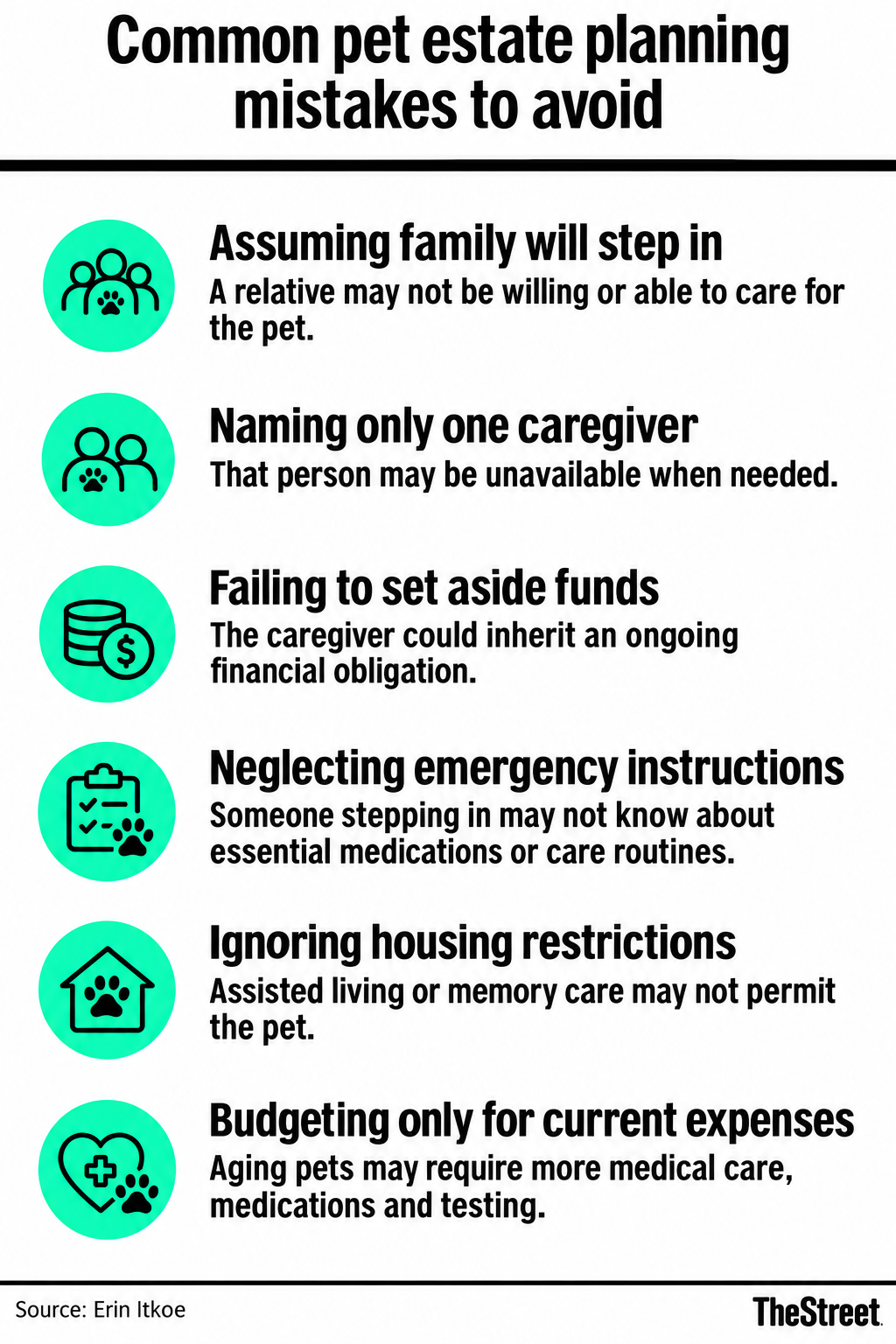
Include specifics for that pet’s feeding routine, medications, including when the medications need to be given and how.
If your dog goes on a walk at a certain time every day and is going to expect that, make sure the caregiver knows what the pet’s routine is.
Include veterinary contact information so that should the pet become sick, they know who to contact.
Include behavioral notes, such as certain things that agitate the pet, so that someone stepping in isn’t surprised and can provide the same care that you’ve given them.
Also include other emergency contacts so that should something happen, that person knows who to contact.
Why every pet needs backup caregivers
Powell: You also emphasize the importance of having a backup plan for a successor caregiver. Why?
Itkoe: As with all planning, it’s important to make sure that you have a bench of people listed.
If something happens to you, maybe whoever that primary person is that you wanted to step in and care for your pet isn’t able to at that time.
More Retirement
- The year-end RMD trap: Why waiting until late December could cost retirees 25%
- The “Gap Year” Roth: Early retirees slash lifetime taxes before RMDs hit
- Tax-loss harvesting guide: $3,000 limit & wash-sale rules
It’s important to have a bench and have at least one or two backups behind that primary person to make sure your pet is taken care of.
Make sure you’ve had conversations with these people and that they’re willing to step in and care for your pet going forward should you not be able to.
They should know where you’ve documented everything about your pet, understand your pet’s needs and expected expenses, know where the funds are and how care will be paid for, and understand your wishes for the pet’s care and quality of life.
How assisted living can complicate pet ownership
Powell: Housing needs often change as people age. What do older pet owners need to know about that?
Itkoe: Retirement often brings housing changes. Sometimes people need to move to assisted living, memory care, or another community.
A lot of times those communities have restrictions on pets.
If you have a pet, it’s important to look into your options before you need to make any of these changes.
Find out what residences allow pets and, if they do, whether there are additional costs or other requirements so you can plan for them.
If it ends up that you don’t have options where your pet can come with you, that’s where having an emergency contact in place becomes important, someone who can step in and care for the pet going forward.
How to budget for pets in retirement
Powell: We always tell older adults to plan for the expenses they’ll have in retirement. It’s no different with pets. What expenses should retirees factor into their planning?
Itkoe: Most certainly, you need to include ongoing expenses such as food, normal veterinary care, and any medications they’re on today.
Some pets need grooming. Sometimes you may want pet insurance. You need to factor in all of those costs.
But as with people, pets’ costs often increase as they age, as they need different medications or have to have different care and testing done.
You need to make sure that you include a cushion in your budget for those potential increases as well.
What pet owners should remember most
Powell: We’ve covered a lot of ground. What bears reemphasizing before we wrap up?
Itkoe: As you’re planning your budget, estate planning needs and future needs, our pets are our family.
A lot of times they get overlooked because they aren’t that person you can name in your documents. But they are just as important to us, and we need to make sure that we’re planning for them and thinking about what will happen to them and how they’ll be taken care of should we not be able to.
Related: Why relying on AI chatbots for your 401(k) could cost you thousands in lost company matches