Should retirees replace some of their bonds with annuities?
Retirement researcher Wade Pfau argues that doing so can provide guaranteed lifetime income while allowing the rest of a portfolio to remain invested for growth.
But choosing an annuity requires understanding some consequential differences among fixed indexed annuities, registered index-linked annuities, and variable annuities.
Pfau, creator of the Retirement Income Style Awareness assessment, explained in a recent episode of “Decoding Your Money” how these products work, what their guarantees actually mean, and why an annuity offering an attractive benefit today may become a costly mistake tomorrow.
Below is a transcript of my interview with Pfau, edited for brevity and clarity.
Why might annuities replace bonds in retirement?
Bob Powell: Wade, retirees often think of annuities as an alternative to stocks. But you’ve argued that they should think of them as an alternative to bonds. Why?
Wade Pfau: I think often when people are thinking the annuities are a bad idea, they’re thinking of it as all or nothing, and then they start comparing them to the stock market, that the stock market’s gonna outperform anything the annuity could do.
But the reality is most retirees would only put a portion of the assets into the annuity and they’re not gonna be a hundred percent stocks in retirement.
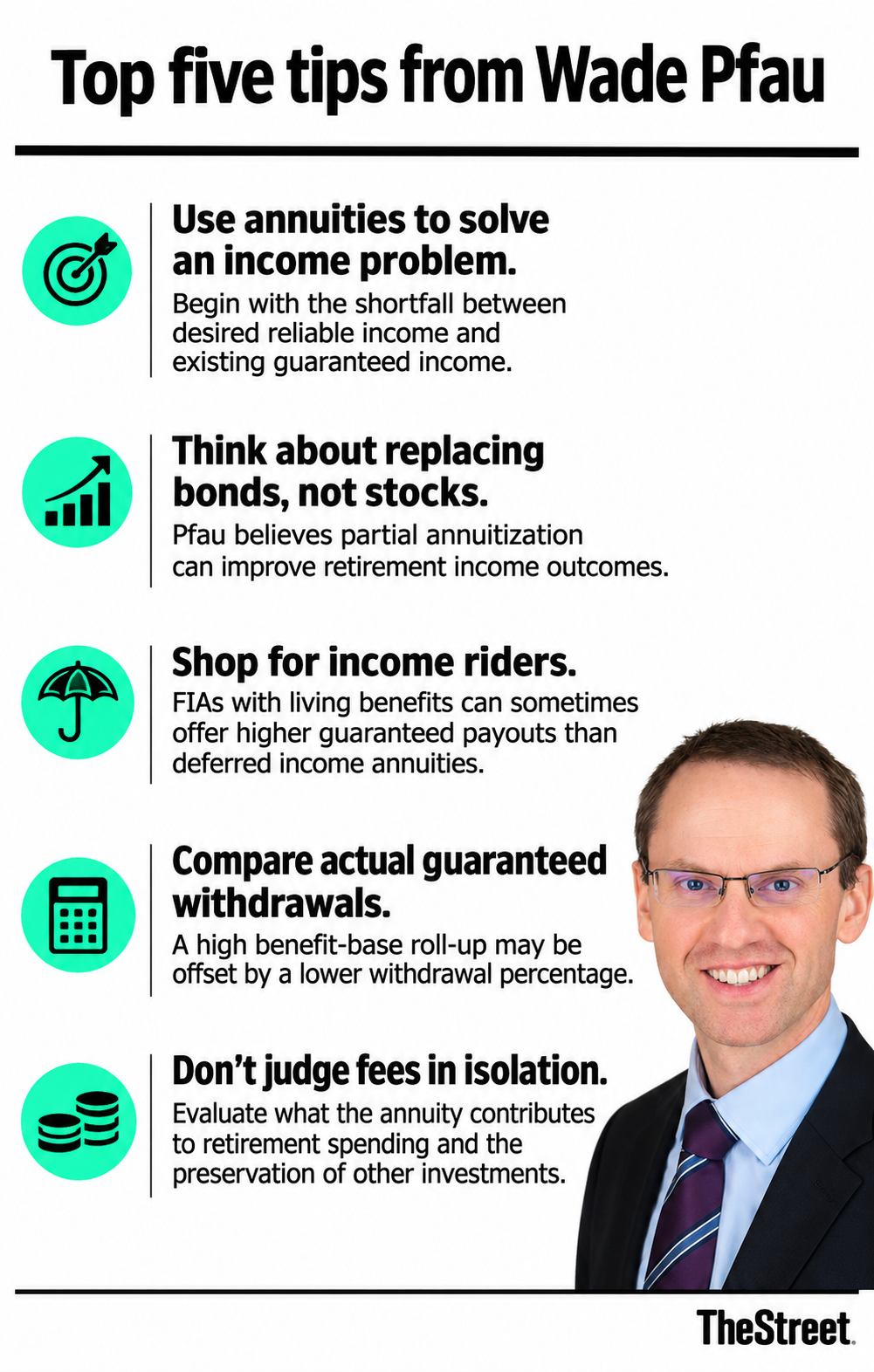
To the extent you’re shifting from bonds to the annuity, the annuity is just a much more efficient way to support retirement income than bonds.
I like the way I summarize this: The efficient frontier for retirement income. Instead of stocks and bonds, it’s stocks and annuities providing lifetime income.
Powell: So the idea isn’t necessarily to give up the stock market’s growth potential?
Pfau: Right. In the research I do, it shows a lot of value for incorporating annuities as bond alternatives. You’re not selling stocks to buy the annuity. You’re selling bonds to buy the annuity, and that can improve long-term financial planning outcomes.
Annuities are not good or bad by themselves. They work best in a plan when they’re used to replace some of the bonds.
If you’ve got that desire for protection, you’re not necessarily sacrificing upside growth potential if you allocate a portion of those assets into an annuity providing lifetime income. That gives you security and the license to spend throughout retirement.
How much guaranteed retirement income do you need?
Powell: Before choosing an annuity, what should someone figure out?
Pfau: The first thing is that an annuity is really meant to fill an income gap. Look at your Social Security, look at any pensions, and see whether there’s still a gap.
Say I’d really like to have $80,000 of reliable income, but between Social Security and a small pension, I’ve got $60,000. I have a $20,000 gap. Would I like to allocate from my bond portfolio to help fill that gap through an annuity?
Instead of stocks and bonds, it’s stocks and annuities providing lifetime income.
Powell: And if Social Security and pensions already cover someone’s expenses?
Pfau: You don’t need the annuity if Social Security and a pension already give you more than you need to spend.
It’s filling an income gap. If that aligns with your desire for contractual protection and safety, those are the two main indicators that would lead you toward considering an annuity.
Which retirement income strategy fits your preferences?
Powell: You’ve created the Retirement Income Style Awareness assessment, or RISA. What does it tell people?
Pfau: There are a lot of different ways to build a retirement income plan, and there are different viable approaches.
A colleague of mine, Alex Marghia, who has a Ph.D. in psychology, and I wondered whether we could create an assessment tool to help people identify which approach might be right for them.
One is an investment-oriented approach, relying primarily on investments, including strategies like the 4% rule or variable spending.
Another is income protection. You first build a floor of reliable lifetime income and then invest on top of that for discretionary goals.
There’s also bucketing, where you hold bonds for upcoming expenses and stocks for longer-term expenses.
RISA uses a series of questions to guide people toward a starting point based on their preferences and how they think about retirement.
Powell: And there are four retirement income styles?
Pfau: Yes. Total returns means you’re comfortable relying on market growth and want maximum flexibility.
Income protection is the opposite. For basic retirement expenses, you want contractual protection, and you’re comfortable committing to a strategy that solves your lifetime income need.
Robert Powell interview with Wade Pfau, Decoding Your Money, finStream, Nov. 21, 2026.
Time segmentation, or bucketing, is a behavioral version of total returns investing. You position fixed income assets for upcoming expenses and stocks for long-term growth.
The fourth is risk wrap. That’s a cousin of income protection. It helps explain the development of annuities that offer growth opportunities, liquidity, and guaranteed lifetime income that may increase when markets perform well.
Powell: Can someone use income protection for essential expenses and market investments for growth?
Pfau: Yes. That’s the income protection style.
First, build a floor of reliable lifetime income. Social Security counts. Pensions count. If there’s an income gap, you might look at fixed annuities.
Then invest on top of that.
With total returns, you don’t really think about building a floor. You draw from the portfolio as needed to meet expenses.
How do fixed indexed annuities work?
Powell: Let’s start with fixed indexed annuities. What should consumers understand?
Pfau: The starting point is the traditional income annuity. You pay a premium, annuitize the contract, and receive a defined income, potentially for life. You no longer have liquidity for those funds.
With deferred annuities, including fixed indexed annuities, registered index-linked annuities and variable annuities, you don’t have to annuitize the contract.
They can be accumulation tools, providing tax deferral. But the big innovation for retirement income is the optional living benefit rider.
That can guarantee lifetime income without requiring you to annuitize the contract. You maintain control over the underlying contract value.
With a fixed indexed annuity, you also have principal protection. If the linked market index experiences a loss, you’re credited with 0% interest for the term rather than experiencing that market loss.
Powell: But you don’t receive all the market’s upside?
Pfau: Correct. Suppose the annuity is linked to the S&P 500 and has a 7% cap.
If the index is down 5%, you receive zero. If it’s up 3%, you receive 3%. If it’s up 20%, you receive 7%.
You’re receiving somewhere between zero and 7%, depending on the index’s performance. And generally, it’s based on price returns, not dividends.
Powell: What about participation rates?
Pfau: Instead of a cap, an annuity might have a 50% participation rate.
If the index increases 5%, you’d receive 2.5%. If it increases 20%, you’d receive 10%.
With a participation rate, you might do better when markets perform very well. But with positive, more modest growth, a cap might be preferable because you’re receiving 100% participation up to that cap.
Powell: Are these products bond alternatives?
Pfau: I think of them that way.
There are important differences. Bonds in a taxable brokerage account generate interest that is generally taxed annually, while the annuity provides tax deferral until distribution.
Bonds can also experience losses when interest rates rise. Fixed indexed annuities have principal protection against negative index performance.
And over time, there’s the potential for fixed indexed annuities to outperform bonds on a growth basis.
Powell: Does the particular index matter?
Pfau: The S&P 500 is the most common, and most insurance companies offer it. That makes comparing terms easier.
I’d be more cautious about proprietary indexes designed to have lower volatility.
They may offer higher caps, but it’s harder to know how competitive those terms are because you may not have comparable offerings from other companies.
Can an income rider guarantee payments for life?
Powell: You’ve mentioned living benefits several times. What exactly does a living benefit do?
Pfau: Living benefits are available with fixed indexed annuities, registered index-linked annuities, and traditional variable annuities.
They often have an annual charge.
The benefit defines how much you’re allowed to withdraw each year. As long as you don’t exceed that amount and comply with the terms, the insurance company promises that if the account value reaches zero, it will continue paying the promised income.
That can be for one lifetime or, with a joint-life rider, two lifetimes.
Powell: But the rider itself can reduce the account value?
Pfau: Yes. Suppose you have a fixed indexed annuity that credits zero for the year and the rider fee is 1%.
Your account value would decline 1% to pay for the rider.
Principal protection applies to the index-crediting mechanism, but rider charges can still reduce the account value.
Powell: Are you a fan of income riders?
Pfau: I am, especially with fixed indexed annuities when there’s a deferral period of five or 10 years.
In theory, a deferred income annuity should offer the highest payout rates. But in practice, fixed indexed annuities with living benefits can sometimes offer higher payouts.
Part of the reason is that some people pay for the protection but never use it. They don’t turn on the rider or withdraw as much as they’re allowed.
That reduces the likelihood that their accounts will deplete, which puts less pressure on the insurance company.
It’s definitely worth shopping around.
How do RILAs balance market gains and losses?
Powell: Let’s turn to registered index-linked annuities, or RILAs. How do they differ from fixed indexed annuities?
Pfau: They have a lot in common. You’re choosing an external market index and receiving credits based on its performance.
The big difference is that you can lose money with a RILA.
By accepting some downside risk, you can get more upside growth potential.
Suppose a fixed indexed annuity has a 7% cap. A RILA with a 10% buffer might support a 17% cap. With that 10% buffer, if the market declines 18%, you lose 8%.
Powell: How should someone choose the buffer?
Pfau: Different companies might offer buffers of 10%, 15%, 20%, or 40%.
With a 40% buffer, you’re getting pretty close to a fixed indexed annuity because you’re only exposed to losses exceeding 40%.
Most people considering RILAs are probably looking at buffers around 10% to 20%.
The trade-off is straightforward: The more downside risk you accept, the more upside growth potential you can receive.
Powell: There’s also something called a floor. How does that work?
Pfau: A 10% floor means you’re exposed to losses up to 10%, but not beyond that for the specified term. If the market declines 8%, you lose 8%. If it declines 18%, you lose 10%.
I prefer the buffer approach because smaller market downturns are much more common than very large ones.
Powell: What’s the best retirement income use for a RILA?
Pfau: With a living benefit, you would compare the income it provides if markets don’t perform well with the potential for income increases if markets do reasonably well.
A RILA might provide less guaranteed income initially than a fixed indexed annuity, but it may have more growth potential. That could lead to increases in the income you’re able to receive.
The question is whether you’re comfortable accepting that trade-off.
What makes traditional variable annuities different?
Powell: What about traditional variable annuities?
Pfau: With a traditional variable annuity, you choose investment subaccounts. They’re similar to mutual funds, and you build an asset allocation inside the annuity.
The contract provides tax deferral, and you can add living benefits that guarantee lifetime income.
Traditional variable annuities with living benefits used to be more common, but we’re seeing more emphasis on fixed indexed annuities and RILAs.
One reason is that traditional variable annuities can be harder for insurance companies to manage.
People can make poor investment decisions, including buying high and selling low.
If those decisions cause the account to run out of money, the insurance company remains responsible for the promised lifetime income. That can contribute to higher rider fees.
Powell: And what about mortality and expense charges?
Pfau: Traditional variable annuities can have investment fund fees, mortality and expense charges, and rider fees.
Those combined costs can exceed 3%, potentially reaching 3.5%.
Fixed indexed annuities and RILAs generally don’t have that same combination of charges, although optional riders may have fees.
Can high annuity fees still produce better outcomes?
Powell: Those fees sound expensive. Why shouldn’t consumers reject the product on that basis?
Pfau: A big part of these tools is that you should expect to spend the contract value down to zero. That’s how you get the most value out of the annuity.
The annuity becomes the workhorse of retirement income.
If it’s covering a disproportionate amount of spending, you don’t need to withdraw as much from your other assets. That reduces sequence-of-returns risk and makes it easier for your non-annuity assets to grow.
You may end up with a bigger legacy using a partial annuity strategy. The legacy isn’t coming from the annuity. It’s coming from the assets outside the annuity.
Powell: Does longevity matter?
Pfau: Yes. If you don’t live very long, you might have a slightly higher legacy without the annuity because of lower fees on your non-annuity assets.
But once you get beyond life expectancy, for many people in their mid-80s, the partial annuity strategy can increasingly produce a larger legacy.
That’s why I think the fee drag on an annuity can sometimes be overstated.
Why isn’t a 10% roll-up a 10% return?
Powell: One of the biggest sources of confusion seems to be the benefit base. What is it?
Pfau: The benefit base is a hypothetical number used to calculate how much income you can receive. It isn’t necessarily the actual value of the annuity.
A traditional variable annuity might have a benefit base linked to the highest account value achieved on a contract anniversary. It might also have a roll-up rate that increases that hypothetical benefit base during the deferral period.
Powell: Walk us through an example.
Pfau: Suppose you put $100,000 into an annuity with a 10% simple annual roll-up rate.
The benefit base increases by $10,000 each year. After 10 years, the benefit base would be $200,000.
People sometimes think that means they’re receiving a guaranteed 10% investment return. But that’s not what it means at all.
If you leave the contract, you don’t receive the benefit base. You receive the actual contract value, based on underlying performance net of fees.
The roll-up rate isn’t a return on your assets.
Powell: So a higher roll-up rate doesn’t automatically mean a better annuity?
Pfau: Exactly. An insurance company could offer a 20% roll-up rate but reduce the withdrawal rate applied to the benefit base.
If you double the benefit base but cut the withdrawal rate in half, you’re not any better off. That’s why consumers need to understand all the moving parts rather than focus on one attractive number.
What can surrender charges cost you?
Powell: How liquid are these deferred annuities?
Pfau: You can access the underlying contract value, but there may be surrender charges in the early years.
As a hypothetical example, you might face a 7% surrender charge in year one, 6% in year two, and 5% in year three.
After seven years, the charge might disappear.
These products are intended to be held for the long term, but surrender charges can reduce your liquidity if you need the money sooner.
Powell: What about the ability to withdraw 10% without a surrender charge?
Pfau: That’s pretty common. But companies may calculate the 10% differently. It could be based on the original premium or the remaining account value.
You need to understand exactly how the contract defines that free withdrawal.
How important is the insurer’s financial strength?
Powell: What should buyers know about the financial strength of the insurance company?
Pfau: If you’re relying on an annuity for lifetime income, you want an insurer with strong finances and a strong credit rating.
States also have guaranty associations, but coverage varies by state.
You need to understand the applicable limits and whether the protection extends to the particular type of annuity and living benefit you own.
One strategy is to diversify among insurers rather than concentrate all your annuity assets with one company.
When should retirees purchase an annuity?
Powell: Does age matter when buying these products?
Pfau: Age matters, but I don’t think there’s one universally best age. Longevity credits begin to increase more rapidly around age 75 because mortality rates rise.
That can support higher payout rates for someone purchasing an income annuity at an older age. But buying earlier also means receiving those credits over a longer period.
Someone might consider reallocating from bonds into deferred annuities five to 10 years before retirement, with income beginning when they retire.
Others might prefer to preserve flexibility and wait.
Powell: How do health and interest rates factor into the decision?
Pfau: Generally, people in good health benefit more from lifetime annuities because they’re more likely to receive payments over a longer period.
Someone in poor health might consider whether an underwritten annuity could provide a better quote.
Higher interest rates generally support higher annuity payouts and potentially better terms, including higher caps on fixed indexed annuities and RILAs.
Powell: Should someone buy after a strong stock market?
Pfau: If market gains have put you in a position where you’re adequately funded for retirement, it may be an opportunity to take some risk off the table.
You can allocate some assets to an annuity and lock in protected lifetime income.
If you’re underfunded, the decision is harder. Whether to stay invested or reduce risk depends partly on your retirement income style.
There’s no clear agreement about one best approach.
Should annuities be held in retirement accounts?
Powell: Should someone purchase an annuity inside an IRA or with money from a taxable account?
Pfau: There’s no simple answer.
In a taxable brokerage account, selling appreciated investments to fund an annuity could trigger capital gains taxes.
On the other hand, the annuity’s tax deferral may provide a benefit in a taxable account.
More Retirement
- The year-end RMD trap: Why waiting until late December could cost retirees 25%
- The “Gap Year” Roth: Early retirees slash lifetime taxes before RMDs hit
- Tax-loss harvesting guide: $3,000 limit & wash-sale rules
Inside a qualified retirement account, you’re already receiving tax deferral. You generally don’t have to realize capital gains to reallocate investments within that account.
You’re not buying the annuity primarily for tax reasons. You’re buying it because you want more reliable income.
Then you figure out the most tax-efficient way to accomplish that based on your circumstances.
When is exchanging an annuity a costly mistake?
Powell: People who already own annuities may be offered the opportunity to exchange them for newer contracts. When does that make sense?
Pfau: There can be good reasons to exchange an annuity. But you have to be careful, particularly if an older contract has a valuable living benefit.
Suppose you bought a variable annuity 15 years ago. Today, the benefit base is $100,000, but the actual contract value is only $20,000.
If you move that $20,000 into another annuity, you may lose the $100,000 benefit base. You’d be starting over with a much smaller amount from which to calculate income.
Powell: So even an annuity that wasn’t particularly attractive when purchased could become valuable?
Pfau: Exactly. You don’t want to decide that an annuity is bad and surrender it without investigating the value of its living benefit.
Sometimes the existing guarantee may be worth considerably more than what you could obtain with a replacement contract.
And be careful when an agent suggests moving to another annuity simply because the existing contract has reached the end of its surrender-charge period.
That may create an opportunity for the agent to earn another commission. That isn’t, by itself, a good reason to exchange annuities.
What should buyers ask an annuity agent?
Powell: What should consumers ask about compensation?
Pfau: You definitely want to understand how the agent is compensated.
Many annuities pay commissions. That’s not inherently bad. A one-time commission could be less expensive over the long run than paying an adviser an annual fee of 1% of assets.
But you should understand the compensation structure and how it affects the product being recommended.
Powell: Should buyers insist on seeing alternatives?
Pfau: Ideally, yes.
Think about the free steak dinners that some agents and advisers offer to attract retirees. They may be pitching a particular fixed indexed annuity because it pays a higher commission.
That doesn’t necessarily make it the best product for the consumer.
You’re not really getting a free dinner. You’re paying for everyone’s dinner and then some through the annuity’s terms.
You need to shop around and compare alternatives.
Powell: What about beneficiaries?
Pfau: With a deferred annuity, if there’s a remaining contract value, you can generally name a beneficiary to receive it.
Income annuities can also offer provisions such as cash refunds. But the tax rules for inherited annuities can be complicated, particularly when the contract includes additional benefits.
It may make sense to consult a CPA.
What is the most important number before signing?
Powell: If you had to identify one number every annuity buyer should know, what would it be?
Pfau: The amount of premium going in and whether that fills the income gap you’re looking to fill.
Powell: And if someone takes away just one lesson from our conversation?
Pfau: Annuities are not inherently good or bad. Get away from thinking it’s all or nothing, or that it’s annuities versus the stock market.
Annuities work best in a plan when they’re used to replace some of the bonds.
If you want protection, allocating a portion of your assets to an annuity can provide lifetime income and give you greater security and the license to spend throughout retirement.
Related: Why relying on AI chatbots for your 401(k) could cost you thousands in lost company matches