CoreWeave (CRWV) shareholders have watched a rough stretch.
The stock fell about 17% over the past week as investors reacted to the company’s plan to spend far more on data centers than expected.
That kind of spending scares people who want profits now, not years from now.
Shares recently traded near $86, down sharply from where they sat earlier in the month. But one analyst looked at the same numbers and reached the opposite conclusion.
Truist Securities thinks CoreWeave could nearly double from here. The firm sees a specific reason why the recent sell-off creates an opening rather than a warning.
Why Truist raised its CoreWeave price target to $165
Truist analyst Arvind Ramnani lifted his price target on CoreWeave to $165 from $155 while keeping a Buy rating, CNBC reported.
That new target points to a nearly 88% increase from CoreWeave’s Friday, Aug. 21, closing price.
Ramnani’s core argument sits on one point that many investors missed during the sell-off. He believes CoreWeave’s pricing power will more than cover the higher costs coming from Nvidia’s chips.
CoreWeave is a specialized AI cloud company. It rents out Nvidia graphics processing units, the chips that power the training and running of AI models, to businesses that need heavy computing but do not want to build their own data centers.
How CoreWeave’s July price hike changes the math
Here is the move Ramnani focused on: CoreWeave raised prices across its entire cloud lineup by 25% in July, as Investing.com reported.
Meanwhile, Nvidia is reportedly raising prices on its newest AI server systems by about 17%, The Information reported.
Those higher chip costs feed straight into CoreWeave’s spending.
CoreWeave raised its own prices more than its main supplier is raising costs.
More AI Stocks:
- Bank of America tweaks CoreWeave stock forecast after earnings
- Bank of America sends blunt message to Nvidia stock investors
- JPMorgan warns AI stocks echo the dot-com bubble
Timing matters just as much as the size of the increases.
Ramnani expects CoreWeave’s higher prices to reach customer contracts during the second half of 2026. Nvidia’s cost increases, by contrast, only hit systems shipped in early 2027, Yahoo Finance reported.
That gap hands CoreWeave several months where it collects more revenue before its costs climb.
What the margin uplift means for CRWV shareholders
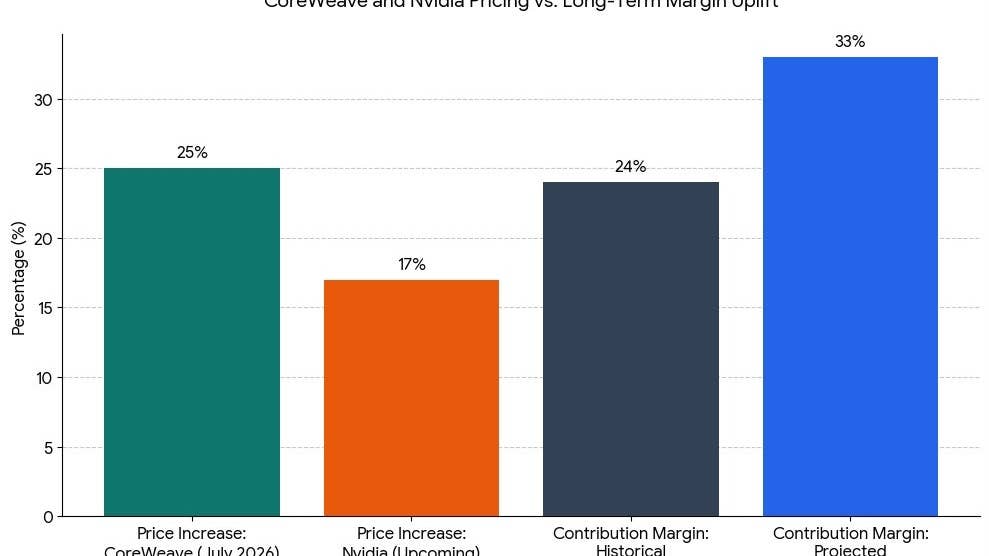
Ramnani’s analysis suggests contribution margins on longer-duration customer contracts could rise from about 24% to 33%.
Contribution margin measures how much money is left from each sale after the direct costs of delivering it. So a jump from 24% to 33% means CoreWeave keeps a much bigger slice of every dollar it books on those deals.
For shareholders, that shift supports the case that CoreWeave can grow revenue and improve profitability at the same time.
TheStreet
The figures below lay out the pricing gap and the margin change Truist expects.
- CoreWeave price increase (July 2026): 25%
- Nvidia price increase (early 2027, reported): 17%
- Contribution margin, historical: 24%
- Contribution margin, projected: 33%
CoreWeave raised prices 8 percentage points more than Nvidia did.
Combined with the expected 9-point rise in contribution margin, that gap explains most of why Truist expects the stock to climb sharply.
Where CoreWeave’s growth is heading next
CoreWeave built its business renting raw computing power for training AI models. Ramnani highlights a shift that could make the company’s revenue steadier.
CoreWeave is moving into managed inference, which means helping companies run their finished AI models in live use rather than just building them.
That business is growing fast.
Managed inference booked annual recurring revenue climbed from $1 million to more than $100 million since launch.
Related: Cathie Wood buys $16.2 million of popular semiconductor stock
The company’s management expects to exit 2026 with at least $250 million, according to The Motley Fool.
Inference contracts tend to run longer and generate more predictable cash than one-off training jobs. That predictability is exactly what nervous investors have been asking for.
CoreWeave’s second-quarter results already showed the demand.
Revenue rose 112% from a year earlier to $2.58 billion, and the company added nearly 500 megawatts of active power, CNBC reported.
The risks that could cap CoreWeave stock gains
CoreWeave is spending aggressively, and that spending carries real risk if AI demand slows.
- Rising spending: CoreWeave raised its full-year 2026 capital expenditure guidance to a range of $35 billion to $39 billion, up from $31 billion to $35 billion.
- Widening losses: The buildout pushed the second-quarter net loss to $626 million, up from $290 million a year earlier, driven mostly by a $640 million interest expense.
- Concentration and selling: Meta accounts for a large share of CoreWeave’s backlog, and insiders have sold stock in recent months, two factors that could limit near-term gains.
Ramnani has covered CoreWeave through several sharp swings this year, including a July note where he upgraded the stock to Buy after a steep three-month decline.
His view rests on a business firing on demand and pricing while burning through cash quickly.
What still needs to happen for the $165 target
Truist’s target depends on a chain of events playing out.
- CoreWeave needs its July price increases to flow into contracts on schedule during the second half of 2026.
- It needs the margin improvement to show up in reported results, not just in the model.
- The company also needs demand to stay strong enough that customers accept higher prices without walking away.
If those pieces fall into place, the $165 target implies a stock that nearly doubles from the Friday, Aug. 21, close. If capital spending outruns the revenue gains, or if a major customer pulls back, the path narrows quickly.
CoreWeave’s pricing power gives it a real path to higher margins. At the same time, its heavy borrowing means a slowdown in AI spending could hit the stock hard.
Ramnani’s note gives the bull case a concrete anchor.
The decision on whether that anchor holds still belongs to each investor’s tolerance for a company spending tens of billions today on demand it expects tomorrow.
Related: Morgan Stanley resets Nvidia stock forecast ahead of earnings