The U.S. economy has proven to be resilient in 2026 despite numerous headwinds.
The war in Iran and the subsequent spikes in oil, gas, and energy prices probably should be having more of an effect on the economy, but the latest economic data shows that Q1 gross domestic product was actually revised upward to 2.1%.
At the same time, the Federal Reserve‘s inflation gauge shows a price acceleration in May, but even that inflation was in line with consensus estimates. Helping matters is the fact that gas prices have fallen back below $4 per gallon nationwide.
Still, core PCE inflation, excluding food and energy, rose 0.3% in May, rising for the third month in a row, and is up 3.4% year over year. However, personal income is also up, rising 0.7% month over month in May and 3.8% year over year.
That extra income is more than just helping keep the automotive market afloat. It is presenting a tailwind that not even the most ardent industry watchers saw coming.
U.S. auto buyers keep the pace amid numerous headwinds
The big automakers are all expected to report their second-quarter vehicle sales Wednesday. While Wall Street has been expecting a bleak snapshot of the state of the industry, analysts at research firm Cox Automotive say that the automotive sales are actually doing quite well, all things considered.
Cox estimates that second-quarter U.S. vehicle sales will be 4.19 million vehicles, down a modest 0.5% year over year.
“Although there is a tremendous amount of economic and policy uncertainty these days, the new-vehicle market seems to be relatively unfazed,” said Charlie Chesbrough, Cox Automotive senior economist. “Thus far, vehicle buyers have shrugged off the latest shock – the Iran War and higher gas prices – as new-vehicle sales have been fairly stable the last few months.”
Related: Toyota’s global dominance faces new test
That wasn’t the case in the first quarter. The conflict in the Middle East started Feb. 28, so two-thirds of the first quarter was over. But the initial shock of the war had a tremendous effect on sales in March.
First half sales, combining the first and second quarters, were significantly lower in 2026 than they were last year when the threat of tariffs pushed many car buyers to pull the trigger on purchases that they may have waited to complete under normal circumstances.
So while second quarter auto sales are down 0.5% year over year, according to Cox estimates, they are up 13.4% compared to the first quarter. Suggesting Americans are becoming more comfortable with the economic uncertainty from the war.
“For the automotive market, the picture is more constructive than the broader consumer spending environment might suggest. New vehicle transaction trends have remained solid through mid-June, while used-vehicle values are holding at normal seasonal levels,” Jeremy Robb, Cox Automotive’s chief economist, wrote this week.
“Overall consumer spending appears somewhat muted, but pent-up demand accumulated over the last several years continues to support auto sales, a durable tailwind that has proven more resilient than many expected.”
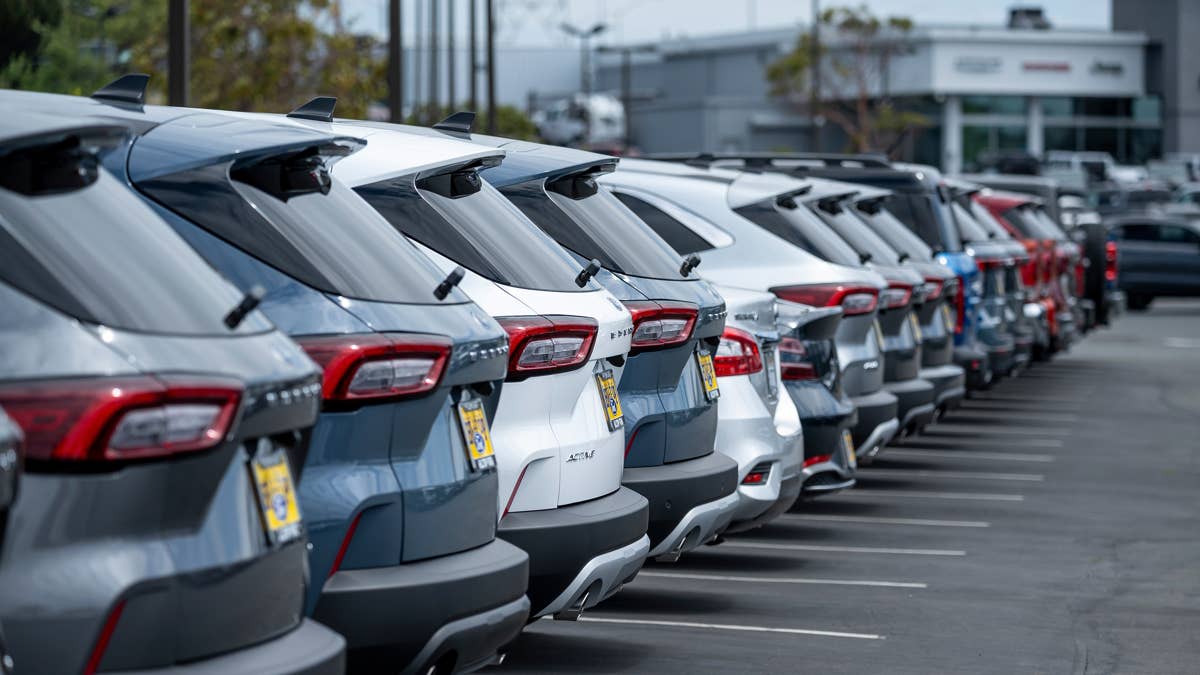
What does strong demand mean for car buyers?
Data comparisons to last year can be slightly skewed since much of the buying activity was driven by an outlier event (tariffs) that consumers no longer have to worry about.
However, the data from this year, in an environment where the opposite is true, and car buyers are facing numerous headwinds, suggests that demand is still there.
According to Cox Automotive, the new-vehicle sales pace of 15.8 million units for 2026 represents a 2.9% decline from the previous year, but the decline is “more a function of last year’s stronger-than-expected performance, rather than a meaningful deterioration in demand in 2026.”
More Automotive:
- The U.S. may never sell 17.6million cars again
- Volkswagen may cut 100,000 jobs in brutal reset
- A U.S.-built EV brand just got banned from America
“Last year’s stronger performance set a high benchmark, but demand remains resilient. As inflation pressures begin to ease and the Fed stays focused on supporting economic stability, we believe the industry is positioned to maintain a steady sales environment through the remainder of 2026,” said Robb.
That strong demand is what is keeping vehicle prices at multi-year highs.
New car transaction prices were averaging around $50,900 this spring, representing a 3.3% increase from December, according to CarGurus. Their report also shows that dealer inventories have shifted considerably, with more new vehicles on lots priced above $50,000 than below $35,000.
But as long as demand is as strong as it has been, there probably won’t be a rightsizing of prices anytime soon.