Every industry gets a window when the rules are still wet. Before the statutes harden and the case law piles up, somebody decides who is allowed to do what, and whoever is standing in the room during that window tends to eat well for the next 20 years.
Uber (UBER) understood that better than almost anyone else did. It launched into cities where its own service was arguably illegal, absorbed the fines as a cost of doing business, mobilized its riders into a lobbying bloc, and dared local regulators to shut the whole thing down.
City councils blinked. Taxi commissions rewrote their codes.
Medallion owners in New York watched a seven-figure asset shed most of its value while the rulebook slowly caught up to what had already happened on the street.
The company called that disruption. The people on the other side of it called it something else. Either way, the window closed with Uber standing inside it.
Which is what makes the past several months so strange to watch. Uber has spent this year back in statehouses, arguing the reverse of everything it once argued.
Uber is now lobbying lawmakers to slow the rollout of driverless taxis, and it is doing that work beside the same driver unions it fought for the better part of a decade, according to the Financial Times.
In New Jersey, Uber lobbyists proposed that any robotaxi operator keep human drivers behind at least 85% of rides during a three-year pilot, the FT reported.
Why Uber wants a hybrid robotaxi network
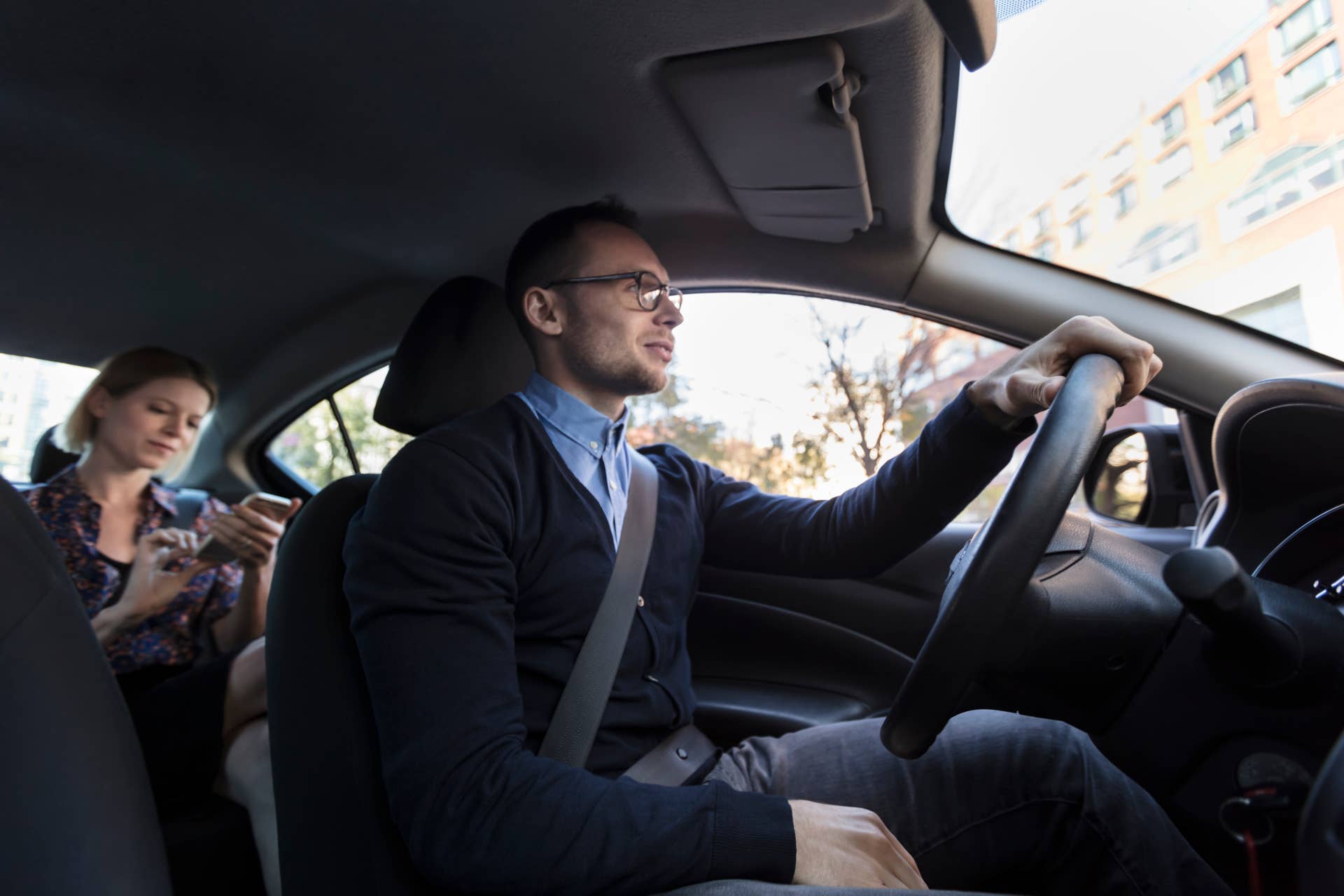
The ask has a name. Uber wants any platform offering self-driving rides to also run a hybrid network, robots and humans dispatched from the same app, rather than the pure driverless fleet Alphabet’s (GOOGL) Waymo already runs in several U.S. cities.
Uber president Andrew Macdonald has conceded the position looks odd coming from a company that spent its early years ignoring the social cost of its own growth, the FT reported.
A former Uber executive put the math more plainly. “For AVs to scale, drivers have to lose,” the person told the FT.
Here is where my analysis parts ways with the messaging on both sides. The hybrid rule is not really about the driver. It is about the aggregator.
Related: Uber CEO sends shocking message to employees
If regulators let pure-play autonomous vehicle companies operate their own booking apps, Uber gets removed from the transaction entirely. No driver to pay, no commission to collect, no app sitting in the middle. That risk is exactly what a 600,000-member union warned the D.C. Council about in July, and a hybrid mandate keeps Uber in the middle regardless of who or what is steering.
The technology gap explains the urgency. Uber sold its self-driving unit, Advanced Technologies Group, to Aurora Innovation in 2020 for roughly $4 billion, down from a $7.25 billion valuation a year earlier, and has since committed more than $10 billion to vehicles and stakes across a scattered field of partners.
CEO Dara Khosrowshahi has described the goal as building the “world’s leading commercialization platform for autonomous vehicles,” reported Fortune.
Waymo owns its stack. Uber rents access to everyone else’s.
What the driver pay data actually shows
The labor argument is not invented. It is just messier than either camp lets on.
Here is what the most recent independent data says.
- Trips per hour fell 5.32% in markets with active robotaxi service, against a 2.56% decline nationwide, according to Gridwise Analytics.
- Los Angeles drivers saw trips per hour slide close to 10% year over year while national hourly gross pay rose about 2%, according to Gridwise Analytics.
- Uber’s own policy paper this year conceded lower utilization and hourly earnings in San Francisco and Los Angeles, according to Gizmodo.
- Autonomous rides account for less than 0.5% of roughly 300 million weekly Uber trips, Khosrowshahi said on the second-quarter earnings call, according to CNBC.
That last figure is the one I keep circling back to. Uber is spending political capital in statehouses to slow a competitor that currently accounts for fewer than one trip in 200 on its own platform.
Read that as insurance, not as a response to this quarter’s revenue. The threat Uber is legislating against is a 2030 threat. The legislation has to be written now, because once a state licenses pure-play driverless operators without a hybrid requirement, nobody is reopening that statute to help a ride-hailing incumbent.
More Automotive:
- The failed Honda-Nissan merger just got a second life
- EV maker’s biggest ever recall hits 27,000-plus sedans
- Tesla just set a date for its riskiest launch yet
There is a second reading, and it is less cynical. Robotaxi supply is genuinely lumpy, concentrated in a handful of dense metros, and a hybrid rule keeps coverage intact in the neighborhoods autonomous fleets skip. Uber has made that argument publicly. It also happens to be the argument that protects the commission.
How the layoffs undercut the driver message
The timing did Uber no favors. The same week its driver advocacy made headlines, the company said it would cut about 3,300 jobs, roughly 10% of its global workforce, reported Bloomberg.
Khosrowshahi told staff that years of growth had produced “more layers, more coordination, more fragmented ownership,” reported Bloomberg. Uber also exited Nigeria and Uganda on the same date, according to Al Jazeera.
So a company arguing that automation should reach contractors slowly applied that same efficiency logic to its own payroll immediately, and did it first.
Drivers noticed. Manny Pastreich, president of the New York service workers’ union 32BJ SEIU, told the FT the alliance has helped delay the next stage of the rollout, and that the union is not counting on Uber’s support outlasting its usefulness.
What robotaxi rules mean for Uber investors
The regulatory outcome is a live variable in the stock, not background noise. Autonomous vehicle bills have stalled in roughly half a dozen states this year largely over labor concerns, per the FT, which means the map is still being drawn.
Uber closed at $75.76 on Sept. 4, down about 6% in 2026 and roughly 26% below its 52-week high of $101.99, according to CNBC. Those figures move intraday, so verify at publish.
Wall Street has not repriced the risk. The 12-month consensus target sits near $102 across 51 analysts with an average rating of buy, according to Stock Analysis. Roughly a third of that upside depends on a regulatory map nobody has finished drawing.
Who actually collects the toll
Here is the part the headline promised. The 85% rule floated in New Jersey is not a safety standard. It is a toll booth.
If a version of it passes, every robotaxi operator that wants to serve the state has to route through a platform carrying human drivers, and Uber runs the largest such platform in the country.
Uber loses the technology race and wins the distribution one. That is a worse business than owning the robot. It is a far better business than owning nothing.
Drivers get a few more years out of the arrangement, and that is real. It matters to somebody still making payments on a 2019 Camry they bought to work the platform. It is also not the same thing as a seat at the table, which is why Pastreich hedged.
The rules are still wet across most of the country. Watch which states let them harden first, because that is where the next decade of this business gets decided.