Holiday gatherings tend to follow a familiar script: warm welcomes at the front door, followed quickly by a quiet search for an exit strategy.
While hosting family and friends remains a cherished tradition, new research from Zillow, Vogo, and Zig-Zag — alongside reporting from The Wall Street Journal — reveals that both sides of the guest-room door rely on an elaborate set of coping mechanisms to survive the season.
For hosts, the pressure often leads to hiding behind locked doors or eyeing real estate listings. For guests, it means paying hundreds of dollars to turn down a free bed or stepping outside for a “walk” whose real purpose is no longer much of a secret.
Hosts hide in bathrooms and rethink their floor plans
Playing host comes with heavy logistical lifting—and tight quarters frequently push homeowners to their limits.
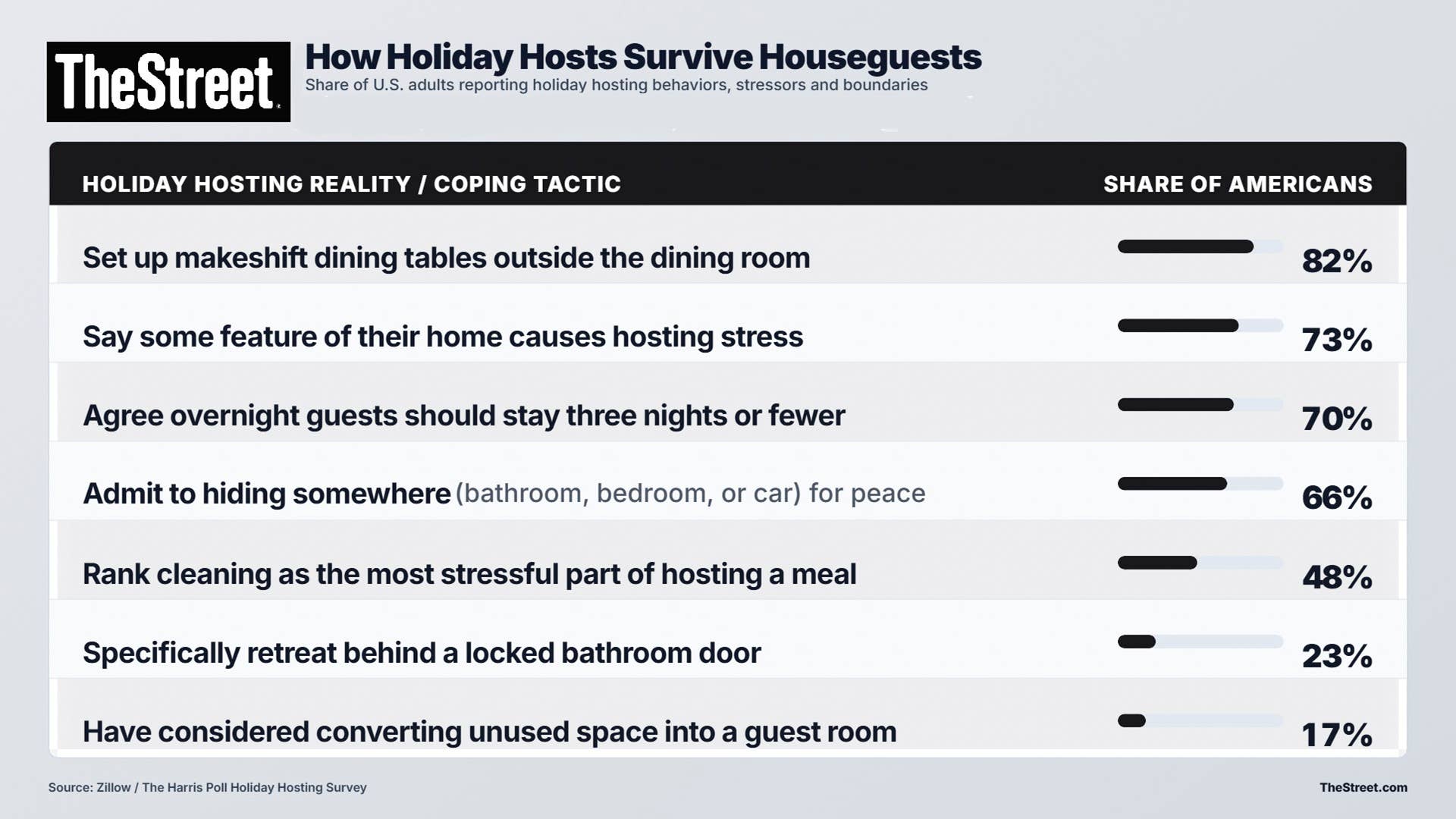
According to Zillow’s holiday hosting survey, two-thirds of Americans (66%) admit to hiding somewhere — whether in a bathroom, a bedroom, or a car — just to grab a few minutes of peace away from their guests. Nearly 1 in 4 (23%) specifically retreat behind a locked bathroom door.
The friction starts long before anyone sits down to eat. Nearly half of Americans (48%) rank cleaning among the most stressful parts of hosting a holiday meal, topping cooking (33%), finding enough seating (28%), and managing the cost (27%). In-laws and parents top the list of the most stressful guests (26%), ahead of siblings and their partners (21%).
Cramped layouts compound the strain. Nearly three-quarters of respondents (73%) say some feature of their home causes hosting stress, led by insufficient seating or a small dining table (32%) and a lack of counter space (29%). Consequently, 82% of holiday hosts have set up makeshift dining tables outside the dining room.
“The holidays can put a home to the ultimate test, and this survey shows how much our homes shape the way we celebrate,” Amanda Pendleton, Zillow’s home trends expert, said. “Too few seats, a cramped kitchen or no spare bedroom can turn a favorite tradition into a frenzied one. It’s no surprise many Americans have thought about moving or adding a room to their home when space is what stands between them and the holiday they picture.”
Indeed, 17% of Americans have considered converting unused space into a guest room, and 16% have thought about buying a home with more bedrooms. Another 11% have considered moving farther away from family altogether.
Still, 50% say they love hosting holiday meals, and 70% agree on one clear boundary: overnight guests should stay three nights or fewer.
Guests pay hundreds to skip the free spare bedroom
On the other side of the threshold, travelers are increasingly unwilling to test that three-night limit — even when a free bed is waiting.
Research from Vogo finds that 61% of holiday travelers have booked their own hotel or vacation rental at least once despite receiving a free offer to stay with family or friends. Another 29% say they have seriously considered doing so.
Rather than stemming purely from family drama, the decision usually comes down to logistics and personal space. Privacy ranks as the top reason travelers book separate lodging (53%), followed by the freedom to keep their own schedule (44%) and not wanting to be a burden on their host (39%). Avoiding tension or arguments trails at 26%.
More Housing Market:
- Fannie Mae predicts mortgage rate, housing market shifts
- Zillow drops new renting vs. home-buying cost as mortgage rates jump
- First-time homebuyers face new challenges in U.S. housing market
Even so, travelers frequently soften the blow with white lies: 40% admit they have given family a reason other than the real one for why they booked their own place or altered their arrival and departure times.
Buying that breathing room isn’t cheap. Half of travelers are willing to spend $300 or more to avoid the guest room, with the average traveler willing to pay $523 — and 61% want that lodging within a 10-minute drive of the family home.
“Think about the drive back after a late dinner, not just the miles on the map. A simple route and easy parking make the whole trip smoother. And a place with your own amenities lets you start your morning on your schedule before you head over to see everyone,” Heath Hammett, CEO of Vogo, said.
The ‘cousin walk’ drops its cover story
When guests and hosts do share the same roof, smaller, shorter escapes often bridge the gap — most notably the pre- or post-dinner “cousin walk,” a euphemism for stepping outside to smoke cannabis.
As The Wall Street Journal reported, “What started as a secret trip to smoke pot before dinner has mushroomed into a full-blown commercial holiday.” Dispensaries have even begun selling pre-roll packs labeled specifically for the occasion.
New survey data from rolling-paper brand Zig-Zag suggests the tradition’s cover is largely blown.
While 84% of respondents say they have stepped away from a family gathering for cannabis, nearly half (49%) admit they no longer bother inventing an excuse — selecting the response, “I don’t need an excuse; my family knows.” Another 24% still rely on “Taking a walk” or “Walking the dog.”
For most participants, the ritual is less about rebellion than decompression: 72% cite relaxing or unwinding as their primary reason for stepping out, and 71% say they have bonded with a relative over cannabis during a holiday gathering.
“Rolling a joint can be a simple way to slow down and catch up with the people you don’t see enough,” Maggie Streng, Marketing Director at Zig-Zag, said. “That’s what stood out to us in the survey.”
“The Cousin Walk reinforces that the shared ritual of cannabis can be the part of the day you look forward to most, especially during the busy holiday season.”
Related: Zillow drops new renting vs. homebuying cost as mortgage rates jump