Nvidia (NVDA) started as a video game chipmaker. It invented the term Graphics Processing Unit (GPU). Used the crypto boom to its advantage. And it is now the king of AI, thanks to its CUDA software moat.
The stock is down 2.34% at $218.23 at the time of writing, Thursday morning, May 21, according to Yahoo Finance. The stock is taking a hit following the Q1 fiscal year 2027 earnings beat-and-raise report released on May 20.
It has become almost a tradition that Nvidia’s stock drops after earnings, despite beating the outlook.
Nvidia CEO Jensen Huangexplained this phenomenon at the all-hands meeting after the Q3 fiscal 2026 earnings. “If we delivered a bad quarter, it is evidence there’s an AI bubble. If we delivered a great quarter, we are fueling the AI bubble.”
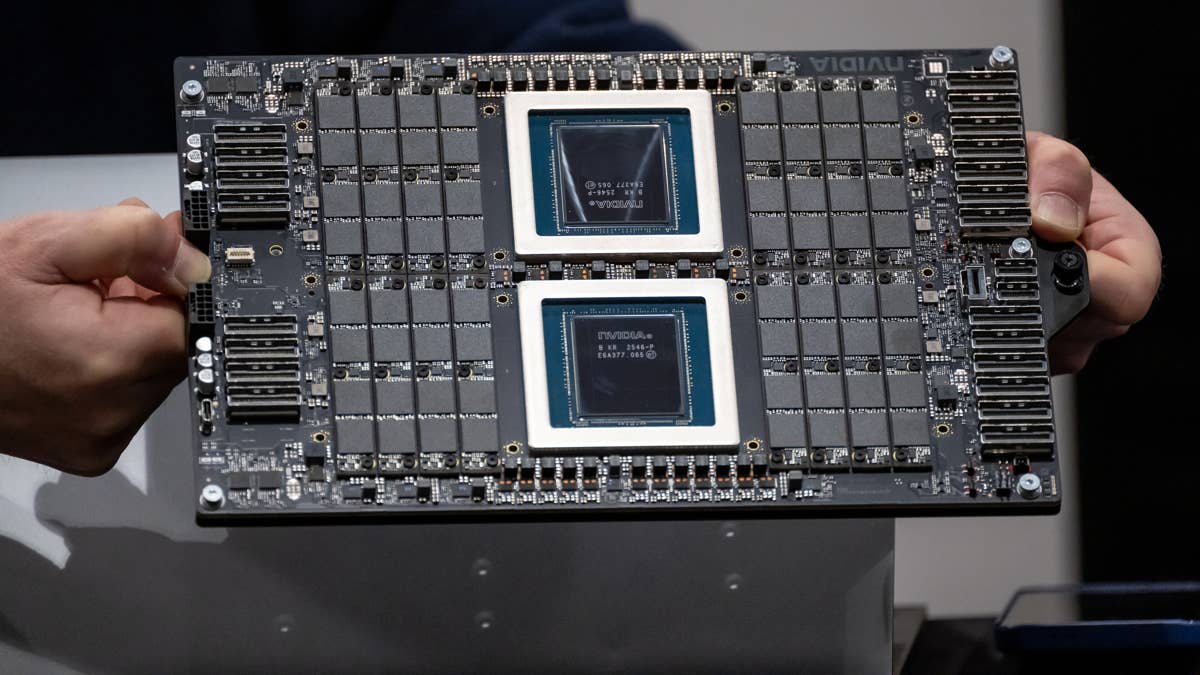
Key facts from Nvidia’s Q1 earnings report
Nvidia reported record revenue of $81.6 billion, up 20% from the previous quarter and up 85% from a year ago. Both GAAP and non-GAAP gross margins were impressive at 74.9% and 75.0%, respectively.
Nvidia EVP and CFO, Colette Kress, touted the launch of the Vera CPUs during the earnings call:
“Vera CPU opens a brand-new $200 billion [total addressable market] for Nvidia, a market we have never addressed before. Every major hyperscale and system maker is partnering with us to get it deployed. We have visibility to nearly $20 billion in total CPU revenue this year, setting us up to become the [world ‘s] leading CPU supplier.”
However, while talking about Vera CPUs, founder and CEO of Nvidia Jensen Huang noted during the same earnings call: “My sense is that we’ll be supply constrained throughout the entire life of Vera Rubin.”
Nvidia provided guidance for Q2:
- Revenue of $91.0 billion ± 2%
- GAAP and non-GAAP gross margins are expected to be 74.9% and 75.0%, respectively, ±50 basis points.
- Nvidia is not assuming any Data Center compute revenue from China in its outlook.
Nvidia noted in its Form 10-Q that its revenue is concentrated among a limited number of direct and indirect customers, and this trend may continue.
The form states: “Direct Customers – For the first quarter of fiscal year 2027, three direct customers represented 21%, 17%, and 16% of total revenue, all of which was primarily attributable to the Compute & Networking segment.”
Bank of America raises Nvidia stock price target
Following the report’s release in a research note shared with me, Bank of America analyst Vivek Arya and his team updated their opinion on Nvidia stock.
The team said the report is a solid beat-and-raise for Nvidia, noting that the $91 billion outlook is in line with bullish expectations, which is likely to lead to usual post-call volatility.
Analysts raised their estimates for fiscal years 2027 and 2028 pro forma EPS by 9% and 15% to $9.09 and $13.27, respectively.
More Tech Stocks:
- Analysts reset Broadcom stock price target
- Bank of America resets Microsoft stock forecast after earnings
- Bank of America resets Google stock forecast before key event
The team expects Nvidia to use its CEO Keynote at Computex on June 1 to provide further details on the company’s roles in agentic AI and its CPU potential.
Arya reiterated a buy rating for Nvidia stock and raised the price target to $350 from $320, based on a 26 multiple of his estimate for price-to-earnings ratio excluding cash for calendar year 2027, which is within Nvidia’s historical forward year P/E range of 25 to 56.
Analysts noted downside risks for Nvidia:
- Weakness in the consumer-driven gaming market
- Competition with major public firms
- Larger-than-expected impact from restrictions on compute shipments to China
- Lumpy and unpredictable sales in new enterprise, data center, and auto markets
- Potential for decelerating capital returns
- Enhanced government scrutiny of Nvidia’s dominant market position in AI chips
Disclosure: The author holds no position in Nvidia stock at the time of writing.
Related: AMD makes a major $10 billion push in crucial tech hub