Nvidia has been one of the biggest darlings of the artificial intelligence (AI) boom. But even Wall Street’s favorite stocks aren’t immune to sharp declines.
Since early October, Nvidia shares have plunged approximately 35%, falling from around $230 to $150. Nvidia’s longtime CEO, Jensen Huang, stepped down from the company’s helm on November 11 after the co-founder’s multiple extramarital affairs were made public, further complicating the stock’s position in a broader tech selloff.
For investors who believe in Nvidia’s long-term prospects, though, this decline might look like an opportunity to buy shares at a discount.
But according to Carter Worth, CEO and founder of Worth Charting, there’s an important distinction between a stock that’s poised for a rebound and one that’s ready for a sustained recovery.
Worth recently sat down with TheStreet’s Caroline Woods to explain why he believes Nvidia’s sell-off could create a short-term buying opportunity, even if the company isn’t out of the woods yet.
His approach focuses less on Nvidia’s earnings or valuation and more on how sharply its share price has fallen.
Worth believes the stock could be due for a bounce, but that doesn’t necessarily make it a good long-term investment at current levels.
In other words, he’s approaching Nvidia as a short-term trade rather than a buy-and-hold investment, and cautions that a lasting recovery could take months.
Nvidia isn’t the only stock he’s watching, either. Worth also sees opportunities — and risks— in other technology stocks, defensive sector names, and the broader market.
Here’s how he breaks it down.
Note: The market musings expressed herein are those of the interviewed guest and should not be treated as professional investment advice. Readers should consult a certified financial planner (CFP) for individualized advice based on their available capital, goals, risk tolerance, and time horizon.
Why Nvidia’s strong earnings don’t guarantee a recovery
Worth’s starting point may seem counterintuitive: A company can report strong earnings, raise its outlook, or announce a share buyback, yet still see its stock price decline.
Nvidia’s latest earnings illustrate that disconnect. The chipmaker reported quarterly revenue of $115.84 billion, more than double the previous year’s, yet shares fell 2.9% the following day, according to Reuters.
The reaction underscores Worth’s central argument: Even exceptional financial results aren’t always enough to convince investors that a stock is worth buying.
There’s no such thing as good or bad results, so to speak. There’s only how the stock acts.
Carter Worth, when asked what Nvidia’s post-earnings reaction says
For a technical analyst like Worth, how a stock reacts to news can be just as important as the news itself.
A decline following positive earnings results suggests that investors expected even more from the company. It doesn’t necessarily mean the business is struggling, but it does indicate that the sellers remain in control.
But that doesn’t mean fundamentals are irrelevant. Rather, Worth believes that earnings and valuation aren’t always reliable indicators of a stock’s short-term direction.
Even a stock that’s already fallen sharply can continue declining.
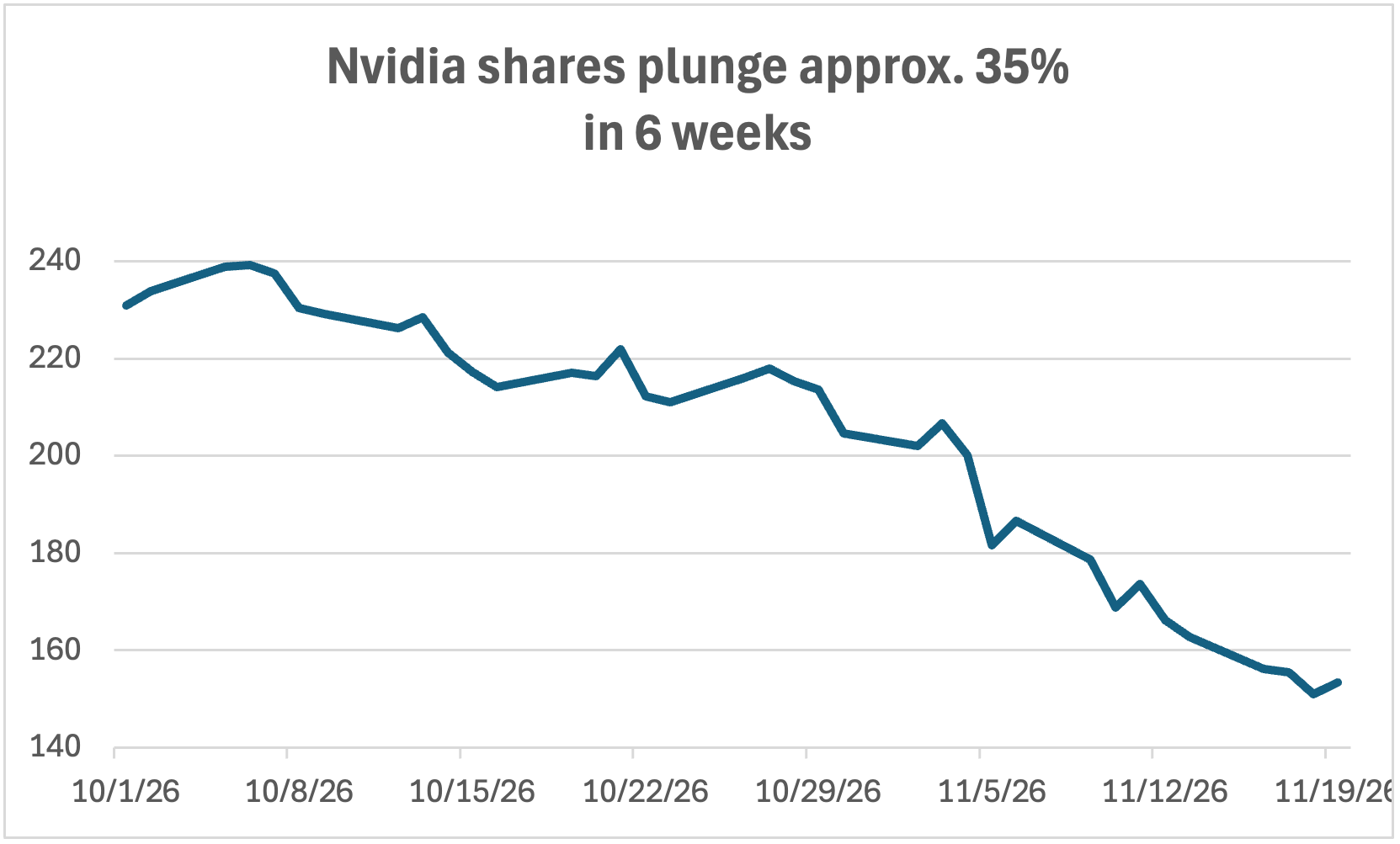
Yahoo! Finance
But Nvidia’s steep sell-off has created what Worth calls a potential “mean reversion” opportunity, which describes a situation where a stock that has moved sharply in one direction reverses at least part of that move.
Rather than betting on a sustained rally, Worth suggests capitalizing on a short-term rebound.
He suggested taking some profits if Nvidia reaches $170, selling more shares around $175, and potentially exiting the position entirely between $175 and $180.
Those price targets represent his trading strategy, not a guarantee that Nvidia will reach those levels.
Worth also emphasized the importance of risk control. For a position purchased around $150, he said he would be willing to lose only $2 to $3 per share before selling.
The idea is to keep losses small rather than allowing a short-term trade to become an unintended long-term holding.
Related: Colette Kress’s net worth in 2026 as Nvidia’s interim CEO
Why Nvidia’s recovery could take months
Even if Nvidia rebounds, Worth cautioned that investors shouldn’t confuse a short-term rally with a lasting recovery.
A stock that’s suffered a significant decline typically needs time to establish a new foundation before it can begin a sustained climb.
Those are trades. That’s important. When something has collapsed, it doesn’t repair itself quickly.
Carter Worth, when asked whether oversold technology shares are investments or trades
In other words, Nvidia could experience a sharp bounce without having established a durable bottom.
Worth believes that process could take months rather than days or weeks. He also applies that same thinking to other technology stocks that have suffered steep losses.
Following the sell-off in semiconductor and software stocks, for instance, Worth increased his technology exposure from underweight to equal weight, bringing his allocation back in line with the sector’s benchmark weighting.
But he’s still being selective.
He identified Snowflake, Nvidia, and the iShares Semiconductor ETF as potential candidates for short-term rebounds, while cautioning that these stocks may need more time to establish lasting bottoms.
Among the Magnificent Seven, Worth prefers Amazon over Microsoft based on their respective chart patterns. He considers Amazon’s technical outlook stronger, while Microsoft’s volatility makes it less attractive at current levels.
However, Worth said he would consider buying Microsoft after a further 10%–12% pullback.
Related: How much NVDA stock does Nvidia interim CEO Colette Kress own?
Why defensive stocks may not be as safe as investors think
Technology stocks aren’t the only area of the market giving Worth pause. He’s also concerned about stocks that have benefited from investors seeking safety during the recent sell-off.
Companies including Apple, Costco, Walmart, Johnson & Johnson, Berkshire Hathaway, and Procter & Gamble have attracted investors looking for stability. But Worth cautioned that when too many investors crowd into the same stocks, they can become expensive.
One sector he considers to be an exception, however, is energy.
Worth noted that energy accounted for just 3.2% of the S&P 500 but contributed 5.5% of its earnings and 7% of its revenue.
He remains overweight the sector, preferring major integrated oil companies such as Exxon Mobil and Chevron over oil-services companies including SLB, Halliburton, and Baker Hughes.
Worth also highlighted an opportunity involving Caterpillar and Coca-Cola.
Since June 30, he said, Caterpillar had fallen approximately 50%, while Coca-Cola had gained about 23%.
His strategy would involve buying Caterpillar and shorting Coca-Cola, betting that the performance gap between the two stocks will narrow. Worth believes the trade could generate a net return of approximately 10% if that happens.
For long-term investors who aren’t comfortable with short selling, his simpler approach would be to own Caterpillar and sell Coca-Cola.
Related: Jensen Huang’s net worth: Nvidia’s ex-CEO’s wealth & income
Why the S&P 500 may be masking deeper market weakness
While the broader stock market’s recent losses may appear relatively modest, Worth believes the major indexes aren’t telling the whole story.
When he spoke, the S&P 500 was down approximately 3.5% in November, while the Nasdaq had fallen about 4.5%.
But those declines masked much steeper losses in individual stocks.
Worth pointed to Caterpillar’s sharp decline as an example of the damage occurring beneath the surface, even as some defensive stocks continued to rise.
This divergence has created a challenging environment for investors.
Stocks that have suffered significant losses may need months to recover, while defensive stocks that have attracted substantial investor interest could be vulnerable if sentiment shifts.
It’s one reason Worth remains skeptical of optimistic year-end market forecasts. He believes stocks could finish the year lower, although that’s far from certain.
His analysis focuses primarily on stock-price patterns and relative strength — how a stock performs compared with its peers or a broader index — rather than earnings forecasts or economic projections.
What Nvidia’s sell-off means for investors
If you’re considering buying shares of Nvidia, make sure you decide whether you’re buying it for a short-term rebound or investing in the company for the long haul.
A tactical trade requires a clear exit strategy, including a plan for taking profits and limiting losses.
A long-term investment, on the other hand, requires confidence in the company’s future and a willingness to ride out periods of volatility.
Investors should also pay attention to whether Nvidia can establish a sustained base rather than simply bounce from oversold levels.
And with some traditionally defensive stocks attracting significant investor interest, it may also be worth reviewing whether those holdings have become too large or expensive within your portfolio.
Ultimately, the right approach depends on your investment goals, risk tolerance, and time horizon.
Related: David Wagner pairs AI infrastructure with a beaten-down Copart in ‘barbell’ strategy
Some or all of this content may have been generated by AI. While we strive for accuracy, AI can occasionally produce incorrect information. If you buy something via one of our links, we may earn a commission.