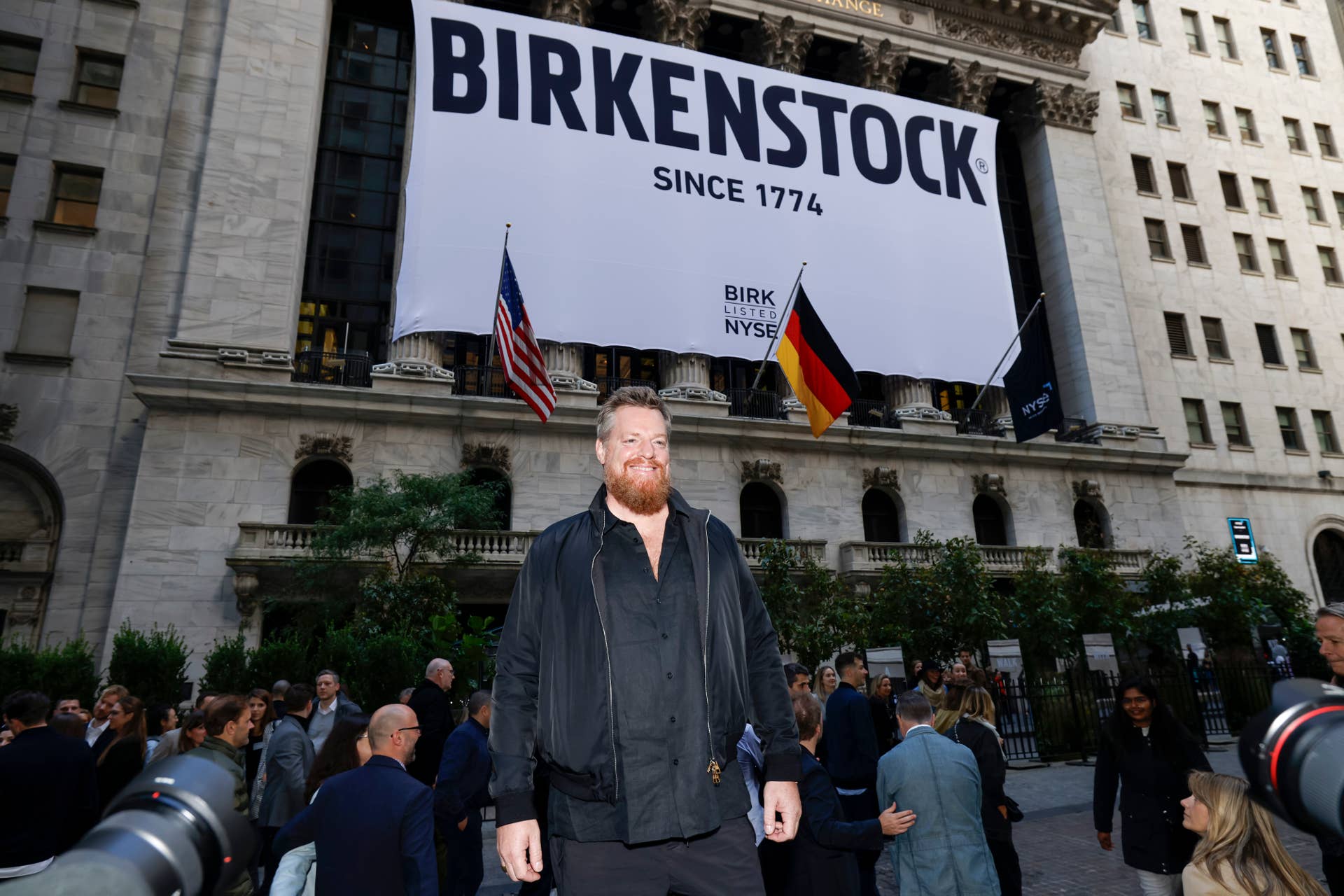
When Birkenstock (BIRK) went public in October 2023, the pitch was bold and simple: a 250-year-old German sandal maker reinvented as the next big luxury name on the New York Stock Exchange.
That story is now in serious trouble.
Shares, as of mid-day May 19, have collapsed from an all-time high of $123.17 to a record low of $32.44, wiping out roughly $5.7 billion in market value and leaving the business worth almost 38% less than its IPO valuation, Reuters reports.
The slide last week was sharp. After Birkenstock reported softer fiscal Q2 growth on May 13 and declined to raise its annual sales outlook, the stock fell more than 14% in a single session.
What looks like a one-quarter stumble is something deeper for long-term holders. Investors are openly rethinking whether a sandal maker can ever be valued like LVMH (LVMUY), the French house that quietly backs Birkenstock through private equity firm L Catterton.
For shareholders, the question now is simple. Is this a buying opportunity, or is the luxury premium gone for good?
Birkenstock’s Q2 earnings exposed a margin problem investors can’t ignore
The numbers tell the story.
Birkenstock grew revenue 14% in constant currency last quarter, but reported revenue rose only 8% to €618 million, missing the consensus estimate of €620.3 million, WWD reports.
Net income fell 22.1% year over year to €81.9 million.
The bigger concern is what’s happening to profitability. Adjusted EBITDA margin declined 270 basis points in the quarter, with management warning those pressures will continue through fiscal 2026, according to the company’s Q2 earnings call transcript.
Two forces are squeezing margins at once:
- A weaker U.S. dollar against the euro, which created a 640 basis point headwind to revenue growth
- A U.S. tariff burden that doubled to 20%, hitting profitability in Birkenstock’s largest market
Adjusted EPS dropped 9% year over year. For a stock that was once priced for compounding luxury growth, those are heavy numbers.
The valuation reset: from luxury multiple to mass-market reality
Here’s the part most readers should pay attention to.
At its $123 peak, BIRK traded as if it could become the next LVMH. That premium has now evaporated. The stock currently trades at around 13 times forward earnings, roughly in line with the broader footwear industry average.
A forward price-to-earnings ratio compares a stock’s price to expected earnings over the next 12 months. Lower numbers usually signal that investors expect slower growth.
That compression matters because it shows the market is no longer paying for “luxury optionality.” It’s paying for what Birkenstock actually is, a profitable but cyclical footwear brand.
More Manufacturing:
- Iconic auto giant may turn to its biggest rival for help
- Lockheed Martin wins another massive military deal
- Ford rival doubles down on China with bold move
For context on how stretched the original thesis was, LVMH itself has had a brutal year. The French luxury giant’s shares fell more than 25% in the first quarter of 2026 alone, its worst start ever, according to MarketScreener.
If the gold standard of luxury is being repriced, a sandal maker pricing itself alongside it was always going to struggle.
How Crocs avoided the same trap and why it matters for BIRK investors
This is the comparison that should reset every Birkenstock thesis.
Crocs (CROX) trades at roughly seven times next-12-month earnings, with operating margins above 20%. That’s a mass-market footwear multiple, and it’s exactly why Crocs hasn’t suffered the same kind of sell-off.
Crocs never asked the market to pay for luxury. Birkenstock did.
Related: Crocs shoes are making a surprising comeback
When you build the bull case on premium positioning, every quarter has to validate that positioning. Slip once, and the multiple compresses fast. Crocs, by positioning itself as the cash-generative footwear company it actually is, gave itself room to breathe.
For BIRK investors, the takeaway is direct. The stock’s path forward depends less on growing revenue and more on whether management can convince the market that what’s left of the premium is real.
What still needs to happen for Birkenstock stock to recover
A bullish case on BIRK from here requires several things to fall into place:
- Margin stabilization in fiscal Q3 and Q4. The company has reiterated full-year guidance of 13% to 15% constant-currency revenue growth and at least €700 million of adjusted EBITDA, per Yahoo Finance data. But management warned about additional pressure in Q4 if tariffs hold.
- Successful diversification beyond sandals. Birkenstock’s contoured cork footbed remains heavily associated with summer. Clogs, boots, and trainers must start contributing meaningfully.
- A working pricing strategy. Wealthier customers have absorbed price increases. More price-sensitive shoppers have not.
- Distribution discipline. Eric Tsytsylin, brand strategy partner at consultancy Lippincott, warned that if Birkenstock “chases volume by opening too many wholesale doors or relying on promotions, they will lose the luxury premium they’ve spent decades building.”
Notably, L Catterton, the LVMH-backed private equity firm that controls Birkenstock, sold 15.3 million shares worth roughly $549 million in Q1 2026, trimming its stake by 13.4%, according to Quiver Quantitative. That’s a signal worth watching.
BIRK vs. CROX vs. the S&P 500: how the year really looks
A quick check on relative performance frames the discussion.
- BIRK: Down sharply from its $123 peak, hitting a record low of $32.44, off about 38% from the IPO price
- CROX: Trading around $85, with analysts setting a median 12-month target near $103, per MarketBeat
- LVMH: Off roughly 26% in the first quarter of 2026
- S&P 500: Recently hit fresh record highs
Source: CNBC
The footwear-as-luxury thesis was already on shaky ground across the sector. Birkenstock’s collapse is the cleanest evidence yet that the market wants honesty about what these companies actually are.
What practical investors should think about now
Before adding or trimming BIRK exposure, three things are worth weighing carefully.
First, the analyst community remains mixed but cautious. The median 12-month price target sits near $56, with BTIG recently lowering its target to $60, TipRanks reveals.
Second, the tariff situation is fluid. The U.S. Supreme Court’s ruling on IEEPA tariffs has actually increased Birkenstock’s near-term exposure, even as the company estimates roughly €30 million in eventual refund claims.
Third, exclusivity and scale are inherently in tension. Birkenstock cannot grow into a global luxury brand without expanding distribution, but expanding distribution risks eroding the premium that justified the multiple in the first place.
For investors who like the brand long-term, the current valuation reset may make BIRK more reasonable than it was at $123. For investors who bought into the “next LVMH” pitch, the math no longer supports that thesis.
Either way, the next two quarters will tell us whether the luxury dream is recoverable or finished.
Related: Buffett’s Berkshire drops bold $55M bet on struggling retail icon