Rate cuts? Rate hikes? Another pause?
Federal Reserve Bank of Chicago President Austan Goolsbee said all these options over interest-rate policy are on the table at the central bank right now.
“I don’t see how you can look at the current situation and, at least to me, view that the only thing that’s on the table conceivably are rate cuts,” Goolsbee said May 8 in an interview on Bloomberg Television.
Goolsbee’s comments add to the ongoing shift among Fed policymakers away from any consideration of a rate reduction in the near future.
That’s driven largely by concerns over inflation due to an energy-price shock triggered by the Iran War.
Goolsbee doesn’t vote on monetary policy this year, but will in 2027.
He reiterated that he believed both options — a rate cut and a rate hike — are possible choices ahead for him and his colleagues.
He also repeated that he’s anxious about inflation and sees price pressures beyond just the energy shock from the Iran War.
“We’ve been above the 2% Fed target for five years now. We stopped making progress last year, and now the last three months, it’s going up instead of down,” Goolsbee told CNBC in an interview earlier that day.
Fed’s dual mandate requires a tricky balance
The Fed’s dual mandate from Congress requires maximum employment and stable prices.
- Lower interest rates support hiring but can fuel inflation. This risks fueling further inflation, potentially leading to an inflationary spiral.
- Higher rates cool prices but can weaken the job market. This increases the cost of borrowing and further stifles economic activity.
Traders are currently pricing in the next interest-rate cut for mid-to-late 2027, according to the CME FedWatch Tool.
And as I reported, bond traders are rapidly reshaping their outlook on U.S. monetary policy, increasing bets that the Fed could raise interest rates before cutting them as persistent inflation risks and geopolitical tensions upend dovish expectations.
The Kalshi prediction market estimates a 44% chance of a Fed rate hike before July 2027.
Latest inflation figures show increase in energy prices
The Consumer Price Index for March pointed to an inflation rate of 3.3%, well above the Fed’s 2% goal.
The April CPI report will be released May 12.
The Bureau of Economic Analysis released the March 2026 Personal Consumption Expenditures — the Fed’s preferred inflation gauge — on April 30 showing an acceleration in headline inflation largely driven by energy costs.
- Headline PCE (Year-over-Year): 3.5% up from 2.8% in February.
- Core PCE (Year-over-Year): 3.2% (excluding food and energy) up from 2.9% in February.
Economists at Nationwide expect the inflation rate to peak sometime this summer at around 4.5%, more than double the Federal Reserve’s 2% target, The New York Times reported.
Soaring gas prices have put the brakes on the spending habits of millions of Americans, hitting their wallets hard and fueling America’s persistent economic inflation-driven K-shaped divide, according to a new study by Federal Reserve economists.
Strong April jobs report shifts rate-cut bets
Despite rising energy costs fueled by the Iran War, U.S. employers added more jobs than expected for a second month and the unemployment rate held steady in April, the Bureau of Labor Statistics reported May 8.
- Nonfarm payrolls rose 115,000 last month after an even bigger surge in March, marking the strongest two-month increase since 2024.
- The unemployment rate was unchanged at 4.3%.
White House Council of Economic Advisors Director Kevin Hassett told Bloomberg that the April jobs report should not cause the Fed to raise interest rates, describing the data as “blockbuster.”
Historic Fed vote reflects 8-4 divide
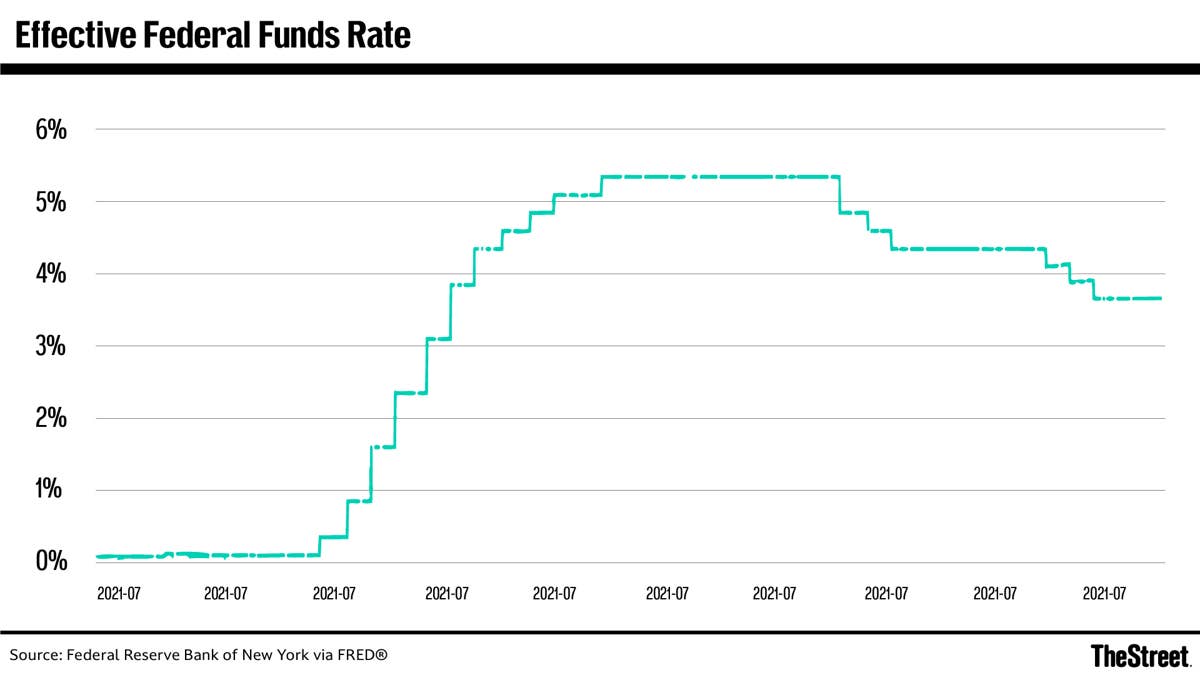
The Federal Open Market Committee voted 8-4 April 29 to leave the benchmark Federal Funds Rate unchanged at 3.5% to 3.75%.
It was the Fed’s third pause after cutting rates by 75 basis points during its last three meetings of 2025 due to a weakening labor market — and the first time in more than 30 years the FOMC vote reflected four dissents.
Related: Hawkish dissents fuel alarming warning to Fed rate outlook
“The center is moving toward a more neutral place,” outgoing Fed Chair Jerome Powell told the post-meeting press conference, describing the U.S. economy as “resilient” in spite of the recent price shocks from the Ukraine and Iran wars, the pandemic and President Donald Trump’s tariffs.
A neutral state is when an economy operates at sustainable growth with stable inflation and full employment without overheating or recessionary pressure.
It can also mean interest rates move in either direction.
Fed officials debate resumption of rate cuts
Judging from the language in its official post-meeting statement, the FOMC appeared to signal it could resume cutting benchmark interest rates which guide short-term borrowing from credit cards to business loans, and even indirectly, mortgage rates in the stagnant U.S. housing market.
The primary point of contention: the two magic words “additional adjustments” which in Fed-speak meant a signaling of resumption of rate cuts.
Regional Fed Presidents Beth Hammack of Cleveland, Neel Kashkari of Minneapolis and Lorie Logan of Dallas all dissented from the April 29 FOMC decision.
They released independent statements May 1 saying the Fed should be more explicit that the next monetary-policy step may not be a rate cut but rather a rate hike as inflation risks rise due to the energy shocks of the Iran War.
Boston Fed President Susan Collins, a non-voting member of the FOMC this year, said May 7 that she supported the dissents, adding that interest rates are likely to remain on hold “for a longer time period, with further easing further down the road.”
Goolsbee, in the CNBC interview, said: “I have never been that big of a fan of trying to use words to jawbone policy decisions.”
Goolsbee cites inflation as key to rate-cut bets
Supply-chain disruptions from the Iran War could cause price increases to spread beyond energy to food and other goods as global spillovers from the Middle East conflict continue.
“We’ve got to just keep an eye on this, because if everybody starts presuming that inflation rates are going back to something like what they were a few years ago, we would be in a bit of a pickle as a central bank,” Goolsbee said.
Goolsbee further argued that inflation pressure is coming from more than just gasoline and tariffs, and is increasingly showing up in services costs.
Warsh’s task to cut rates grows tougher
Former Fed Governor Kevin Warsh is expected to be approved as the incoming Fed Chair by the Senate the week of May 11.
He assumes the role at a critical time for the central bank which faces not only interest-rate concerns from the Middle East conflict but worries that Fed independence will be politicized by the White House.
Trump has been demanding the Fed slash rates to 1% or less. He also said he would only nominate a Fed Chair candidate who agreed with his monetary-policy stance.
Warsh has criticized the central bank on several fronts including interest rates and pledged a “regime change” under his leadership although he has not been clear on exactly how that change will be implemented.
The next FOMC meeting, Warsh’s first as Chair, is June 16-17.
Dan North, senior economist for North America at Allianz, told CNBC that selling a rate cut with inflation north of 3% will be a difficult job, particularly considering the signals from the other 11 members of the FOMC.
“He has really got his hands full on this. Certainly he was chosen by Trump because he is probably leaning towards lower interest rates,” North at Allianz said.
“Warsh comes in, saying, ‘Gosh, I think it’d be great if we had a family fight once in a while.’ Well, I don’t think this was the fight he was expecting,” North said.
Could Fed pause rate cuts indefinitely?
While the traditional approach to higher inflation and a steady labor market normally would argue against cuts, recent data trends signal that the Fed can continue holding rates steady while also keeping its options open, including raising them.
“This makes it more and more clear that the Fed [can have] all the patience in the world,” Scott Clemons, chief investment strategist at Brown Brothers Harriman, told CNBC.
“There’s nothing on the economic front that’s requiring them to lower interest rates any further,” Clemons said.