The surprisingly stable April jobs report just made incoming Federal Reserve Chair Kevin Warsh’s cues from the White House to slash interest rates next month a good deal more difficult to execute.
Despite rising energy costs fueled by the Iran War, U.S. employers added more jobs than expected for a second month and theunemployment rate held steady in April, the Bureau of Labor Statistics reported May 8.
- Nonfarm payrolls rose 115,000 last month after an even bigger surge in March, marking the strongest two-month increase since 2024.
- The unemployment rate was unchanged at 4.3%.
Investors and economists debate how this could shift the Fed’s rate cut outlook from the central bank’s current “wait-and-see” approach.
Bill Adams, Chief U.S. Economist at Fifth Third Commercial Bank, said a falling labor force participation rate shows that the job market’s emerging problem is a shortage of workers.
“For the Fed, growing payrolls and a falling labor force are one more argument against a rate cut,’’ Adams told TheStreet in an email.
The labor market appears to be gaining steam after near-zero job growth in 2025. Hiring increased across a variety of sectors, including retail trade, healthcare and transportation and warehousing.
Yet signs of the “low-fire, low-hire” patterns of employers linger.
“It’s still a high-anxiety job market,” Diane Swonk, chief economist at KPMG, told The Wall Street Journal. “Those who have a job are clearly clinging on, while those looking for a job are feeling frozen out.”
Bloomberg Economics’ Anna Wong said the April jobs report doesn’t change their forecast as to the “trajectory” of the benchmark Federal Funds Rate.
“The central bank is still on track to keep rates steady until the fourth quarter, when we expect it will cut rates by 50 basis points as the unemployment rate climbs,” she said.
Fed’s dual mandate requires a tricky balance
The Fed’s dual mandate from Congress requires maximum employment and stable prices.
- Lower interest rates support hiring but can fuel inflation. This risks fueling further inflation, potentially leading to an inflationary spiral.
- Higher rates cool prices but can weaken the job market. This increases the cost of borrowing and further stifles economic activity.
Traders are currently pricing in the next interest-rate cut for mid-to-late 2027, according to the CME FedWatch Tool.
And as I reported, bond traders are rapidly reshaping their outlook on U.S. monetary policy, increasing bets that the Fed could raise interest rates before cutting them as persistent inflation risks and geopolitical tensions upend dovish expectations.
The Kalshi prediction market estimates a 44% chance of a Fed rate hike before July 2027.
Historic Fed vote reflects 8-4 divide
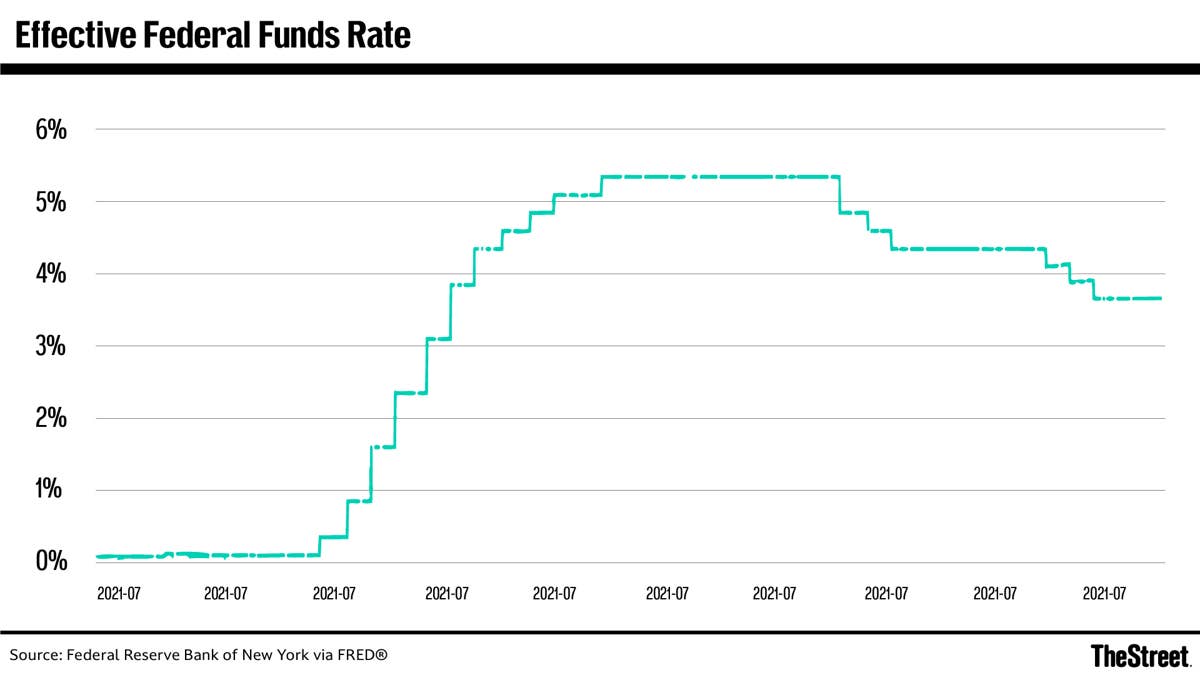
The Federal Open Market Committee voted 8-4 April 29 to leave the benchmark Federal Funds Rate unchanged at 3.5% to 3.75%.
It was the Fed’s third pause after cutting rates by 75 basis points during its last three meetings of 2025 due to a weakening labor market — and the first time in more than 30 years the FOMC vote reflected four dissents.
“The center is moving toward a more neutral place,” outgoing Fed Chair Jerome Powelltold the post-meeting press conference, describing the U.S. economy as “resilient” in spite of the recent price shocks from the Ukraine and Iran wars, the pandemic and President Donald Trump’s tariffs.
A neutral state is when an economy operates at sustainable growth with stable inflation and full employment without overheating or recessionary pressure.
It can also mean interest rates move in either direction.
Fed Governor Stephen I. Miran voted against the rate pause, preferring to lower the target range for the funds rate by 25 basis points.
Miran, the most dovish of seven-member Board of Governors, will be replaced by Warsh later this month.
Fed language signaling resumption of rate cuts under fire
Judging from the language in its official post-meeting statement, the FOMC appeared to signal it could resume cutting benchmark interest rates which guide short-term borrowing from credit cards to business loans, and even indirectly, mortgage rates in the stagnant U.S. housing market.
Regional Fed Presidents Beth Hammack of Cleveland, Neel Kashkari of Minneapolis and Lorie Logan of Dallas all dissented from the April 29 FOMC decision as a result of that language.
They released independent statements May 1 saying the Fed should be more explicit that the next monetary-policy step may not be a rate cut but rather a rate hike as inflation risks rise due to the energy shocks of the Iran War.
Boston Fed President Susan Collins, a non-voting member of the FOMC this year, said May 7 that she supported the dissents, adding that interest rates are likely to remain on hold “for a longer time period, with further easing further down the road.”
Supply-chain disruptions could cause price increases to spread beyond energy to food as global spillovers from the war continue.
Jobs report makes Warsh’s mandate to cut rates tougher
Warsh is expected to be approved by the Senate the week of May 11. He assumes the role at a critical time for the central bank which faces not only interest-rate concerns from the Middle East conflict but worries that Fed independence will be politicized by the White House.
Trump has been demanding the Fed slash rates to 1% or less. He also said he would only nominate a Fed Chair candidate who agreed with his monetary-policy stance.
Warsh, a former Fed governor, has criticized the central bank on several fronts including interest rates and pledged a “regime change” under his leadership although he has not been clear on exactly how that change will be implemented.
White House Council of Economic Advisors Director Kevin Hassett told Bloomberg that the April jobs report should not cause the Fed to raise interest rates.
What are the odds of a potential June rate cut?
The next FOMC meeting is June 16-17, Warsh’s first as Fed Chair.
Hiring Lab analysts say that “barring a meaningful shift” in the Middle East or the labor market, it would be surprising if Warsh could foster consensus among the 12-person FOMC to resume easing in his first month.
Greg Gizzi, Head of Fixed Income and Municipal Bonds at Nomura Asset Management International, said revised March non-farm payrolls were revised higher from 178,000 to 185,000 added to the upside surprise in the April jobs numbers while average hourly earnings came in marginally below estimates.
“Despite the modest wage softness, the overall report reflects continued labor market resilience and provides no justification for near-term Fed rate cuts,’’ Gizzi told TheStreet in an email.
“The strength of this print, coupled with the upward March revision, is likely to embolden recent FOMC dissenters who pushed back against dovish language at the last meeting, reinforcing the case for a wait-and-see approach to monetary policy,’’ he said.
Related: Fed drops rate-cut bombshell
But Ben Fulton, CEO at WEBs Investments, said the jobs report could have a chilling effect on those recent signals of a potential increase in rates — a relief to Wall Street and Main Street investors.
“This will make the odds of a potential rate cut less likely, and hopefully the discussion of a rate hike removed as well. The volatility of the markets has been slowly declining, which foreshadows a continued slow march higher for the markets, which is good,’’ he told TheStreet in an email.
“I expect the renewed discussions of an overheating market, if and when the Iran conflict is settled, will be front and center. For now, stay invested and enjoy a favorable wind to your backs,’’ Fulton said.
Fed officials eye latest inflation figures
With the latest employment report showing signs of improvement in the labor market, Angelo Kourkafas, senior strategist at Edward Jones, told CBS News that the Fed will likely hold off on interest rate cuts as policymakers assess the impact of surging energy costs from the Iran War.
The April CPI report will be released May 12.
The Bureau of Economic Analysis released the Marcht Personal Consumption Expenditures — the Fed’s preferred inflation gauge — on April 30 showing an acceleration in headline inflation largely driven by energy costs.
- Headline PCE (Year-over-Year): 3.5% up from 2.8% in February.
- Core PCE (Year-over-Year): 3.2% (excluding food and energy) up from 2.9% in February.
Economists at Nationwide expect the inflation rate to peak sometime this summer at around 4.5%, more than double the Federal Reserve’s 2% target, The New York Times reported.
Consumers battle energy price shocks
Soaring gas prices have put the brakes on the spending habits of millions of Americans, hitting their wallets hard and fueling America’s persistent economic inflation-driven K-shaped divide, according to a new study by Federal Reserve economists.
The sharp increase in gas prices severely curbed the purchasing power of lower-income households at the pump, the New York Fed study said.
The University of Michigan preliminary reading of its Consumer Sentiment Index, released May 8, fell to a new record low of 48.2 points, dropping from April’s final reading of 49.8 points.
This read was lower than the market expectation of 49.5 points.
Survey director Joanne Hsu said U.S. consumers are “buffeted by cost pressures” that make their daily life difficult.
Related: Hawkish dissents fuel alarming warning to Fed rate outlook