Over the past few years, the sluggish U.S. housing market has weighed heavily on home improvement retail, and Lowe’s hasn’t been immune.
After weak sales growth in 2025, the home-improvement retail chain has recently expanded its services to win back customers. As these changes roll out, Lowe’s has noticed a concerning shift in how customers are shopping in its stores.
In the first quarter of 2026, Lowe’s saw its comparable sales increase by 0.6%, compared to the same quarter the year before, according to its latest earnings report. Also, recent Placer.ai data revealed that foot traffic in Lowe’s stores during the quarter spiked by 2% year over year.
The small lift in demand comes at a time when Lowe’s has been focusing on making the customer experience more seamless, especially for its Pro customers (residential and commercial trade professionals).
In February, it expanded product access and added digital tools to its Pro Extended Aisle, a digital catalog that gives Pro customers access to real-time inventory and pricing.
The following month, Lowe’s introduced a HomeCare+ subscription for MyLowe’s Rewards members, offering seven essential home maintenance services for $99 a year. Additionally, it began offering free same-day delivery to MyLowe’s Rewards members who make online purchases of $25 or more.
Lowe’s sees a shift in how customers are shopping
During an earnings call on May 20, Lowe’s Chief Financial Officer Brandon Sink revealed that the average amount of money Lowe’s customers spent per purchase in comparable store locations during the quarter increased by 1.5% year over year.
This was mainly driven by “modest price inflation” and a boost in appliance sales.
However, the number of transactions customers made at these locations declined by 0.9% due to continued low DIY (do-it-yourself) discretionary purchases.
Sink said customers are scaling back large discretionary purchases in the DIY category and are instead focusing on tackling smaller home improvement projects.
Related: Home Depot and Lowe’s quietly gain new rival
“DIY (is) still very much engaging, but it continues to be in the repair, maintenance, replacement-related categories,” he said. “… I would say this has been a trend now for multiple years. The categories that are related to big-ticket discretionary are those categories in merch divisions that sort of continue to lag.”
Lowe’s CEO Marvin Ellison said during the call that the company is noticing a shift in how higher-income customers shop compared to lower-income customers as economic pressures mount.
“What we’ve seen so far is what we’ve seen all year long, and that is we’re operating and what we would describe as a K-shape economy where the higher-income consumer spends and they’re spending on innovation, and they’re spending on things to modernize their home, and the lower-income consumer is a little bit more cautious and a little bit more uncertain based on all of the macro factors that we all know so well,” said Ellison.
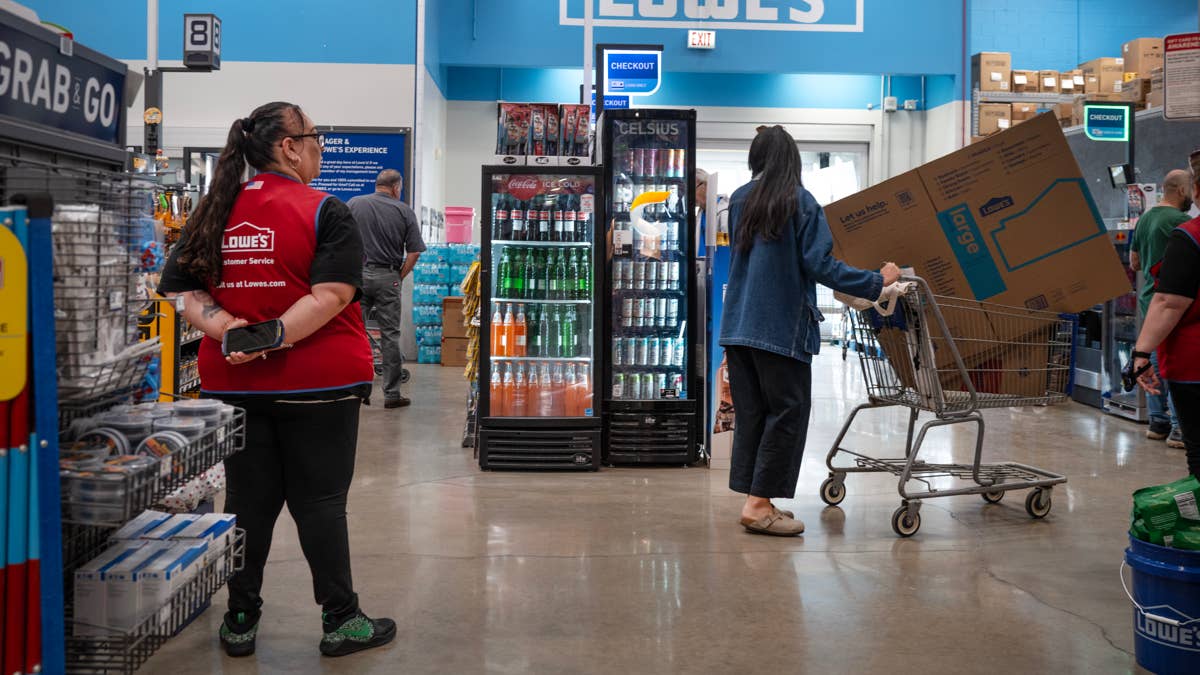
Lowe’s CEO reveals why customers are shifting gears
He also flagged that challenges in the U.S. housing market are negatively affecting DIY customers.
“This has been the most difficult housing market that I have faced in this business since the financial crisis,” said Ellison. “It’s almost exclusively or disproportionately on the DIY customer. That’s the majority of where our revenue comes from.”
Housing turnover rates have fallen to historic lows since 2022, the same year the 30-year fixed-rate mortgage surpassed 6%. After seeing improvement late last year, mortgage rates have slowly climbed back up in recent months.
According to data from the National Association of Realtors, the average 30-year fixed-rate mortgage reached 6.33% in April, up from 6.18% in March and 6.05% in February.
Amid this spike, existing-home sales in April increased 0.2% month over month, but were flat compared to the time period last year.
In a press release, Lawrence Yun, National Association of Realtors chief economist, said the number of days homes are staying on the market is “lengthening on average, implying that consumers are taking their time before making decisions.”
Lowe’s leans on value to lift customer demand
As uncertainty in the housing market persists, Lowe’s plans to double down on value to keep customers engaged.
“We continue to listen to the customer, and they’re looking at all these values that we bring to market,” said William Boltz, executive vice president of merchandising at Lowe’s, during the earnings call.
“And so, when we think about Q2 (the second quarter of 2026), what’s up in front of us coming into this weekend with Memorial weekend, obviously, is continue to keep these values front and center for the customer,” he continued.
More Retail:
- Home Depot CEO raises alarm bells on consumer problem in stores
- Ross Stores CEO eyes a change that could drive away shoppers
- Kroger CEO pledges key changes to boost customer loyalty
Lowe’s expects its comparable sales this year to either remain stagnant or increase by 2% year over year.
“We started this year with a pretty muted view that we would have basically flat growth overall in the home improvement sector,” said Ellison. “And we basically set our guidance to take share and outperform the market.”
In an analyst note obtained by TheStreet, Bank of America research analyst Christopher Nardone wrote that his institution is lowering its fiscal year 2026 earnings-per-share (EPS) estimates for Lowe’s by $0.10 to $12.33 to reflect a “weaker” second-quarter sales/margin forecast.
“Given the incremental demand and cost pressures, we think the lower end of mgmt’s EPS guidance is more likely absent an improvement in underlying housing fundamentals,” wrote Nardone in the note. “Mgmt is leaning into sales driving initiatives like promos and marketing to help bolster demand in a weak DIY market while cost pressures are not abating.”
It is vital for Lowe’s to focus on enhancing the customer experience with value this year, as it battles economic headwinds. A recent JD Power survey found that the company lags behind its top competitors in the home improvement retail market in terms of consumer satisfaction.
2026 home improvement retail consumer satisfaction rankings:
- The average consumer satisfaction score for the U.S. home improvement retailers is 672 (on a 1,000-point scale), up 1 point from the same survey in 2025.
- Menards has the highest consumer satisfaction score, 690.
- Home Depot takes second place with a satisfaction rating of 679.
- Ace Hardware falls right behind Home Depot with a 673 score.
- Lowe’s consumer satisfaction score hit 659, falling below the segment average.
Source: JD Power
“Although there have been meaningful gains in most operational areas, shoppers cannot ignore the rising prices,” said Michael Taylor, a senior managing director at JD Power, in a press release. “This sensitivity to value for price paid has a direct impact on trust in the retailer, as both dimensions saw a satisfaction decrease this year.”
“Even with the recent emphasis on technology and delivery, home improvement shoppers still want in‑store advice, and retailers that invest in knowledgeable, service-oriented staff will be best positioned to rebuild trust and drive long-term loyalty,” he continued.
Related: Home Depot, Lowe’s hidden anti-theft tactic angers shoppers