SK Hynix is becoming more than a hot artificial intelligence stock.
It now represents a test of how much leverage the ETF market can absorb.
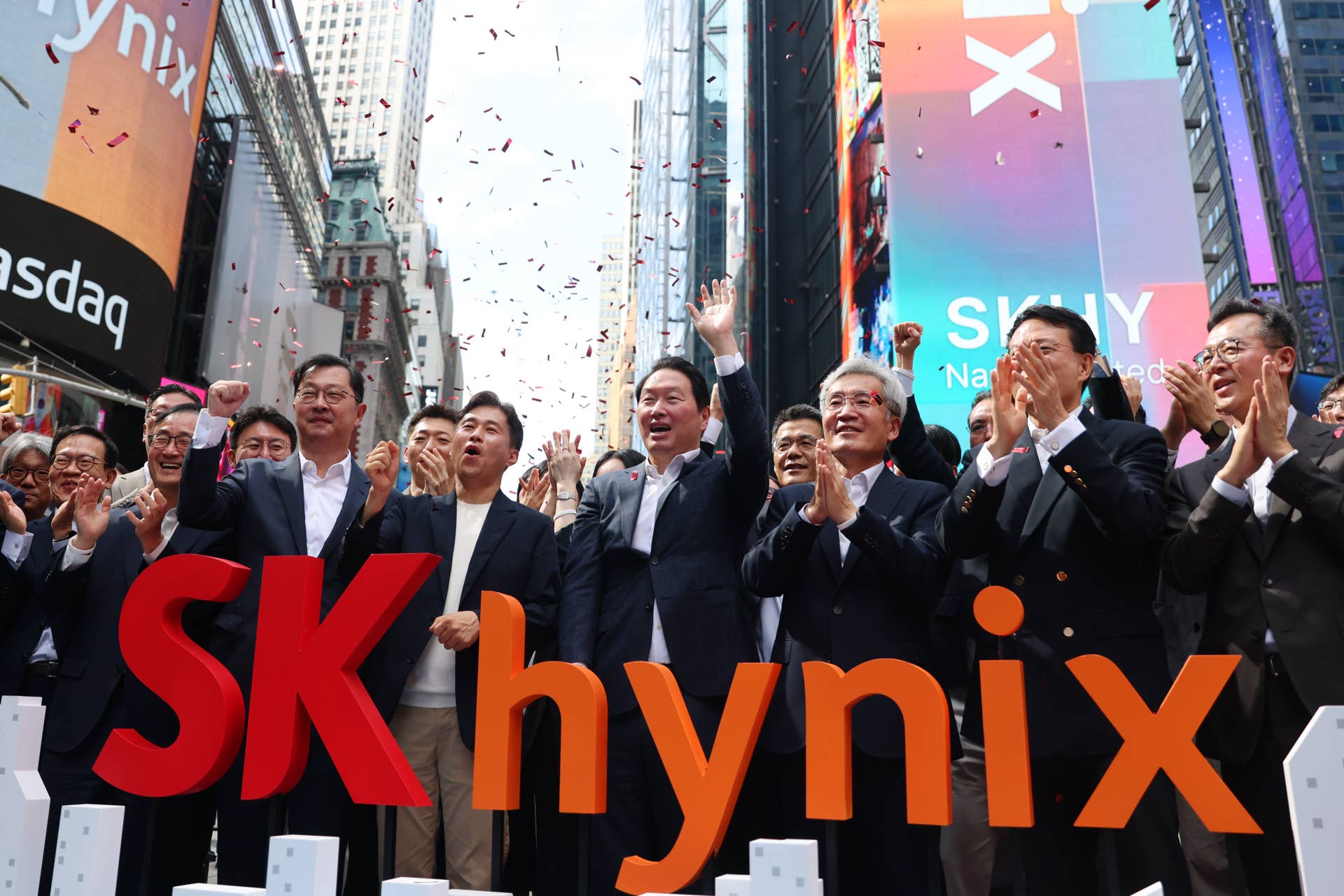
South Korea’s memory-chip behemoth began trading in the U.S. under the ticker SKHY, Reuters reported, giving American investors easy access to one of the companies most closely related to high-bandwidth memory demand and AI data-center development. The listing soon drew interest from ETF issuers eager to build leveraged single-stock products around SK Hynix.
That’s the superficial tale. The more basic problem for investors, however, is that SK Hynix has become the latest example of how the AI trade is going beyond just owning stocks.
Investors aren’t buying AI chip winners alone anymore. They are buying leveraged ETF wrappers that give them increased exposure to these stocks.
That can create an opportunity for sophisticated traders. It might also convert one volatile AI stock into a broader market structure test.
“Leverage in the ETF market is getting a little carried away,” ETF Action founding partner Mike Akins said on CNBC’s “ETF Edge.”
SK Hynix is now an AI stock and an ETF stress test
SK Hynix lies at the heart of one of the greatest obstacles in the AI boom: memory.
The company is one of the largest suppliers of high-bandwidth memory, an important ingredient in advanced AI accelerators and data-center systems. That has made SK Hynix an increasingly essential brand for investors seeking to track the AI infrastructure buildout outside of Nvidia (NVDA).
But the U.S. listing transforms the investor landscape.
There was little access to the stock for many American investors until SK Hynix traded directly in the U.S. SKHY is listed on Nasdaq, which makes it easier for ETF providers to create products that follow its daily moves.
The Ultra SK Hynix ETF, ticker SKHU, aims to deliver double the daily return of SK Hynix’s ADR listed in the U.S., ProShares said. GraniteShares also stated that it planned to launch leveraged SK Hynix ETFs, including a 2x long product and a 2x inverse product.
Related: SK Hynix’s Nasdaq debut could be the market’s next stress test
That makes SK Hynix a useful case study. The stock offers investors a direct way to trade AI memory demand. Leveraged ETF products give traders a way to leverage that bet.
There is a danger that the ETF wrapper can make an aggressive short-term trade seem as easy as buying a typical fund. Yet a leveraged single-stock ETF is not a normal investment instrument. It’s built for exposure to the elements, not long-term ownership.
Since these products reset daily, the effects of compounding and volatility might lead returns to vary from those of the underlying stock over time. That difference matters for SK Hynix investors.
The AI memory story is compelling, but the stock can still make significant moves. In the face of such volatility, losses can accumulate fast.
SK Hynix’s debut shows why leverage can move fast
The ETF rush for SK Hynix began almost immediately after its U.S. listing.
At least 10 fund managers, including Direxion and ProShares, had filed for single-stock ETFs linked to SK Hynix after the company’s ambitions to list in the U.S., Reuters reported. That’s a sign of just how quickly hot AI stocks can be turned into the raw material for new trading products.
More AI:
- The new Chinese AI model rattling U.S. tech investors
- Anthropic restores access to Mythos 5 for select organizations
- SoftBank CEO offers stinging critique of Musk’s AI bet
The pace is important, since it reflects the evolution of the ETF market. ETFs were associated for decades with low-cost, tax-efficient exposure to broad indexes such as the S&P 500. A regular investor can buy one fund and hold hundreds of stocks.
Single stock leveraged ETFs do the reverse. They focus exposure on one firm and then magnify the daily move. Such products can be handy for traders who understand the mechanics. But they can be dangerous for investors to read the acronym “ETF” and think “diversity” or “long-term fit.”
The volatile nature of this setup was also seen in early U.S. trade for SK Hynix, Reuters noted. The company’s U.S.-listed shares had surged on debut before the later decline in Seoul shares, and linked leveraged products showed the extent of investor positioning around the brand.
Notably, SK Hynix is no longer just a chip stock. It’s a stock. It’s an AI proxy. It’s a memory-cycle play. It’s a leveraged ETF target.
Those layers can punch each other if the momentum is high. They can also unwind fast if sentiment changes.
The AI memory trade is powerful, but not risk-free
The bull case for SK Hynix is straightforward.
AI data centers require a lot of memory bandwidth. Nvidia’s most sophisticated artificial intelligence systems rely on high-bandwidth memory. That demand has made SK Hynix a big beneficiary, and it’s what draws investors to the stock.
But the market also has to price in a tricky question: How much of the AI memory growth has already been priced into the shares?
Shares of SK Hynix plunged in Seoul as investors became increasingly wary about optimism on earnings and supply-chain dynamics, wondering whether AI spending could eventually generate oversupply pressure, Reuters reported.
This development will not hurt the case in the long run, but it does make the leveraged ETF tale more pertinent.
If investors buy SK Hynix directly, they are taking single-stock semiconductor risk. If they buy a 2x daily ETF tied to SK Hynix, they are taking that risk and magnifying it. If they hold that ETF longer than intended, daily reset and volatility can create returns that differ sharply from what they expect.
That’s why product design is as important as the stock story. SK Hynix may continue to be a key name in AI hardware. But even major firms can experience wild movements in their stocks, particularly following a large offering and a rapid build-up of market attention.
Key takeaways for SK Hynix investors
These points set the terms of the investment decision.
- SK Hynix’s U.S. listing gives American investors more direct access to a major AI memory-chip supplier.
- ETF issuers are already moving to launch leveraged products tied to SK Hynix’s daily stock moves.
- ProShares’ SKHU is designed to target 2x the daily return of SK Hynix’s U.S.-listed ADR.
- Leveraged single-stock ETFs are trading tools, not traditional diversified funds.
- Daily reset, compounding, and volatility can make returns diverge from the underlying stock over longer periods.
- SK Hynix’s AI memory exposure is attractive, but the ETF rush shows how quickly the trade can become crowded.
Buying SK Hynix is a gamble on AI memory demand, execution, and value, and a leveraged SK Hynix ETF is a distinct kind of bet, involving short-term trading on daily fluctuations with magnified risk and a need for close monitoring.
That distinction sounds technical.
SK Hynix may reveal whether the AI trade is getting overpackaged
The SK Hynix story has two sides.
The first one is bullish. A key supplier of AI memory is now more accessible to U.S. investors, and the demand for exposure is definitely significant.
The second is more of a caution. The ETF market is wrapping that demand up so swiftly that SK Hynix is turning into a stress test for the next phase of AI investing.
That doesn’t mean the stock is a poor buy. It simply implies that the wrapper counts.
An SK Hynix direct stake and a 2x daily ETF on SK Hynix are not the same. One is an investment in stocks. The other is a leveraged trading vehicle based on one risky company.
The Securities and Exchange Commission has previously asked public feedback on new ETFs and investment methods, saying it wants to encourage innovation while safeguarding investors and ensuring fair and orderly markets.
That’s why that review matters, as proven by SK Hynix.
The AI boom is no longer just about which companies are going to win. And it’s about the Wall Street packaging of those winners for regular investors.
The opportunity for SK Hynix is evident. It has become a more prominent approach to play the AI memory cycle in the U.S.
The risk is just as plain. When a hot AI stock becomes the target of a leveraged ETF rush, investors need to know whether they are buying the firm or buying the volatility around the company.