Wall Street is about to get the one inflation number that could determine if the Federal Reserve raises interest rates next week.
With wholesale prices already showing renewed inflation pressure and crude oil prices climbing, the Sept. 11 August Consumer Price index has taken on importance for a divided Fed.
Even a modest upside surprise in the August CPI could strengthen the case for a quarter-point rate hike when policymakers meet Sept. 15-16.
Economists and consensus forecasts expect the August CPI to show a bump in headline monthly inflation driven primarily by higher energy and gas prices.
Aptus Capital Advisors Portfolio Manager and Head of Fixed Income John Luke Tyner said the unexpected surge in the August jobs report puts additional pressure on the Fed’s price stability mandate.
“You typically don’t think about Fed decisions as binary outcomes but I wouldn’t be surprised if the fate of a September hike hinges upon the PPI and CPI prints,’’ Tyner told TheStreet in an email.
“With tariffs continuing to be in the conversation (Canada), energy prices higher, AI demand pretty much unaffected by higher rates, as well as data quirks from the government shutdown last year, it appears inflation pressures will not be fleeting soon.’’
The August CPI arrives one day after a hotter-than-expected August Producer Price Index report.
Producer prices rose 0.4% in August from July and 5.4% over the 12 months through August, adding to concerns that inflation pressures may be proving more persistent than Fed officials had expected.
Fed Governor Christopher Waller last week flagged both August prints as critical in the Federal Open Market Committee’s decision to hike rates or continue to hold.
Persistent sticky inflation could result in a 25-basis point hike in the Federal Funds Rate.
Then there’s Fed Chairman Kevin Warsh’s hawkish tone at last month’s Jackson Hole conference (“We have work to do”), during which he pledged the central bank would commit to taming inflation.
“My opinion is Warsh does not want to hike and could be the swing vote on the decision,’’ Tyner said.
“We will be interested in how markets react to the data and his decision next week. We are also interested in whether a skip in September would also mean a skip in October given Fed policy action around elections is unpopular. Bottom line: I do not envy his job,” he added.
Markets expect hot CPI report to trigger Fed rate hike
The CME Group FedWatch Tool, which gauges market expectations from federal-funds futures, shows traders increasingly betting on a rate hike at the Fed’s September meeting.
The odds rose to about 70% on Sept. 10, up from roughly 61% earlier in the week and below 50% late last month.
“This is the double-dog daring you. This is straight schoolyard,” BNY Investments Chief Economist Vincent Reinhart told The Wall Street Journal.
Markets also are pricing in a growing likelihood that interest rates will be higher later this year.
The odds of a rate increase by the October meeting have climbed above 80%, while the probability of the rates being higher by December has risen even further.
As widely expected by investors, the European Central Bank voted Sept. 10 to raise three rates by 25 basis points to 2.5% from 2.25%, due to inflation concerns stemming from the Iran war.
The ECB expects baseline inflation, excluding energy and food, to reach 2.5% in 2026, 2.6% in 2027 and 2.3% in 2028.
The Bank of Japan is also expected to raise interest rates due to the Iran war’s impact on gas and energy prices.
TheStreet
Fed’s dual mandate focuses on jobs, prices
The Fed’s dual mandate from Congress requires maximum employment and stable prices.
- Lower interest rates support hiring but can fuel inflation. This risks fueling further inflation, potentially leading to an inflationary spiral.
- Higher rates cool prices but can weaken the job market. This increases the cost of borrowing and further stifles economic activity.
The Sept. 4 blowout jobs report demonstrates the U.S. labor market is plowing through the economic uncertainty and financial jitters from the Iran war, despite higher gas and other energy prices.
How Fed monetary policy affects you
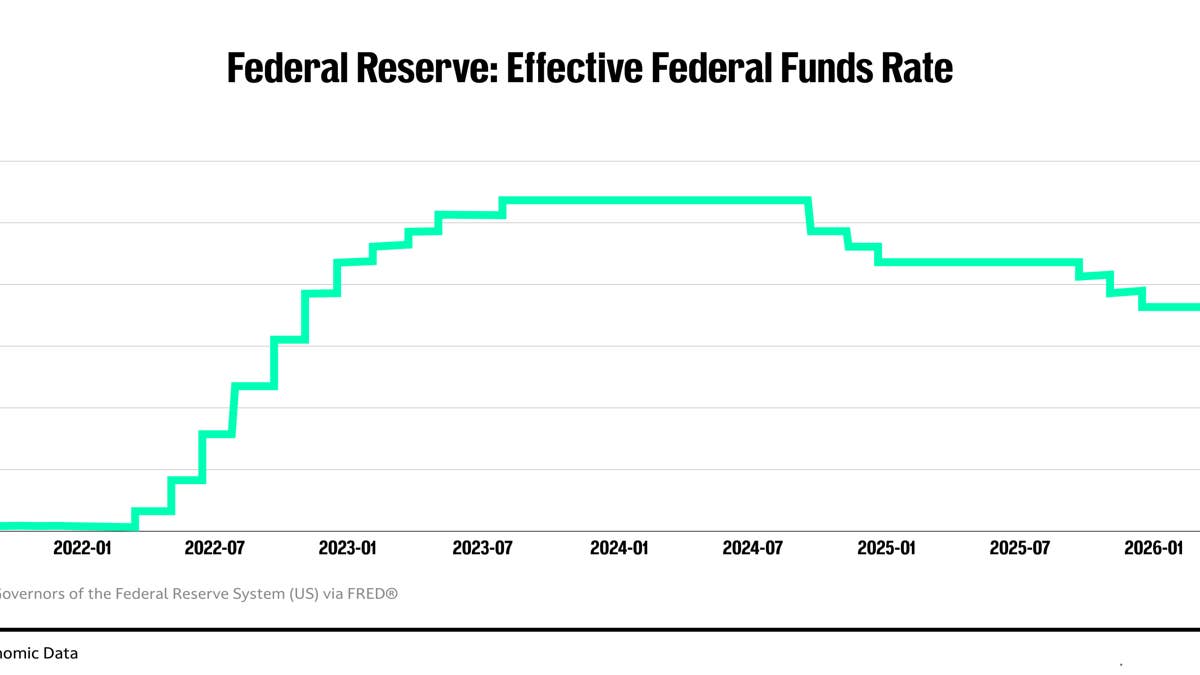
The rate-setting FOMC voted 9-3 in July to hold the benchmark Federal Funds Rate target in a range of 3.5% to 3.75%. The three dissenters wanted to raise rates by 25 basis points because of inflation concerns.
Policymakers had cut rates by 25 basis points at its last three meetings of 2025 to shore up the softening labor market.
Related: UBS doubles down on Fed rate-hike forecast for 2026
These “insurance” cuts stopped after the majority of policymakers decided the risk from higher prices was outweighing signs that the jobs market was stabilizing.
The funds rate is the interest rate at which banks lend balances at the Federal Reserve to other banks overnight. It sets the pace for short-term borrowing costs like credit cards, student loans and home equity loans.
Higher short-term interest rates impact mortgages, corporate credit
A change in the funds rate triggers moves in short-term borrowing costs, ranging from credit cards and student loans to home equity loans.
Higher interest rates also increase the yield on fixed income and alter how equity markets value future corporate earnings.
The hotter-than-expected PPI report and climbing crude oil prices sent the benchmark 10-year Treasury yield surged to roughly 4.93%, near the critical 5.00% mark.
Yields across the board also reached their highest levels in three years. Market strategists note that if the 10-year crosses and holds above 5.00%, it will increase long-term borrowing costs for mortgages and corporate credit.
Related: Fed rate-hike threat heats up as August inflation data looms