Few companies have as good a front-row seat to the future of money as Visa. So when its CEO talks about artificial intelligence rewriting the rules of commerce, it’s worth listening.
Visa CEO Ryan McInerney used the company’s fiscal second-quarter 2026 earnings call to lay out a sweeping and surprisingly direct vision for where payments are headed.
McInerney called AI and blockchain significant opportunities. “Visa has become the leading hyperscaler of payments globally, and our strategy and Visa as a Service stack will help us drive future growth,” he said.
That’s a bold claim. But the numbers more than support his outlook.
Visa posted its best growth in years
Before getting to the CEO’s roadmap, it’s worth understanding just how strong the quarter was.
- Net revenue hit $11.2 billion, up 17% year over year (YoY).
- That marked Visa’s fastest top-line growth since 2022, and the company said it was the strongest in roughly 13 years when you strip out the post-pandemic bounce and the Visa Europe deal.
- Earnings per share rose 20% YoY.
- Payment volume reached $3.7 trillion, up 9% in constant dollars.
- Processed transactions also grew 9%, hitting $66 billion for the quarter.
- Value-added services (VAS), Visa’s growing suite of data, fraud, and analytics tools, brought in $3.3 billion in revenue. That’s 27% growth in constant dollars.
- VAS now makes up 30% of Visa’s total net revenue.
In other words, Visa is a tech business that runs on an expansive card network.
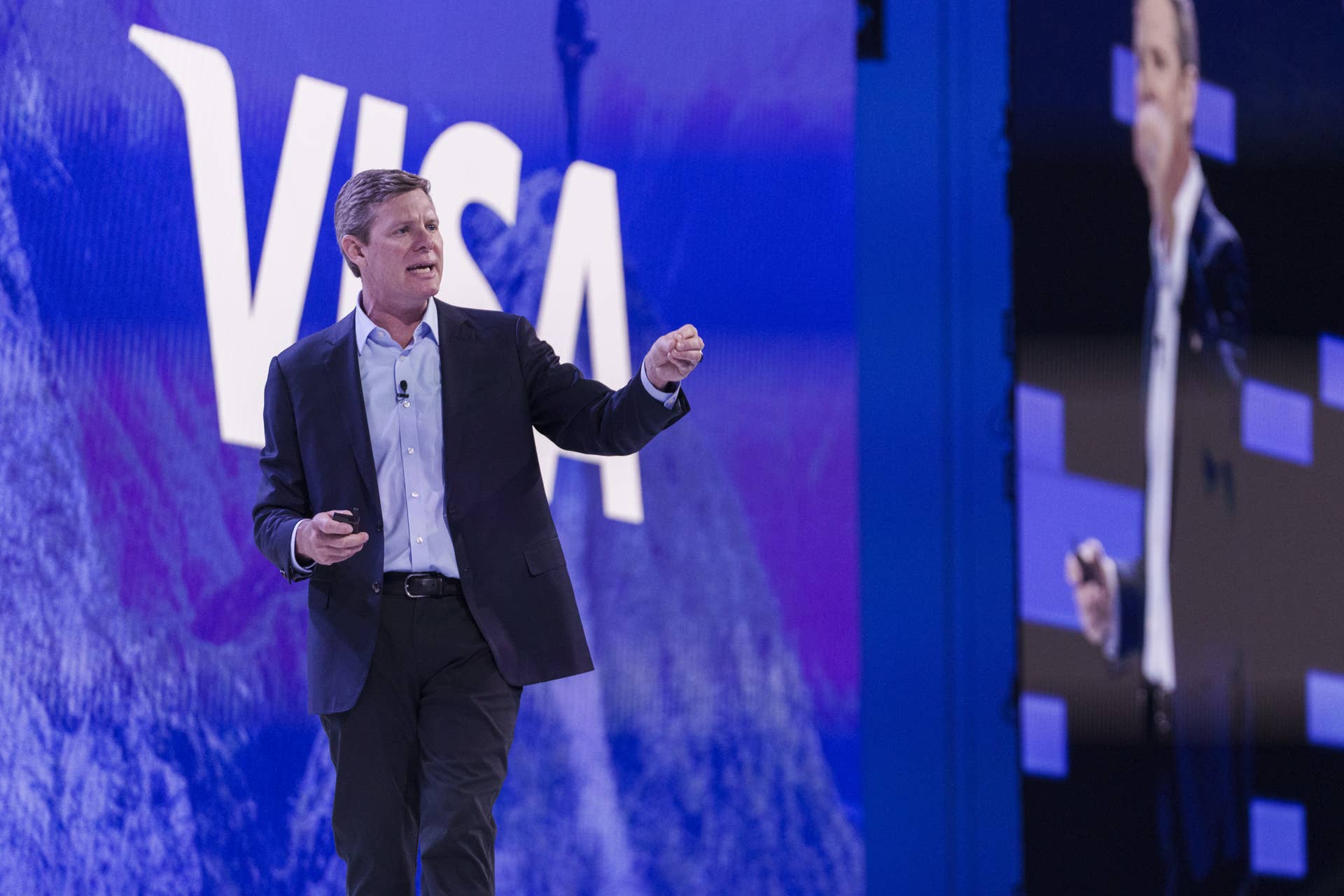
McInerney sees AI as a payments goldmine for Visa
McInerney’s pitch on artificial intelligence wasn’t theoretical. He laid out four specific ways he believes AI and so-called “agentic commerce,” where AI models autonomously make purchases on a user’s behalf, will expand Visa’s business.
First, he argued it will accelerate the global shift away from cash, much like e-commerce and mobile payments did before it.
Trending Stock News:
- Qualcomm stock draws attention after major OpenAI news
- QuantumScape has a bold message for investors
- Analysts reset ServiceNow stock price target after earnings
Second, AI agents will create more transactions, not fewer. An agent shopping for you might split a single purchase across multiple transactions to get the best price, timing, or value.
In some cases, agents will pay for their own computing resources transaction by transaction, a new category McInerney called “micro transactions.”
Third, AI will speed up business-to-business payment digitization. Agents can pull payment details directly from invoices and contracts and approve them without human input. Virtual cards and tokenization become a natural fit there.
And fourth, he cited third-party estimates suggesting AI could add 80 to 150 basis points to global economic growth over time, which means more spending and more transactions flowing through Visa’s rails.
Visa recently launched “Intelligent Commerce Connect,” a protocol that enables AI agents to make authenticated card payments.
The company also unveiled “Visa CLI,” a proof-of-concept tool that lets developers pay for digital services directly from a command-line interface using a Visa credential.
McInerney put it plainly. Trust is the limiting factor in agentic commerce, not compute power. Visa cards offer privacy, fraud protection, issuer-verified identities, and rewards.
He believes users will want their AI agents to spend on the same cards they already trust.
Stablecoin bets are paying off faster than Visa expected
The blockchain side of McInerney’s message was equally direct and backed by real volume numbers.
- Visa now runs more than 160 stablecoin-linked card programs globally, working with partners including Rain, Reap, and Bridge.
- Payment volume through those programs was up nearly 200% YoY in the second quarter.
- Visa is also settling transactions between its roughly 14,500 financial institution clients using stablecoins.
- That settlement volume is now running at a $7 billion annual pace — up more than 50% from just one quarter earlier.
- The company recently added five new blockchains for settlement, bringing its total to nine supported networks.
McInerney described Visa’s role as an infrastructure provider building bridges. Stablecoins, he argued, are becoming de facto dollar-denominated savings accounts in emerging markets.
Visa’s job is connecting that stored value to the 175 million merchant locations where its cards are already accepted.
Visa has also taken on a deeper role in blockchain governance, becoming a validator on the Tempo network and a “super validator” on Canto, meaning Visa now helps govern transaction validation on at least one major regulated blockchain.
The message from McInerney was clear. Visa isn’t watching AI and blockchain from the sidelines. It’s already building the plumbing, and the quarterly results suggest the strategy is working.